

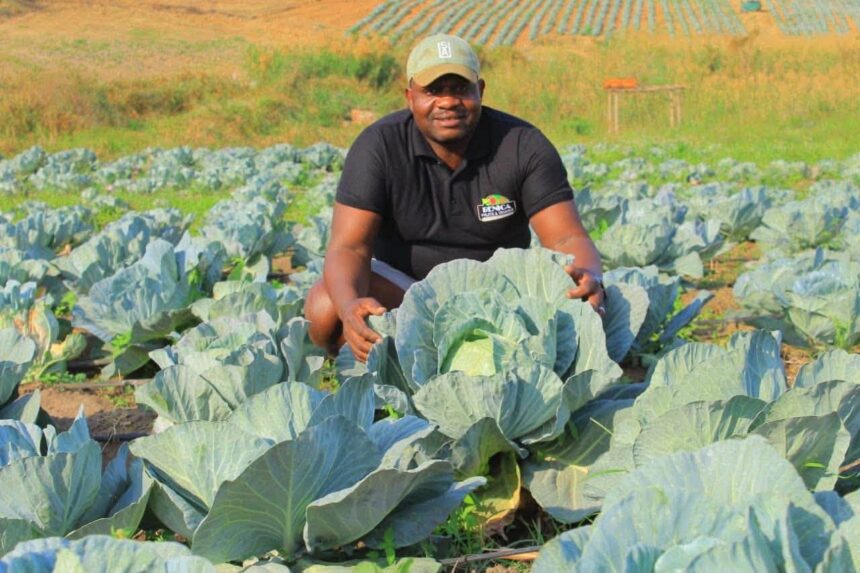
Bennedicter Mhlongo’s journey from working as a nurse at Tintswalo Hospital to becoming a successful first-generation agripreneur in Acornhoek, Mpumalanga, is a powerful example of how agricultural businesses can grow through patience, resilience and consistent effort. Popularly known as BenicaTheFarmer, Mhlongo did not inherit a commercial farming operation or step into an established agricultural business. Instead, he started with a modest backyard garden and gradually turned his passion for farming into a diversified enterprise that produces food, creates employment, supports other farmers and trains young people. His journey shows that agricultural success is rarely achieved overnight, particularly for emerging farmers who must learn production, markets, finance, compliance and business management along the way. It also demonstrates how farmers can build resilience by continuously reinvesting in their operations and finding new ways to create value from what they produce. Today, BeNica Farm represents the result of more than a decade of learning, adaptation and determination.
Mhlongo’s path to agriculture was shaped by a difficult childhood and the values he developed while being raised by his grandmother, Lilly Mhlongo. Orphaned at a young age, he learned independence, responsibility and the importance of hard work from an early stage in life. He completed his matric at Puledi Secondary School in 2001 before studying nursing at Sekororo Nursing College in 2003. Between 2005 and 2012, he built a career within government healthcare structures, working as a nurse, secretary to the hospital CEO and communications officer at Tintswalo Hospital. Although healthcare provided him with a professional career, his growing interest in farming eventually convinced him that agriculture was where he wanted to build his future.
The decision to leave formal employment and pursue farming full-time in 2013 marked a major turning point in Mhlongo’s life. Walking away from government employment to enter agriculture required courage because farming carries risks that are often outside a farmer’s control, including changing weather conditions, pests, production challenges and fluctuating markets. Mhlongo also had to develop his agricultural knowledge without the advantage of inheriting an established commercial farm or farming business. He describes himself as a first-generation farmer who learned through experience, observation, research, mentorship and practical work in the field. That approach has remained central to his development, allowing him to turn challenges into lessons while gradually building the skills needed to operate a growing agricultural enterprise.
The beginnings of BeNica Farm can be traced back to a small backyard garden measuring approximately 15 by 15 square metres. At that stage, Mhlongo grew vegetables including cabbages, chillies, peppers, tomatoes and spinach, initially focusing on subsistence production. However, the small garden became much more than a source of food because it gave him an opportunity to learn about crop production and the business side of agriculture. He gained practical experience in areas such as irrigation, pest management, crop planning and the demands of maintaining consistent production. As his confidence and ambition grew, he formally registered his business as Benica Projects in 2016, laying the foundation for the larger agricultural operation that would follow.
By 2020, Mhlongo had already progressed significantly from his backyard beginnings and was farming on an eight-hectare plot. At the time, the operation focused heavily on cash crops and supplied produce to seven local supermarkets, demonstrating his ability to move from small-scale production into more structured commercial markets. The years that followed brought another phase of growth as he recognised the importance of diversification in building a more resilient agricultural business. Instead of relying solely on primary crop production, he expanded BeNica Farm into several interconnected areas of agriculture and value addition. Continuous reinvestment, strategic partnerships and support through government programmes helped him strengthen the business and broaden its commercial footprint.
Today, BeNica Farm produces a wide range of vegetables that includes cabbages, tomatoes, peppers, lettuce, spinach, onions, butternut, beetroot, broccoli, cauliflower, baby marrow and various herbs. This diversified production model gives the enterprise access to different markets while reducing its dependence on a single crop. Crop diversification can also help farmers manage some of the risks associated with changing weather conditions, pest pressure and shifts in market demand. For Mhlongo, however, diversification has gone beyond simply planting different crops because he has also developed activities that allow the farm to generate value from different parts of the agricultural value chain. This broader approach has helped transform BeNica Farm from a crop-producing operation into a more multifaceted agricultural business.
One of the most important developments has been Mhlongo’s move into agro-processing and other value-added activities. BeNica Farm now produces products such as chilli sauce, atchar and lemongrass tea, while the wider enterprise also includes honey from beekeeping, eggs and ice production. These activities create additional opportunities to generate income while allowing agricultural products to reach consumers in different forms. Value addition can be particularly important for farmers because it provides an opportunity to move beyond selling raw produce and explore products with longer shelf lives, different customer bases and potentially higher margins. By combining primary production with processing and other agricultural activities, Mhlongo has created a business model designed to spread risk and unlock more opportunities from the agricultural resources available to him.
The farm has also developed a strong services and mentorship component, showing that Mhlongo’s ambitions extend beyond his own fields. BeNica Farm offers tractor services, produce aggregation and agricultural training, creating additional opportunities for the business while supporting other producers. Through produce aggregation, smaller farmers can have an opportunity to combine their output and reach commercial channels that may be difficult to access individually. Mhlongo’s role as chairperson of the Bushbuckridge Farmers Association has also placed him in a position where he can contribute to broader agricultural development in the area. His work demonstrates how an individual farming enterprise can become part of a wider support network that helps connect producers with markets, knowledge and practical opportunities.
The growth of BeNica Farm has also created employment and learning opportunities within the community. The enterprise supports about 15 permanent workers as well as around five seasonal employees, depending on production cycles and operational needs. It also serves as a Work Integrated Learning practical training site for students from TVET colleges and universities. This creates a valuable link between agricultural education and real-world farming, giving students an opportunity to gain practical exposure to production and agricultural business operations. For an enterprise that began in a small backyard garden, its ability to employ workers and provide practical training reflects how sustained agricultural growth can have an impact far beyond the farmer who started the business.
Mhlongo’s success has not come without serious setbacks, particularly as climate and environmental risks continue to affect agricultural businesses. In 2026, BeNica Farm experienced severe damage when floods were followed by a destructive veld fire that affected critical infrastructure, including irrigation systems and fencing. Such losses can have serious consequences for farmers because infrastructure is essential for maintaining production, protecting fields and managing resources efficiently. Rather than allowing these events to end the enterprise, Mhlongo responded by strengthening his focus on risk mitigation, diversification, food-safety compliance and sustainable production practices. His experience highlights an important reality of farming, which is that resilience is not simply about avoiding challenges but developing systems that allow an enterprise to recover when those challenges occur.
Mhlongo’s approach to farming reflects a long-term understanding of agricultural resilience. He recognises that droughts, floods, fires, pests and market disappointments can all affect a farmer’s ability to produce and sell successfully. For that reason, continuous learning and adaptation have become important parts of his farming philosophy. Diversifying crops and income streams gives the business more options when one part of the operation experiences difficulties, while compliance and sound production practices help protect market access. His journey shows why farmers need to think beyond individual seasons and develop businesses that can continue functioning despite changing conditions.
The commercial reach of BeNica Farm has also expanded as the enterprise has matured. The farm now supplies retail stores, lodges in and around the Greater Kruger area, restaurants, hawkers and members of local communities. Serving different customer groups requires consistent production, reliable quality and an understanding of what individual markets need. It also demonstrates how local agricultural enterprises can build stronger businesses by developing multiple routes to market rather than depending on a single buyer. Mhlongo’s focus on aggregation further strengthens this approach because it creates opportunities for other small-scale farmers to participate in commercial supply chains.
His commitment to agriculture is also reflected in his work as an author and mentor. Through his book, Chronicles of a Farmer’s Life, Mhlongo shares experiences from his journey and provides another avenue through which agricultural lessons can reach aspiring farmers. His vision for the future includes establishing a fruit and vegetable packhouse hub and developing a compliant agro-processing facility. He also wants to expand the BeNica Farming Academy so that more young people can gain practical knowledge and mentorship as they enter agriculture. These ambitions show that his definition of success has expanded from building his own farm to creating infrastructure, knowledge and opportunities that can benefit a wider farming community.
Mhlongo’s journey from a 15-square-metre backyard garden to a diversified agricultural enterprise demonstrates what can happen when a farmer combines practical experience with a willingness to learn and adapt. His story is not simply about growing more hectares or producing more vegetables, but about developing a complete agricultural business that includes production, processing, services, market access, employment and mentorship. The challenges he has faced have reinforced the importance of preparing for risks while continuing to invest in the future. His experience also offers an important lesson for emerging farmers who may begin with limited land, resources or experience, because growth can happen gradually when each season is treated as an opportunity to learn and improve. BeNica Farm stands as an example of how a small agricultural idea can become a sustainable enterprise when resilience, discipline and long-term vision remain at the centre of the journey.
Join 'Farmers Mag' WhatsApp Channel
Get the latest Farming news and tips delivered straight to your WhatsApp
CLICK HERE TO JOIN


