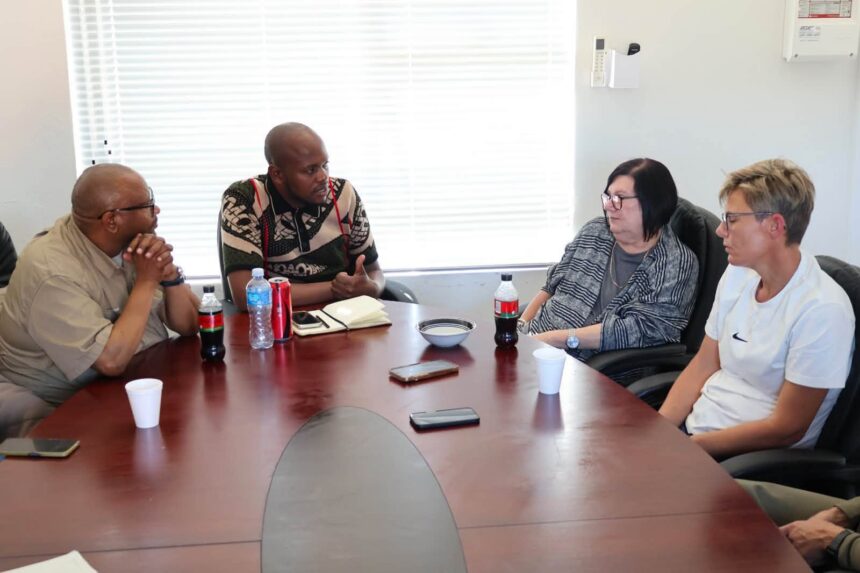
Free State Department of Agriculture, Rural Development and Environmental Affairs MEC Elzabe Rockman has engaged commercial farmers in Zastron on efforts to strengthen Foot-and-Mouth Disease control and improve livestock management in the area. Rockman, together with Executive Mayor of Mohokare Local Municipality Councillor Teboho Mochechepa, held the engagement with farmers at the Farmer Production Support Unit in Zastron. The discussions focused on concerns surrounding access to farms by State Veterinary Services for Foot-and-Mouth Disease vaccination. The engagement also addressed unauthorised livestock, unoccupied farms, stock theft and the enforcement of municipal by-laws. These issues are closely connected to livestock movement and disease control, making cooperation between farmers, government and the municipality important for protecting the area’s cattle and agricultural economy.
During the meeting, MEC Rockman raised concerns about reports that some farmers were denying State Veterinarians access to their farms to carry out Foot-and-Mouth Disease vaccinations. She also pointed to the challenge of untraceable farmers and unauthorised livestock in the area. According to Rockman, the situation is particularly concerning on farms along the border that are owned by Lesotho nationals. She explained that government wants to create a barrier along the border to reduce the risk of Foot-and-Mouth Disease spreading into farming areas. Effective vaccination and livestock movement controls are important components of efforts to strengthen disease management in border communities where livestock can move across areas with different disease risks.
The MEC’s concerns come against the backdrop of the broader challenges associated with controlling Foot-and-Mouth Disease in livestock farming areas. The movement of animals between farms and across borders can make disease control more difficult when authorities cannot establish where livestock originate or where they have moved. Unidentified or unauthorised animals can further complicate vaccination programmes because officials need reliable information about livestock populations and ownership. Traceability is therefore an important part of protecting animal health and supporting an effective response to disease outbreaks. Cooperation between farmers and State Veterinary Services can help officials reach livestock, administer vaccines and maintain better information about animals in affected and high-risk areas.
Commercial farmers responded to the concerns raised during the engagement and disputed the suggestion that farmers in the area were denying State Veterinary Services access to their farms. They said there are no farmers in the area who would deliberately prevent State Veterinarians from accessing their properties to vaccinate livestock. Instead, they identified unoccupied farms as a major concern because these properties contain significant numbers of unauthorised livestock. Farmers also raised concerns that many of the owners of these animals do not have the correct identification required to establish ownership. They said some individuals allegedly have connections with certain police officers and own large numbers of cattle, creating additional concerns around livestock control and accountability.
The farmers said the problems surrounding unauthorised livestock extend beyond Foot-and-Mouth Disease vaccination. They identified the implementation of municipal by-laws, stock theft and the management of unoccupied farms as issues requiring attention. Weak enforcement can make it more difficult to control livestock movement and determine who is responsible for animals found outside designated areas. Stock theft also remains a serious concern for commercial farmers because stolen animals can move through different areas and become difficult to trace. Addressing these challenges will require stronger cooperation between farmers, municipal authorities, law enforcement and veterinary services.
The discussion also highlighted the importance of accurate livestock identification in disease control and agricultural management. Farmers need to know which animals belong to which owners, particularly in areas where livestock share grazing resources or move between properties. Proper identification can help authorities trace animals when disease risks emerge and can assist law enforcement when investigating stock theft. It can also help municipalities manage livestock numbers and enforce rules governing commonage areas. Without reliable identification and ownership records, efforts to control livestock movement and respond to animal health threats can become significantly more difficult.
Farmers also emphasised that many livestock producers in the area are committed to responsible farming and keep their animals under appropriate conditions. They stressed that the challenges discussed at the meeting should not be viewed as representing all farmers in the area. Many producers continue to maintain their livestock properly and cooperate with agricultural authorities. Recognising these farmers is important because effective disease control depends heavily on cooperation between responsible livestock owners and veterinary services. Building trust between farmers and government can also make it easier to address problems involving producers who operate outside established rules.
The management of municipal commonages was identified as another area where Mohokare Local Municipality could play an important role. Farmers said the municipality could strengthen its management of commonage areas, particularly where individuals keep more livestock than the permitted number. Overcrowding on commonages can place pressure on grazing resources and create difficulties for farmers who follow established rules. Better management could help ensure that commonage resources are used fairly and that livestock numbers remain within sustainable limits. Clear enforcement and effective communication with livestock owners could also reduce disputes and improve accountability.
The concerns around unoccupied farms require particular attention because properties without active management can create gaps in livestock control. Unauthorised animals may enter these areas or remain there without proper oversight, making it harder for authorities to determine ownership and monitor livestock health. Unoccupied farms can also become more difficult to manage from a disease prevention perspective if officials do not have clear information about the animals present. Farmers’ concerns therefore point to the need for a coordinated approach involving landowners, municipalities, law enforcement and agricultural authorities. Establishing clear responsibilities for livestock on such properties could help reduce risks and improve control measures.
The meeting also reinforced the need for agricultural communities to work together more closely. Participants agreed that there is a need to resuscitate agricultural communities that can coordinate issues relating to agriculture and contribute to local economic development. Such structures can create a regular platform for farmers to raise concerns, share information and engage with government departments. They can also help coordinate responses to common challenges such as animal diseases, stock theft, grazing management and access to agricultural services. Stronger agricultural communities can support better communication between individual farmers and authorities while helping ensure that local agricultural priorities receive continued attention.
The proposed effort to strengthen controls along the border is particularly important for the Zastron farming community because of its location. Managing livestock movement in border areas requires cooperation between different authorities and communities to ensure that animals are properly identified and controlled. Farmers also need clear information about vaccination requirements and the responsibilities associated with allowing veterinary officials onto their properties. At the same time, government needs to respond to concerns raised by farmers about unauthorised livestock, unoccupied farms and enforcement gaps. A coordinated approach can help address both disease control requirements and the practical challenges experienced by farmers on the ground.
The engagement between MEC Elzabe Rockman, Mayor Teboho Mochechepa and commercial farmers provided an opportunity to address concerns on both sides and identify areas requiring stronger cooperation. Foot-and-Mouth Disease control remains a shared responsibility, and effective vaccination depends on access to livestock, accurate identification and cooperation from farmers and authorities. At the same time, farmers have raised legitimate concerns about unauthorised livestock, stock theft, unoccupied farms and the enforcement of municipal by-laws. The agreement to strengthen agricultural community structures could provide a platform for these issues to be addressed more consistently. Continued cooperation between farmers, veterinary services, the municipality and law enforcement will be essential to protecting livestock, strengthening disease control and supporting the growth of the agricultural economy in Zastron.
Join 'Farmers Mag' WhatsApp Channel
Get the latest Farming news and tips delivered straight to your WhatsApp
CLICK HERE TO JOIN