Khanyisa Bele is showing how determination and a willingness to pursue a long-held passion can open new opportunities in agriculture. After taking voluntary early retirement from the mining industry, Bele established the Mgayo and Bele Projects in 2024 and began turning her dream of poultry farming into a growing agribusiness. Based in Munyu Village under the Mbashe Local Municipality, the project has developed from an idea into a poultry operation that produces broiler chickens and processes them at its own abattoir. The business supplies packaged chicken to local schools and SPAR stores in Dutywa while also providing slaughtering and processing services to other poultry farmers. Her journey demonstrates how women can enter agriculture at different stages of their lives and build businesses that contribute to their communities.
Bele’s transition from mining to agriculture reflects a deliberate decision to pursue an industry that had captured her interest. Voluntary early retirement gave her an opportunity to focus on poultry farming and develop the business she had envisioned. In 2024, she established the Mgayo and Bele Projects with the goal of creating a sustainable poultry enterprise in her community. Starting an agricultural business requires more than passion, as producers need knowledge, resources, infrastructure and access to markets. Bele’s progress shows how these elements can come together when an entrepreneur remains committed to developing the business and seeks assistance from relevant support institutions.
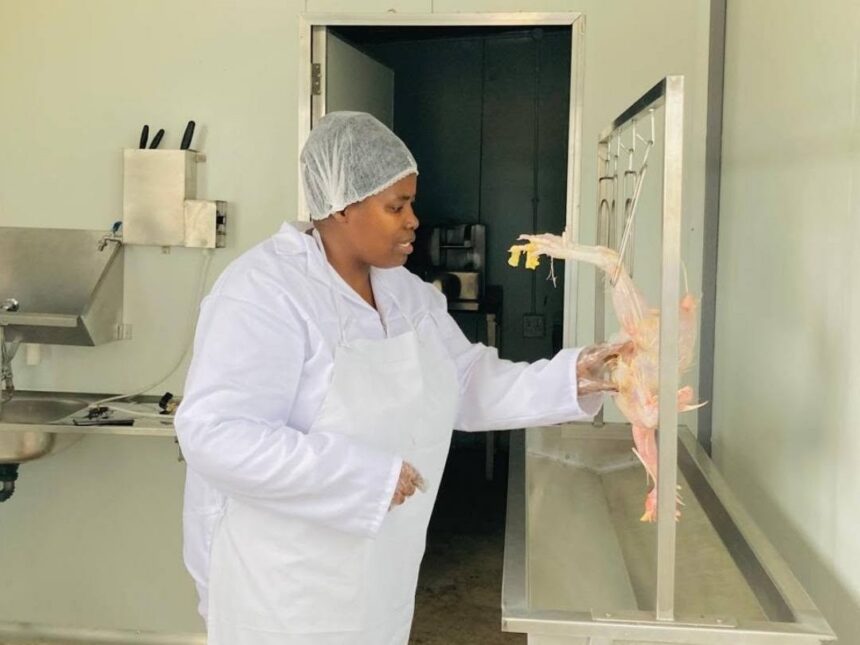
The Mgayo and Bele Projects has focused on broiler chicken production, creating a business model that covers more than simply raising birds for sale. The enterprise has its own abattoir, allowing the business to slaughter and process its chickens before supplying packaged products to customers. This approach adds value to the poultry produced and gives the business greater control over important stages of the supply chain. Access to processing facilities can also help producers meet market requirements and develop relationships with formal buyers. By combining production and processing, Bele has created an agricultural enterprise with several activities that can contribute to its commercial sustainability.
Market access has been an important part of the project’s development, with Mgayo and Bele Projects supplying quality packaged chicken to local schools and SPAR stores in Dutywa. Securing customers in formal markets provides an important opportunity for a growing agricultural business because it creates a route for products to reach consumers. Supplying these markets also requires attention to product quality, consistency, packaging and food safety requirements. Meeting these expectations can help a small agricultural enterprise build credibility and develop longer-term commercial relationships. Bele’s ability to supply local buyers demonstrates the potential for rural agricultural businesses to connect local production with established markets.
The business is also supporting other poultry farmers by offering slaughtering and processing services. This additional service expands the role of the project beyond its own poultry production and creates an opportunity for other producers to access processing infrastructure. Smaller farmers can face difficulties when they need suitable facilities to process their birds for sale, particularly when establishing their own infrastructure is financially challenging. Shared access to processing services can help producers move further along the value chain and potentially reach more formal markets. By supporting other farmers, the Mgayo and Bele Projects is contributing to a broader poultry ecosystem in the Mbashe area.
The development of the project has been supported by the Eastern Cape Department of Agriculture, which provided day-old chicks, feed, technical support and training. These forms of assistance can make a significant difference to emerging agricultural businesses because they help producers overcome some of the costs and knowledge barriers associated with establishing production. Technical guidance can also help farmers improve animal management, feeding practices and overall production systems. Training provides entrepreneurs with knowledge that can support better decision-making as their businesses grow. The combination of production inputs and technical support has therefore played an important role in helping Bele develop the poultry project.
Additional support has come from the National Youth Development Agency, Mbashe Local Municipality and the Small Enterprise Finance Agency. Support from multiple institutions demonstrates the importance of partnerships when developing rural businesses. Different organisations can contribute different forms of assistance, including finance, enterprise development, infrastructure support, training and access to programmes. For agricultural entrepreneurs, knowing which institutions can provide specific forms of assistance can make it easier to address business challenges as they arise. The support received by Mgayo and Bele Projects shows how collaboration between government, development agencies and entrepreneurs can help strengthen emerging businesses.
Bele’s story also carries an important message for women considering careers and businesses in agriculture. The agricultural sector offers opportunities across production, processing, logistics, retail, technology and other parts of the value chain. Women do not have to enter farming at a young age to make a contribution, as Bele’s transition after early retirement demonstrates. Her experience shows that previous professional experience can provide a foundation for pursuing a new business interest and developing it into an enterprise. By sharing her journey, she is encouraging other women to consider agriculture as a sector where they can build businesses and create opportunities.
Women’s participation in agriculture can contribute to wider economic development within rural communities. When women establish successful enterprises, they can create employment, develop local supply chains and provide services to other producers. Businesses such as Mgayo and Bele Projects can also demonstrate that agriculture is not limited to primary production but includes processing and other commercial activities. Creating opportunities for women across these areas can help diversify rural economies and strengthen participation in agricultural value chains. Bele’s poultry business provides a practical example of how a woman-led enterprise can contribute to economic activity within a local community.
The project’s location in Munyu Village also highlights the potential for agricultural businesses to contribute to local development. Rural entrepreneurs often operate close to communities where access to jobs and commercial opportunities can be limited. Establishing productive businesses in these areas can create opportunities without requiring all economic activity to be concentrated in major urban centres. A poultry enterprise can support activity across the supply chain, from the production of birds to processing, packaging, transportation and sales. As the business grows, its impact can extend beyond the owner to other farmers, workers, suppliers and customers.
Bele’s encouragement to women to enter agriculture is based on her belief that farming offers opportunities to those prepared to work and develop their businesses. Her experience also demonstrates that successful agriculture requires commitment, planning and a willingness to learn. Passion can provide the motivation to start, but sustainable business growth depends on understanding production, managing resources and developing reliable markets. Support from government departments and development organisations can provide valuable assistance, but entrepreneurs must also take responsibility for building and managing their enterprises. Bele’s progress provides an example of how determination and access to the right support can help transform an agricultural idea into a functioning business.
The story of Khanyisa Bele and the Mgayo and Bele Projects provides a strong example of women contributing to the growth of agriculture in the Eastern Cape. Her move from the mining industry into poultry farming has resulted in an enterprise that produces broiler chickens, processes them through its own abattoir and supplies packaged chicken to local markets. The business also supports other poultry farmers through slaughtering and processing services, extending its impact across the local value chain. Support from the Eastern Cape Department of Agriculture, the National Youth Development Agency, Mbashe Local Municipality and the Small Enterprise Finance Agency has helped strengthen the project’s operations. As South Africa celebrates Women’s Month, Bele’s journey shows that women can break into agriculture, build sustainable businesses and create opportunities that benefit their communities.
Join 'Farmers Mag' WhatsApp Channel
Get the latest Farming news and tips delivered straight to your WhatsApp
CLICK HERE TO JOIN