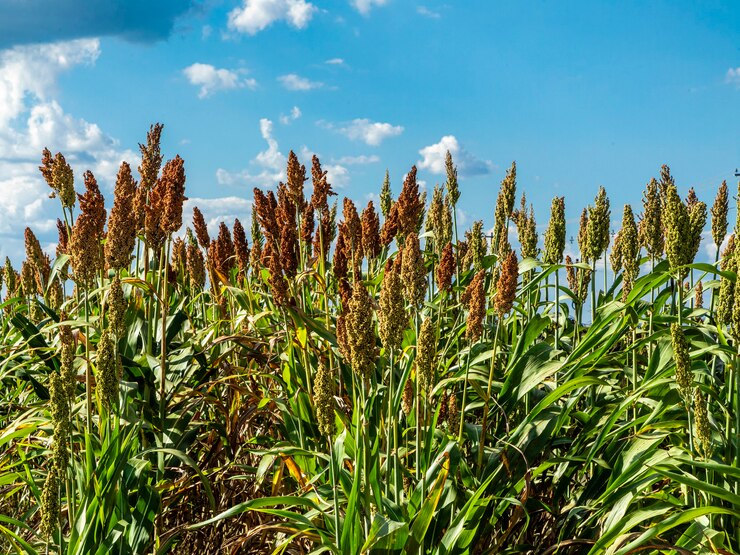
Disease surveys are helping build a clearer picture of the threats facing grain sorghum production across South Africa. Between 2023 and 2025, more than 80 sorghum fields on 27 farms across five provinces were surveyed to determine which diseases were present, how frequently they occurred and how severe they were in different production areas. The work formed part of Thabiso Masisi’s doctoral research, while grain samples collected during the surveys were also used in Nomvula Molol’s MSc research on fungi associated with sorghum grain. The findings showed considerable variation between fields, seasons and locations, confirming that sorghum disease management cannot rely on a single approach for every production region. Three issues stand out for producers because of their potential effect on crop performance and grain quality, namely leaf blight, grain mold and ergot.
Leaf blight was the most frequently observed disease during the recent sorghum disease surveys. The disease is caused by Exserohilum turcicum, the same fungal pathogen responsible for northern corn leaf blight in maize. Although leaf blight was commonly found across the surveyed production regions, the severity differed considerably between fields. This variation means producers need to monitor their crops rather than assuming that the presence of the disease will automatically result in serious yield losses. Regular scouting can help farmers identify changes in disease levels early and decide whether management action is justified.
The first symptoms of sorghum leaf blight generally appear on the lower leaves as small chlorotic or water-soaked spots. As the infection develops, these spots expand into long, narrow lesions that can have an elliptical or cigar-like shape and may reach about 2.5 to 15 centimetres in length. The centres of the lesions can become tan, straw-coloured or brown, while the margins may develop reddish-purple to brown colouring. The appearance can vary between cultivars, and symptoms may be less distinct in some non-pigmented sorghum types. When conditions are humid, the fungus can produce spores on infected tissue, giving lesions a grey, dark or olive appearance.
As leaf blight becomes more severe, individual lesions can join together and create large areas of dead leaf tissue. This reduces the amount of green leaf area available for photosynthesis and can affect crop development when disease pressure is high. The potential effect on yield is particularly important when favourable weather allows the disease to develop rapidly. Farmers therefore need to consider both disease presence and disease severity when assessing the risk to their crop. A field with limited symptoms may require a different response from one where lesions are spreading rapidly across the canopy.
Cultivar selection is an important part of managing sorghum leaf blight because sorghum cultivars can differ significantly in their susceptibility or resistance to the disease. Choosing a cultivar with useful resistance can reduce disease pressure and may also reduce the need for unnecessary fungicide applications. A cultivar evaluation field trial conducted by the Agricultural Research Council-Grain Crops Institute in 2017 demonstrated these differences among 11 cultivars. In that trial, Titan was the only cultivar with less than 10% leaf blight incidence. Such differences show why producers should consider disease resistance alongside other agronomic characteristics when selecting planting material.
Fungicides can provide another management option when disease pressure warrants treatment. In the reported cultivar trial, a single fungicide application reduced leaf blight levels in treated plots to between 5% and 16.7%. Fungicide performance can depend on factors such as disease pressure, timing, environmental conditions and the susceptibility of the cultivar being grown. Applications are generally more useful when made preventively or soon after early symptoms appear rather than after extensive leaf damage has already occurred. Producers should always follow the registered product label, including instructions on application timing, rates, intervals and the maximum number of applications.
Several registered fungicides used for leaf disease management belong to the strobilurin group, also known as FRAC Group 11, or the triazole group, also known as FRAC Group 3. Examples include active ingredients such as azoxystrobin, difenoconazole, tebuconazole, propiconazole and cyproconazole. Some products combine different modes of action to improve disease control. However, repeated use of fungicides with the same mode of action can increase the risk of fungicide resistance. Alternating fungicide groups and following label recommendations are therefore important for protecting the effectiveness of available disease-control products over the long term.
The disease surveys also highlighted the complexity of sorghum grain mold. Unlike a disease caused by one clearly defined pathogen, grain mold is associated with a diverse group of fungi that can occur on developing and mature grain. Nine fungal genera were identified in the surveyed samples, including Alternaria, Bipolaris, Cladosporium, Curvularia, Epicoccum, Exserohilum, Fusarium, Mucor and Nigrospora. The presence and frequency of these fungi varied, showing that grain mold needs to be considered as a complex rather than as a single disease caused by one organism. This distinction is important because different fungi can have different effects on grain quality and may respond differently to environmental conditions.
Epicoccum was the genus recovered most frequently from the grain samples, with more than 20 isolates identified. Fusarium was the second most frequently recovered genus, with 12 isolates, while Alternaria was identified seven times. The frequent recovery of these groups deserves attention because some species within these genera can cause disease or produce mycotoxins. Mycotoxins can affect grain quality and may create concerns for food and feed safety and marketability. The presence of a fungal genus does not automatically mean that harmful toxin levels are present, but it demonstrates why grain quality monitoring remains important.
Some of the fungi associated with sorghum grain have the potential to produce substances that are harmful under certain conditions. Epicoccum sorghinum can produce tenuazonic acid, which can inhibit protein biosynthesis, while its accumulation in sorghum grain can be influenced by prevailing weather conditions. Alternaria alternata can produce several mycotoxins, including tenuazonic acid, alternariol, alternariol methyl ether, altenuene and altertoxins. Certain Fusarium species can also produce mycotoxins such as fumonisins, moniliformin, zearalenone and deoxynivalenol. These compounds can present food and feed safety concerns when they accumulate at significant levels, making continued monitoring an important part of grain production and quality management.
The selected grain samples examined for mycotoxins provided reassuring results. Samples were submitted to a specialised laboratory in the United States for analysis, and none of the mycotoxins included in the laboratory testing were detected above the analytical limits of detection in those selected samples. This finding applies to the samples that were tested and should not be interpreted as evidence that mycotoxin risk does not exist in sorghum production. Mycotoxin production can vary according to the fungal species present and the environmental conditions experienced during grain development. Continued surveillance is therefore important, particularly where weather conditions and disease development create conditions that could increase the risk of grain contamination.
Ergot represents another disease that sorghum producers need to recognise even though it occurred less frequently in the surveys. It is caused by the pathogen Claviceps africana, which infects sorghum during flowering. The disease is strongly associated with weather conditions that interfere with pollination, particularly cool and wet or rainy conditions. When florets remain unfertilised, conditions can become favourable for ergot infection and development. This is one reason why ergot has historically been associated with later plantings that flower during cooler and wetter periods.
Ergot is not a new threat to South African sorghum production. During the late 1990s, the disease caused serious concern and national yield losses were estimated at 10% to 15% in 1996. Some production areas experienced particularly severe problems, including Heilbron in the Free State, Klerksdorp in North West and Standerton in Mpumalanga. Ergot was again prominent in sorghum hybrid and seed production fields during the 1999/2000 season. Since then, improved cultivar screening and efforts to avoid very late planting have helped reduce its impact, but the pathogen has not disappeared from South African production systems.
Recent observations confirm that ergot remains relevant to sorghum disease management. During recent disease evaluations, ergot was recorded in Krugersdorp and Pietermaritzburg, with incidence ranging from 25% to 80% in affected germplasm. These figures should not be treated as national disease levels because they relate to affected germplasm and specific observations. They do, however, confirm that the pathogen remains present and can develop rapidly in susceptible material when environmental conditions are favourable. Producers involved in the surveys also reported having observed ergot previously, although many of those observations were not formally documented.
Avoiding very late planting remains an important strategy for reducing ergot risk, but planting date alone does not determine whether the disease will develop. Recent observations showed that even October and November plantings could be affected under suitable conditions. Cool and wet weather during flowering can interfere with pollination and create favourable conditions for ergot, while susceptible genotypes can increase the risk further. This means producers need to consider planting date together with cultivar susceptibility and weather conditions around flowering. Monitoring crops during this stage can help farmers recognise disease development and respond appropriately.
The broader message from the three-year sorghum disease surveys is that disease pressure can vary considerably between fields, seasons and production regions. Leaf blight was frequently encountered but differed in severity, while grain mold involved a wide range of fungal genera with different potential implications for grain quality and safety. Ergot occurred less frequently but remains an important disease because favourable weather during flowering can lead to rapid development in susceptible material. These findings reinforce the value of regular field scouting, correct disease identification and management decisions based on actual crop conditions. A better understanding of disease patterns can help producers protect yield, maintain grain quality and use fungicides more responsibly.
Sorghum producers can reduce disease-related risks by combining several management practices rather than relying on one solution. Selecting suitable cultivars, monitoring fields regularly, considering weather conditions and using fungicides when justified can form part of an integrated disease management approach. Grain quality also requires attention beyond the field because fungi associated with grain mold can have implications for food and feed safety even when visible disease symptoms are limited. The surveys conducted between 2023 and 2025 provide valuable evidence that South African sorghum diseases need to be viewed across regions and seasons rather than in isolation. Continued research and monitoring will help producers respond more effectively to changing disease conditions and protect the productivity and quality of South Africa’s sorghum crop.
Join 'Farmers Mag' WhatsApp Channel
Get the latest Farming news and tips delivered straight to your WhatsApp
CLICK HERE TO JOIN