

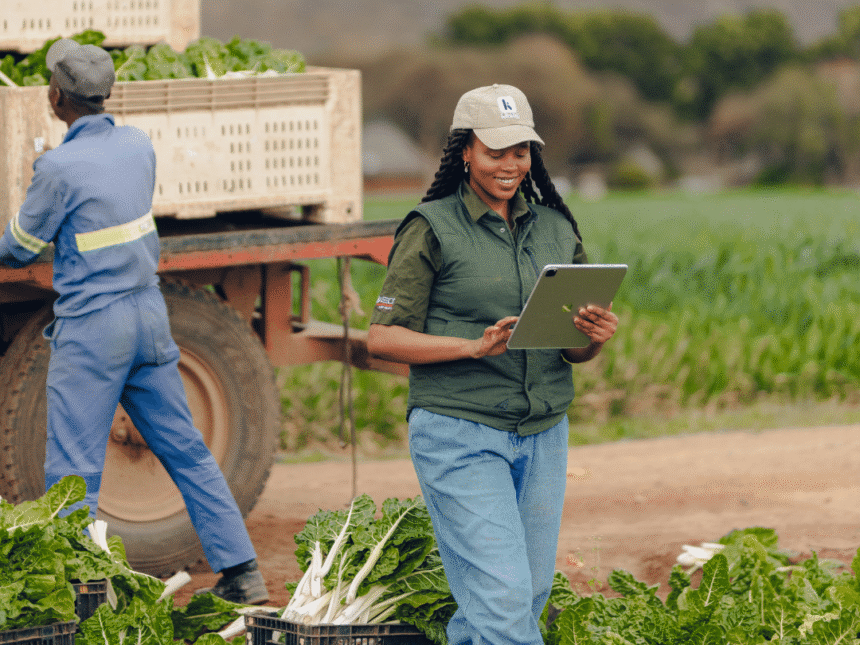
Gugulethu Mahlangu, founder and CEO of House Harvest in Makhanda, is demonstrating how innovation can create new possibilities in agriculture while addressing some of the sector’s most pressing challenges. Through an innovative aquaponics farming system, her youth-owned and female-led enterprise produces vegetables, herbs, indigenous crops and fish while using about 90 percent less water than traditional farming. The approach combines food production with resource efficiency, creating a model that is particularly relevant in areas where water availability can limit agricultural development. Mahlangu is also using House Harvest to create employment and provide young people and women with practical knowledge about sustainable farming. Her work shows that agriculture can offer opportunities for entrepreneurship, skills development and economic participation when producers are willing to embrace new approaches.
Aquaponics forms the foundation of House Harvest’s innovative approach to food production. The system combines aquaculture, which involves raising fish, with hydroponics, where plants grow without traditional soil-based farming. Water circulates between the fish and plants, allowing nutrients from the fish system to support plant growth while the plants help filter and clean the water. This creates a more efficient production cycle that can significantly reduce the amount of water required compared with conventional farming methods. For Mahlangu and her team, the technology provides an opportunity to produce different types of food within a single integrated system while making more responsible use of a critical natural resource.
The ability to use approximately 90 percent less water than traditional farming is one of the most important features of the House Harvest model. Water scarcity remains a significant concern for agricultural producers because farming requires reliable access to water for crops, livestock and other production activities. By reducing water consumption, aquaponics can provide farmers with another option for producing food in environments where conventional farming may face limitations. The system also demonstrates how agricultural technology can be used to improve efficiency without removing the focus on food production. Mahlangu’s work therefore highlights the potential for innovative farming methods to contribute to more sustainable agricultural practices in the Eastern Cape.
House Harvest produces a diverse range of agricultural products, including vegetables, herbs, indigenous crops and fish. This diversity gives the enterprise the opportunity to explore different areas of the food value chain rather than relying on a single product. Producing both plants and fish through an integrated system also demonstrates how different forms of agriculture can work together to maximise available resources. Indigenous crops are particularly important because they form part of local food systems and can contribute to greater awareness of agricultural biodiversity. By combining these products with modern farming technology, House Harvest is creating an approach that connects innovation with food production that remains relevant to local communities.
Mahlangu’s work extends beyond growing food because House Harvest also contributes to employment creation. Agriculture can provide opportunities across many parts of the value chain, including production, processing, marketing, distribution and agricultural services. By building a functioning enterprise, Mahlangu is showing young people that farming can be approached as a business with opportunities for growth and income generation. Employment opportunities linked to agricultural enterprises can also contribute to local economic activity and help people develop practical workplace skills. House Harvest therefore represents more than a farming operation, as it is also part of a broader effort to demonstrate how agriculture can support economic development.
Skills development is another key part of the work being done through House Harvest. Mahlangu provides free workshops aimed at empowering young people and women with knowledge about sustainable farming. These workshops can help participants understand how innovative agricultural systems work while introducing them to practical approaches that they could potentially apply in their own communities or businesses. Access to agricultural knowledge is especially important for aspiring farmers who may have an interest in the sector but lack the resources or experience to get started. By making training available, House Harvest is helping expand awareness of sustainable agriculture and encouraging more people to consider farming as a viable career and business opportunity.
The focus on young people and women is particularly significant because agriculture can play an important role in creating opportunities for groups that are often looking for new pathways into entrepreneurship and employment. A youth-owned and female-led agricultural enterprise such as House Harvest provides an example of how leadership in the sector can take different forms. Mahlangu’s experience also challenges the idea that successful agriculture must rely exclusively on conventional farming methods or large-scale land-based production. Technology, business planning and skills development can create alternative entry points into the sector. Her work encourages aspiring farmers to look beyond traditional approaches and consider how innovation can help them develop sustainable agricultural businesses.
Support from the Department of Agriculture and other partners has also contributed to Mahlangu’s efforts to develop the House Harvest model. Partnerships can be important for emerging agricultural enterprises because access to technical assistance, resources, training and institutional support can help businesses overcome some of the barriers associated with growth. For innovative farming models, collaboration can also create opportunities to demonstrate the technology and share knowledge with a wider group of producers. Mahlangu is using this support as she works towards expanding the House Harvest model across the Eastern Cape. The goal of wider expansion could help more communities learn about aquaponics and explore how sustainable food production can be adapted to local conditions.
The potential expansion of the House Harvest model also points to the wider role that agricultural innovation can play in the Eastern Cape. Sustainable farming systems can help producers consider how to increase productivity while using resources more efficiently. Aquaponics may not replace conventional agriculture, but it can provide an additional production method for farmers and entrepreneurs who have access to the appropriate infrastructure, knowledge and markets. The success of any model will depend on factors such as investment, technical skills, operating costs and demand for the products produced. House Harvest’s experience nevertheless provides a practical example of how innovative thinking can open new possibilities within the agricultural sector.
Mahlangu’s message to women and young people is simple but important: there is a place for you in agriculture. Her journey demonstrates that participation in farming does not have to be limited to traditional production methods, especially as technology continues to change the way food can be produced. Young entrepreneurs can explore areas such as aquaponics, agricultural technology, food processing, marketing and other parts of the agricultural value chain. Women can also build businesses that combine food production with skills development, employment creation and community empowerment. Through House Harvest, Mahlangu is showing that innovation, sustainability and entrepreneurship can work together to create a more inclusive future for agriculture in the Eastern Cape.
Gugulethu Mahlangu and House Harvest are offering a practical example of how agricultural innovation can address resource challenges while creating economic and educational opportunities. The enterprise’s aquaponics system demonstrates the potential to produce vegetables, herbs, indigenous crops and fish while using significantly less water than traditional farming. Its focus on employment and free workshops adds another dimension by ensuring that the benefits of the enterprise extend beyond food production. With continued support from the Department of Agriculture and other partners, Mahlangu is working to take the House Harvest model to more communities across the Eastern Cape. Her message remains clear and relevant, agriculture has space for women and young people who are ready to learn, innovate and build sustainable businesses.
Join 'Farmers Mag' WhatsApp Channel
Get the latest Farming news and tips delivered straight to your WhatsApp
CLICK HERE TO JOIN




