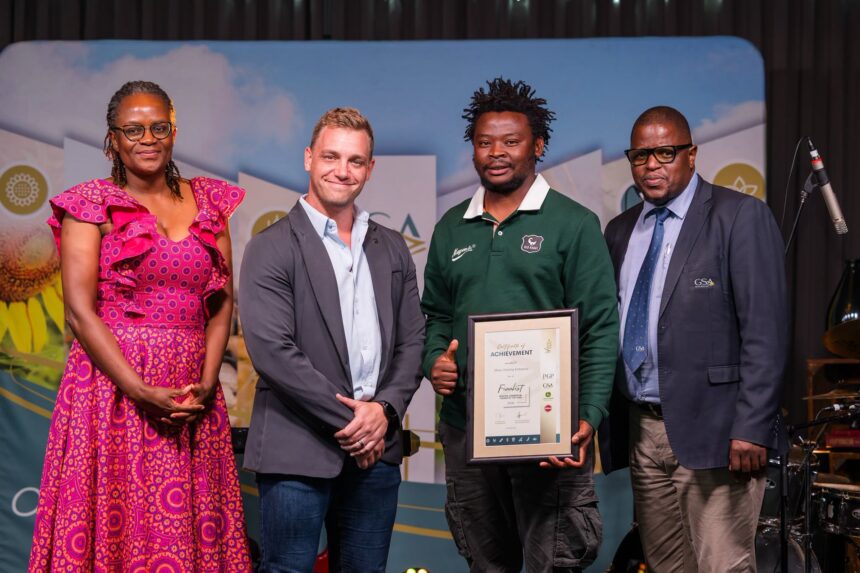
Land Bank is celebrating the success of Masiu Farming Enterprise, a Free State farming business that demonstrates how agricultural finance, mentorship and skills development can help emerging farmers build sustainable commercial operations. Motlalepule Vincent Masiu, 27, who farms with his family near Senekal, has been named the 2026 Grain SA/Phahama Grain Phakama (PGP) New Era Commercial Farmer of the Year. The achievement recognises his progress in farming and highlights the role of support programmes in helping young agricultural entrepreneurs grow their businesses. As part of the award, Masiu received a brand-new John Deere 5075E tractor, which can support the day-to-day demands of running a farming enterprise. His journey offers an example of how knowledge, family involvement, access to finance and practical mentorship can contribute to the development of South Africa’s next generation of commercial farmers.
Masiu’s path into commercial agriculture began with a strong educational foundation and a decision to return to the family farming business. After completing postgraduate studies in agricultural management at the Central University of Technology, he put his knowledge to work in the family enterprise near Senekal. His training provided a foundation for understanding the management responsibilities involved in running a modern farming operation. Returning to the family business also allowed him to build on existing agricultural experience while contributing his own skills and ideas. His progress reflects the importance of combining formal education with practical farming knowledge when developing a sustainable agricultural business.
Today, Masiu Farming Enterprise produces maize, soybeans and sunflower, while also operating a Bonsmara cattle enterprise. This mix of crop production and livestock farming gives the business a broader agricultural base and requires careful planning across different production activities. Each enterprise has its own seasonal demands, management requirements and financial considerations, making sound decision-making essential. Crop farmers must consider factors such as planting schedules, input costs, weather conditions and market prices, while livestock production requires attention to animal health, nutrition and breeding management. Managing these activities together calls for a clear business strategy and the ability to adapt to changing conditions in the agricultural sector.
The family has also expanded its operations through the acquisition of a 700-hectare farm, marking an important development in the growth of the enterprise. Access to additional farmland can create opportunities to increase production and strengthen a business, although expansion also brings greater management responsibilities and operating costs. Farmers need to plan carefully to ensure that land, machinery, labour and other resources are used effectively. They must also consider the financial demands of each production season and maintain sufficient capacity to manage unexpected challenges. For a growing family farming business, expansion is therefore not only a measure of progress but also a responsibility that requires sound financial and operational management.
A significant part of Masiu’s development has been his involvement in Grain SA’s Farmer Development Programme, which he joined in 2020. The programme forms part of a broader effort to help farmers strengthen their skills and improve their ability to operate successful agricultural businesses. Through farmer development initiatives, participants can gain knowledge and practical guidance that support better production decisions and business planning. Mentorship is particularly valuable for emerging farmers who are building commercial operations and must navigate the technical and financial demands of agriculture. Masiu’s recognition as the 2026 New Era Commercial Farmer of the Year highlights the importance of sustained learning and support as farmers progress towards greater commercial maturity.
The Phahama Grain Phakama programme has played a role in Masiu’s development through its focus on farmer mentorship and growth. Farming success depends on more than producing a good crop or maintaining healthy livestock. Farmers must also understand costs, manage cash flow, assess market opportunities and make decisions that support the long-term viability of their businesses. Guidance from experienced agricultural professionals and access to relevant development opportunities can help farmers strengthen these abilities. When mentorship is combined with practical experience and formal training, it can help emerging producers make more informed decisions and prepare for the challenges of commercial agriculture.
Access to finance remains another important factor in the growth of agricultural enterprises. Farming often requires substantial investment in land, machinery, seed, fertiliser, livestock, infrastructure and other production needs, while income may only arrive after months of work. This creates financial pressure, particularly for farmers who are expanding their operations or building a commercial track record. The Land Bank-supported Blended Finance Scheme is intended to help qualifying farmers access finance through a structure that combines different forms of funding support. By helping address financing barriers, blended finance can contribute to the development of agricultural businesses that might otherwise struggle to secure the resources needed to grow. The success of any financing arrangement, however, also depends on sound business planning, responsible financial management and the farmer’s ability to manage production risks.
Land Bank’s recognition of Masiu Farming Enterprise draws attention to the relationship between agricultural funding and farmer development. Finance can help a business invest in productive assets, but money alone does not guarantee a successful outcome. Farmers also need the technical knowledge, management skills and practical support required to use those resources effectively. Mentorship and training can help producers assess investment decisions, improve production practices and plan for future growth. When these forms of support work together, they can strengthen the ability of farmers to build resilient enterprises and contribute to a more inclusive agricultural economy.
The award of a John Deere 5075E tractor is a notable achievement for Masiu and his family. Machinery plays an important role in crop production, helping farmers carry out essential field operations and manage demanding seasonal workloads. Access to suitable equipment can improve operational flexibility and support more efficient use of time and labour, depending on the farm’s needs and how the machinery is used. The value of the award extends beyond the tractor itself because it recognises the work and progress behind the farming enterprise. It also offers encouragement to young farmers who are working to establish and grow their own commercial operations.
Young farmers are important to the future of South African agriculture, particularly as the sector faces pressure to remain productive, competitive and responsive to changing conditions. New entrants need opportunities to develop their skills, access land and finance, build market relationships and gain experience managing commercial enterprises. Family farms can provide a foundation for this development, but long-term growth often requires additional investment and structured support. Masiu’s experience shows how education, participation in farmer development programmes and access to agricultural finance can work together in the development of a commercial farming business. His achievement also highlights the contribution that young agricultural entrepreneurs can make when they have the opportunity to apply their knowledge and grow their operations.
The growth of Masiu Farming Enterprise is relevant beyond the farm itself because successful agricultural businesses contribute to rural economic activity and food production. Crop and livestock enterprises support demand for agricultural inputs, transport, processing and other services linked to the farming value chain. They can also create opportunities for employment and business development in rural communities, although the scale of these benefits depends on each operation. Strong commercial farms are therefore an important part of a wider agricultural system that connects producers with suppliers, processors and markets. Supporting emerging farmers can help strengthen this system while creating more opportunities for participation in commercial agriculture.
Land Bank’s celebration of Masiu Farming Enterprise highlights the value of combining agricultural finance with mentorship, education and practical farming experience. Motlalepule Vincent Masiu’s recognition as the 2026 Grain SA/PGP New Era Commercial Farmer of the Year marks an important milestone in his development as a young commercial farmer. His family’s diversified operation, expansion onto a 700-hectare farm and involvement in farmer development initiatives illustrate the work required to build and manage a growing agricultural business. The Blended Finance Scheme and programmes such as Grain SA’s Phahama Grain Phakama can play an important role in helping farmers access the resources and guidance needed to progress. As South Africa works to support a strong and sustainable agricultural sector, investing in emerging farmers will remain essential to building capable farming businesses, strengthening rural economies and supporting the country’s long-term food production needs.
Join 'Farmers Mag' WhatsApp Channel
Get the latest Farming news and tips delivered straight to your WhatsApp
CLICK HERE TO JOIN