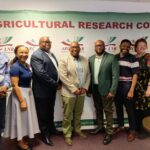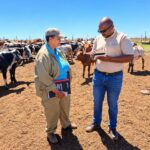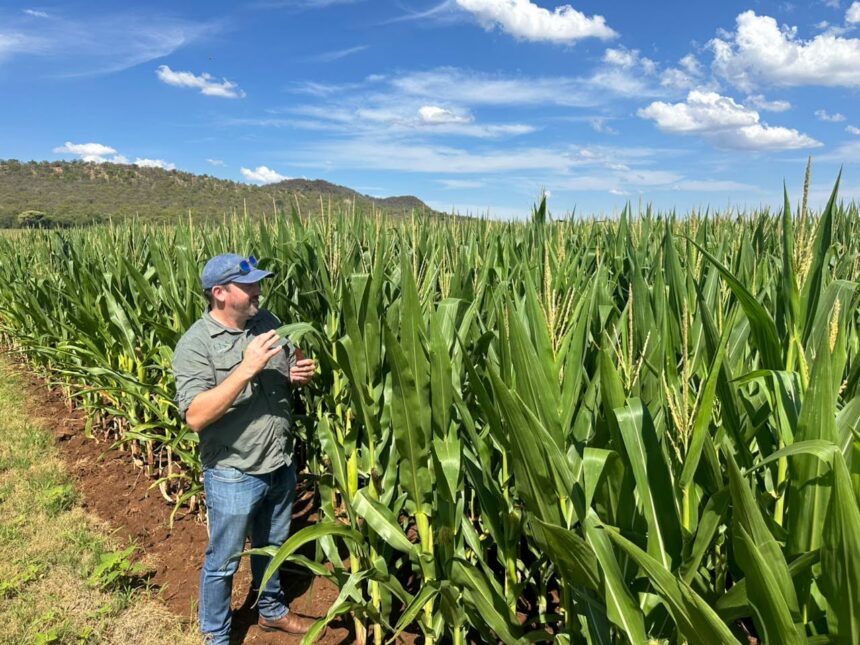
Maize production plays an important role in South Africa’s agricultural sector, but crop diseases remain a major challenge for farmers who depend on healthy plants and reliable harvests. Maize streak virus (MSV) is one of the diseases that can affect maize crops and create production difficulties for farmers. Understanding how the disease affects local farming operations is essential when developing practical ways to manage its impact. Grain SA’s research team recently visited the farm of Uncle Joseph and Neels Swanepoel to discuss their experiences with MSV and the challenges facing irrigation farmers. The team included Mike Ellis and Trystan Nadasen from Grain SA, accompanied by Conrad Cilliers and Ntando Vilakazi from the University of Pretoria’s Forestry and Agricultural Biotechnology Institute (FABI) Diagnostic Clinic. The visit provided an opportunity for farmers, researchers and diagnostic specialists to exchange information and explore possible approaches to managing the disease.
The discussions focused on the experiences of local irrigation farmers and the impact that maize streak virus has on their farming operations. For farmers, disease outbreaks can create uncertainty around crop performance and make production planning more difficult. Identifying the disease and understanding its effects are important steps towards choosing suitable management measures. Farmers also need reliable information when deciding which maize cultivars to plant and how to manage production risks. By visiting the Swanepoel farm, the Grain SA research team and the University of Pretoria specialists could hear directly about the challenges experienced by producers. This direct engagement helps researchers understand the conditions farmers face and consider solutions that are relevant to their production environments.
Maize streak virus is a viral disease that affects maize plants and is associated with characteristic streaking or striping on the leaves. The disease is transmitted by leafhoppers, particularly the maize streak leafhopper. Infected plants may show reduced growth and can produce lower yields, depending on factors such as the timing of infection, the maize variety and growing conditions. Early infection can be particularly damaging because plants may experience the effects of the disease during important stages of development. The severity of the problem can vary between fields and seasons, making accurate identification and suitable management important. Farmers who suspect MSV in their crops benefit from seeking expert advice rather than relying only on visible symptoms to make management decisions.
One of the possible solutions discussed during the farm visit was the use of MSV-resistant maize cultivars. Choosing suitable cultivars is an important part of managing crop diseases because resistant varieties can reduce the risk of serious losses from particular pathogens. MSV resistance does not mean that farmers can ignore other aspects of crop management, but it can form part of a broader strategy to limit the disease’s impact. Selecting an appropriate cultivar requires farmers to consider their local growing conditions, production objectives and the characteristics of available seed varieties. Research and technical guidance can help producers make informed choices when deciding which cultivars are suitable for their farms. Continued cooperation between farmers and agricultural specialists is therefore important in identifying options that can support more reliable maize production.
The involvement of the University of Pretoria’s FABI Diagnostic Clinic added a diagnostic and scientific perspective to the engagement. Plant disease diagnosis is important because different problems can produce symptoms that appear similar in the field. Accurate identification helps farmers and researchers understand what is affecting a crop and consider appropriate responses. Diagnostic specialists can contribute scientific knowledge that supports better disease monitoring and management decisions. Their participation also creates an opportunity to connect farmers’ observations with technical expertise. This relationship can help ensure that discussions about crop health are informed by both practical farming experience and scientific understanding.
The Grain SA research team’s visit reflects the value of direct engagement between agricultural researchers and producers. Farmers work with their crops throughout the growing season and often identify changes in plant health before those observations reach research institutions. Their experiences can provide useful information about disease patterns, production conditions and the challenges associated with managing affected fields. Researchers, in turn, can help interpret these observations and explore possible solutions using scientific knowledge. When both groups share information, they can develop a clearer understanding of agricultural problems and identify areas where further research or technical support may be needed. This type of cooperation is important for strengthening the connection between agricultural research and practical grain production.
Irrigation farmers also need to consider how crop diseases affect the wider management of their farming operations. Production decisions involve planning, input costs, water management, cultivar selection and expectations around harvest performance. A disease such as MSV can add pressure to these decisions, particularly when farmers need to assess the condition of their crops and determine how best to manage future planting. Access to accurate information can help producers evaluate their options and avoid decisions based on assumptions. Although irrigation provides water for crop growth, it does not prevent viral diseases such as MSV. Farmers still need to pay attention to crop health, disease identification and suitable management practices throughout the growing season.
The discussions on the Swanepoel farm also highlight the importance of sharing agricultural knowledge within the farming community. When producers openly discuss their experiences, other farmers can learn about challenges affecting similar production systems. This exchange can encourage early awareness of crop diseases and help farmers understand why timely diagnosis matters. It can also create opportunities for researchers to gather information that may guide future investigations and advisory work. Agricultural progress depends on more than scientific discoveries alone. It also requires ongoing communication between researchers, extension professionals and the farmers who apply knowledge in the field.
Grain SA’s engagement with the Swanepoel family demonstrates an approach to agricultural research that places farmers’ experiences at the centre of problem-solving. The visit was not limited to discussing a disease in isolation. It created space for listening, learning and considering possible solutions alongside the people directly affected by the challenge. The participation of the University of Pretoria’s FABI Diagnostic Clinic further strengthened the technical discussion by bringing diagnostic expertise into the engagement. The Swanepoel family was thanked for welcoming the team, sharing its experiences and contributing to discussions aimed at finding solutions that could benefit the wider farming community. Such cooperation can help build stronger relationships between producers and the institutions working to support grain production.
Managing maize streak virus requires informed decisions, accurate disease identification and suitable production strategies. The discussion around MSV-resistant cultivars offers one possible way for farmers to reduce the disease’s impact, while continued research and technical engagement remain important for understanding the challenges faced by producers. The visit by Grain SA and the University of Pretoria’s FABI Diagnostic Clinic shows why agricultural research must remain connected to farming realities. By listening to farmers and combining practical experience with scientific expertise, the agricultural sector can improve its ability to respond to crop health challenges. Stronger cooperation will remain important in protecting maize production, supporting irrigation farmers and building a resilient grain industry in South Africa.
Join 'Farmers Mag' WhatsApp Channel
Get the latest Farming news and tips delivered straight to your WhatsApp
CLICK HERE TO JOIN