Onion farming in South Africa offers strong income potential when you manage water, soil and timing correctly. The crop grows well in many provinces, especially where summers are warm and winters are cool. Farmers grow onions for fresh markets, processing and long storage supply chains. Success depends on disciplined management from seed selection to harvest. Poor planning leads to small bulbs, disease and low returns. Good planning leads to consistent yields and stable market supply. This guide explains how to build a productive onion farming system in South African conditions.
Onions perform best in well drained soil with a fine texture. Sandy loam or loam soils work well because they support bulb expansion and reduce rot risk. Soil pH should sit between 5.5 and 6.8 for strong growth. Avoid compacted or waterlogged soils because onions have shallow roots that suffer quickly under stress. Proper soil preparation should reach around 30 cm deep to improve root development and drainage. Crop rotation is important and you should avoid planting onions in the same field for at least three to four seasons. This reduces soil pests and disease build up that can damage yield.
Climate plays a major role in onion success. The crop prefers cool conditions during early growth and warmer dry weather during bulb formation. Ideal temperatures range between 12°C and 24°C for vegetative growth. High heat during bulbing can reduce bulb size if moisture is not managed well. Cold stress during early stages can trigger premature flowering which lowers yield. Day length also affects bulb formation, so you must choose varieties suited to South African regions. Short day varieties perform better in most local production zones. Seasonal planning usually places planting between late summer and early autumn depending on the region.
Water management is one of the most important parts of onion farming. Onions require about 400 to 600 mm of water during the full growing cycle. The root system is shallow, so soil moisture must stay consistent. Light and frequent irrigation works better than heavy watering. Allowing the soil to dry out reduces bulb size and quality. Overwatering increases disease pressure such as mildew and rot. Irrigation should stop about two to three weeks before harvest to help bulbs cure properly in the soil. Efficient drip or furrow irrigation systems help control water use and improve yield stability.
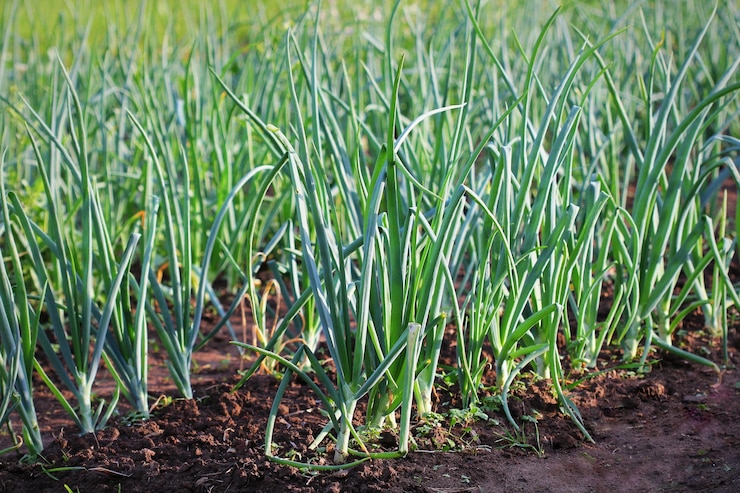
Planting starts with seedbeds or direct seeding, although transplanting is more common for better control. Seeds are usually raised in nurseries for 6 to 8 weeks before transplanting. Seedlings are ready when they reach about 12 to 20 cm in height. Plant spacing is typically 7 to 10 cm between plants and 20 to 25 cm between rows. Correct spacing allows bulbs to form evenly without competition. Planting depth should stay shallow, around 1 to 2 cm, to avoid elongated bulbs. Good field preparation and uniform planting help reduce variation in bulb size at harvest.
Fertilisation supports strong bulb development and high yield. Nitrogen, phosphorus and potassium must be applied in balanced amounts based on soil tests. Nitrogen is often split into multiple applications during the growing season to support leaf growth and bulb formation. Too much nitrogen late in the season delays maturity and reduces storage quality. Phosphorus supports early root development while potassium improves bulb quality and shelf life. Regular soil testing helps you adjust fertiliser plans and avoid waste. Farmers who manage nutrition properly achieve more uniform and marketable bulbs.
Pest and disease control is critical in onion production. Common threats include thrips, downy mildew, purple blotch and white rot. Thrips damage leaves and reduce photosynthesis which directly lowers yield. Fungal diseases spread quickly in wet or poorly ventilated fields. Crop rotation, clean planting material and field hygiene reduce infection risk. Avoid overhead irrigation during disease prone periods. Early detection and control protect both yield and storage quality. Strong pest control practices often decide whether a crop is profitable or not.
Harvesting takes place when about 50 to 60 percent of the tops fall over naturally. This signals that bulbs have matured. Harvest carefully by lifting bulbs without bruising them. After lifting, onions must cure in a dry, well ventilated space until necks are fully dry. Proper curing improves storage life and market value. Yield levels in South Africa vary widely depending on management, but good production systems can reach 25 to 40 tonnes per hectare. Poor management results in much lower returns. Careful harvesting and storage reduce post harvest losses significantly.
Onion farming in South Africa rewards consistency and attention to detail. Soil health, irrigation control and variety selection determine most of your success. Pest management and timing complete the production system. Farmers who follow structured practices achieve stable yields and stronger profits. The crop fits well into commercial and small scale farming systems when managed correctly. Strong planning from the start reduces risk and improves market performance.
Join 'Farmers Mag' WhatsApp Channel
Get the latest Farming news and tips delivered straight to your WhatsApp
CLICK HERE TO JOIN