
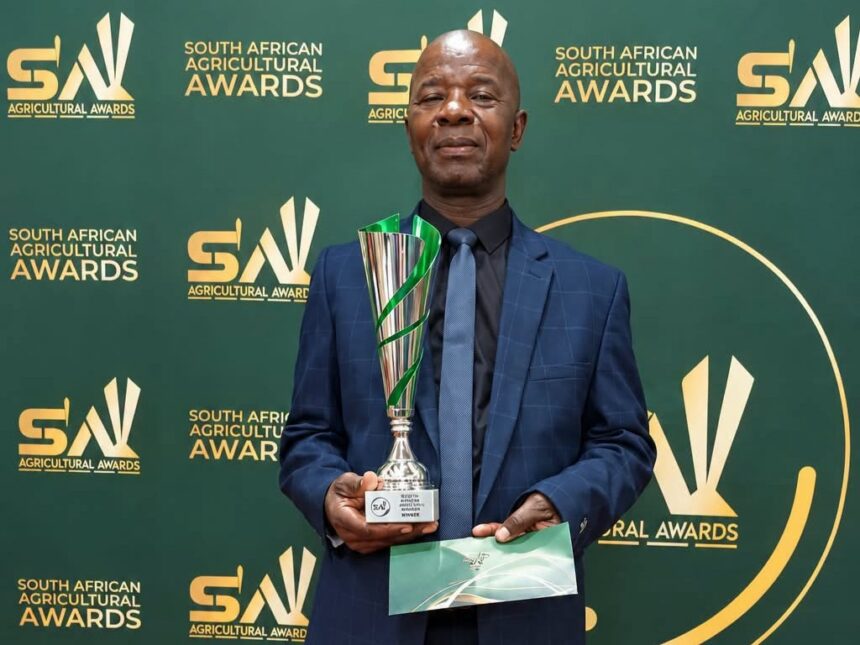
Maize farmer John Ntsitsi Malatjie from Thubelihle in Kriel, under Emalahleni Local Municipality, has earned recognition for his commitment to preserving traditional maize varieties and promoting sustainable farming practices. Malatjie was among the winners at the 2026 South African Agricultural Awards, held recently at the Sandton Convention Centre. He received the Legacy Grower Award for his dedication to seed selection, saving and replanting traditional maize varieties. His approach highlights how farmers can protect valuable agricultural knowledge while managing production costs and maintaining their farming enterprises. The achievement also draws attention to the important role that experienced growers play in supporting food production, rural livelihoods and the future of South African agriculture.
Malatjie’s recognition reflects a farming approach built around preserving seed and making practical use of available resources. Instead of depending entirely on purchasing new seed for every planting season, he selects suitable maize seed from his harvest and saves it for future planting. This practice requires careful attention to the characteristics of the plants and the quality of the harvested grain intended for seed. When managed properly, seed selection can help farmers maintain varieties that are suited to their growing conditions and farming objectives. His work demonstrates how traditional knowledge can remain relevant in modern agriculture, particularly for farmers who need to manage input costs carefully.
Saving and replanting seed has long formed part of farming traditions in many communities. Farmers often select plants based on characteristics such as growth, grain quality and performance under local conditions. By keeping seed from suitable plants, growers can preserve varieties that have value for their farms and communities. Traditional maize varieties may also carry cultural and historical significance, connecting present-day farmers with the agricultural practices of earlier generations. However, saved seed needs careful management to maintain quality, and not every variety will perform equally well under changing weather or production conditions. Malatjie’s Legacy Grower Award recognises his commitment to maintaining this important aspect of farming heritage.
Reducing production costs is a major concern for maize farmers, particularly when seed, fertiliser, fuel, machinery and labour expenses place pressure on farm budgets. Saving suitable seed can reduce the amount a farmer spends on seed purchases, although it does not remove the other costs associated with planting and growing a crop. The financial benefit depends on the variety being grown, seed quality, storage practices and the performance of the resulting crop. Farmers who use saved seed need to select healthy material, store it under suitable conditions and check that it remains viable before planting. They must also consider whether their chosen varieties meet the requirements of their farming system and intended market. Malatjie’s approach illustrates how careful resource management can form part of a broader strategy for maintaining a viable agricultural enterprise.
Traditional seed preservation can contribute to agricultural diversity by helping keep different maize varieties in cultivation. Crop diversity matters because varieties can differ in their maturity periods, grain characteristics and responses to local growing conditions. Maintaining a range of varieties can provide farmers with options when production conditions or farming priorities change. It can also help preserve agricultural knowledge that might otherwise be lost as farming systems become more dependent on a narrower selection of commercial varieties. Seed selection alone cannot guarantee resistance to drought, pests or disease, so farmers still need to assess the suitability of each variety and follow sound crop management practices. Nevertheless, preserving traditional maize varieties can complement other efforts to strengthen the resilience and diversity of South African agriculture.
Malatjie’s farming work also has an economic dimension through the employment opportunities associated with his enterprise. Agricultural production can create work at different stages of the farming cycle, including land preparation, planting, weed control, harvesting and handling the crop. The amount and duration of employment depend on the scale of production and the work required during each season. For rural communities, opportunities linked to local farms can help households earn income and support economic activity beyond the farm itself. Maintaining a viable farming enterprise is therefore important not only for crop production but also for sustaining livelihoods. Malatjie’s recognition highlights the connection between practical farming decisions, enterprise sustainability and opportunities for people in rural communities.
The 2026 South African Agricultural Awards provide a platform for recognising achievements across the agricultural sector. Awards such as the Legacy Grower Award help draw attention to farmers whose work contributes to the continuity of agricultural practices and knowledge. Recognition can also encourage wider discussion about the different approaches farmers use to produce food, manage resources and sustain their businesses. Commercial technologies and improved production methods have an important place in agriculture, but traditional knowledge can also offer useful lessons when assessed and applied appropriately. Malatjie’s achievement demonstrates that agricultural progress can include preserving valuable practices while responding to present-day economic and production challenges. His award places a spotlight on the contributions of farmers who work to maintain agricultural heritage through everyday decisions on their farms.
For other maize farmers, seed selection and preservation offer an opportunity to review how planting material is sourced and managed. Farmers considering saved seed should understand the characteristics of their varieties, protect seed from moisture and pests during storage and test germination before planting. They should also be aware that some hybrid maize varieties do not reliably retain the same performance in subsequent generations, making variety choice particularly important. Where seed is saved for replanting, maintaining varietal identity and avoiding unwanted mixing can help preserve the qualities the farmer values. Local agricultural advisers can assist growers in deciding which seed management practices suit their production systems. These considerations show that traditional seed saving works best when supported by careful selection, good storage and informed farm management.
John Ntsitsi Malatjie’s Legacy Grower Award is a significant recognition of his dedication to preserving traditional maize varieties through seed selection, saving and replanting. His work demonstrates how established farming practices can help reduce certain production costs, sustain an agricultural enterprise and contribute to rural employment. It also highlights the importance of maintaining crop diversity and passing agricultural knowledge from one generation to the next. While successful maize production still requires attention to seed quality, weather, soil conditions and farm finances, preserving suitable traditional varieties can form a valuable part of a farmer’s strategy. Malatjie’s achievement serves as a reminder that the future of South African agriculture depends not only on innovation but also on protecting useful knowledge and recognising the farmers who keep it alive.
Join 'Farmers Mag' WhatsApp Channel
Get the latest Farming news and tips delivered straight to your WhatsApp
CLICK HERE TO JOIN