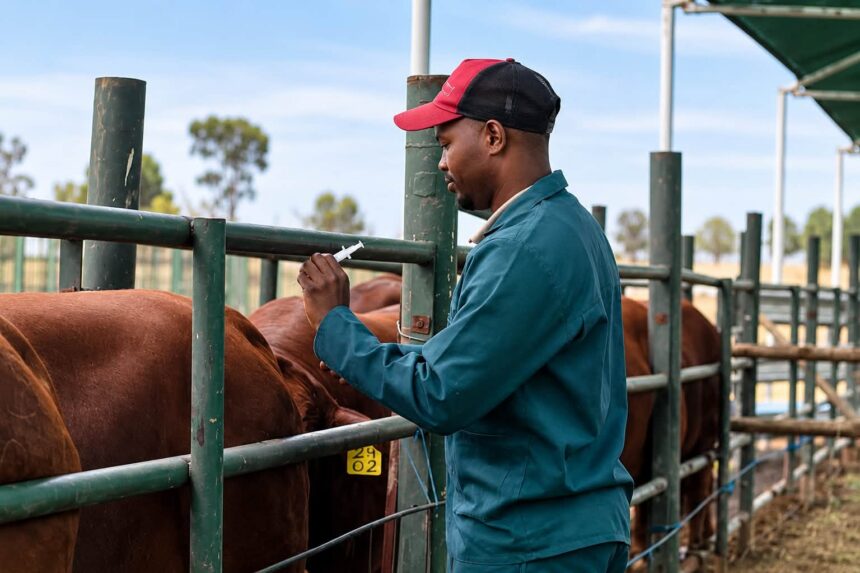
The Gauteng Department of Agriculture and Rural Development (GDARD) joined farmers and livestock producers on-site at Grasdak, Pretoria, to provide practical agricultural support, veterinary services and guidance on livestock disease prevention. The field engagement focused on helping producers protect their herds while strengthening biosecurity practices that can reduce the risk of disease transmission. State veterinary teams worked directly with farmers to address livestock health needs and provide support in the field. The initiative also placed particular attention on Foot-and-Mouth Disease (FMD), a serious livestock disease that can disrupt animal production, movement and agricultural markets. By taking veterinary services directly to farmers, GDARD demonstrated the importance of timely intervention and close cooperation between government veterinary services and livestock producers.
A major part of the day’s activities involved the direct vaccination of livestock using Bioaftogen as part of efforts to strengthen herd protection against Foot-and-Mouth Disease. Vaccination forms an important component of broader disease-control measures because healthy and protected herds can help reduce the impact and spread of serious livestock diseases. State veterinary teams worked alongside farmers to administer vaccinations and support herd healthcare on the ground. This type of field-based veterinary intervention is particularly valuable because producers can receive professional assistance while their animals are being managed under actual farm conditions. It also gives veterinary officials an opportunity to engage directly with farmers about the health status of their herds and the steps required to maintain effective disease prevention.
Foot-and-Mouth Disease remains an important concern for livestock producers because outbreaks can have consequences that extend beyond individual farms. The disease can affect cattle, pigs, sheep, goats and other cloven-hoofed animals, making strong surveillance and prevention practices important across livestock production areas. An outbreak can also result in movement controls and other measures that affect farming operations and the wider agricultural value chain. These impacts can reach livestock markets, abattoirs, processors and other businesses that depend on the movement of animals and animal products. Protecting livestock therefore requires farmers and veterinary authorities to work together through vaccination, monitoring, responsible animal movement and effective biosecurity.
Biosecurity was another key focus during the engagement at Grasdak, with farmers receiving guidance on disease prevention and measures that can reduce opportunities for pathogens to enter or spread across farms. Effective biosecurity involves managing risks associated with animals, people, vehicles, equipment and other materials that move onto and around farms. Farmers can reduce risks by controlling access to livestock areas, maintaining appropriate hygiene practices and monitoring animals for signs of illness. Producers also need to understand the importance of reporting suspected diseases quickly so that veterinary authorities can respond appropriately. Consistent application of these measures can strengthen the protection of individual herds while contributing to wider disease-control efforts across farming communities.
The presence of the state veterinary team also provided an opportunity to reinforce the importance of regular herd healthcare. Livestock health management involves more than responding to disease outbreaks because producers need ongoing measures that support animal health and productivity. Vaccination programmes, observation of animals and early identification of unusual symptoms can all form part of a responsible herd-health strategy. Farmers can also benefit from maintaining accurate records of vaccinations and other veterinary interventions, particularly when managing larger herds. Regular engagement with veterinary professionals can help producers identify potential risks early and ensure that livestock health decisions are based on appropriate technical guidance.
GDARD’s support is relevant to both emerging and commercial livestock farmers who require access to agricultural and veterinary services. Different farming operations may face different challenges depending on herd size, available infrastructure, financial resources and production systems. Emerging farmers may require additional assistance with accessing technical information, veterinary support and departmental programmes, while commercial producers also need reliable disease-control services to protect productive herds. Government support can help strengthen these operations by connecting farmers with professional expertise and relevant agricultural programmes. Building stronger relationships between producers and departmental officials can also improve communication when livestock-health concerns arise.
The field visit also highlighted the value of delivering agricultural services directly to farming communities. Farmers often need practical assistance that addresses immediate conditions on their farms rather than information provided only through formal meetings or written guidance. On-site veterinary support allows specialists to work with producers in the environment where livestock are kept and managed. This can improve the practical understanding of disease-prevention measures and give farmers an opportunity to ask questions based on their specific circumstances. Direct engagement also strengthens cooperation between government officials and farmers, which is essential when disease-control programmes require consistent participation across multiple livestock operations.
Protecting livestock from FMD requires a coordinated approach that combines vaccination with strong biosecurity and responsible farm management. Vaccination can form part of a broader strategy, but producers must also maintain effective controls around livestock movement and interactions that could increase disease risks. Farmers should remain alert to changes in animal health and follow guidance issued by veterinary authorities when disease risks increase. Prompt reporting of suspected cases can also help authorities investigate potential threats and implement appropriate control measures. The combined efforts of farmers and veterinary services therefore play an important role in protecting individual herds and reducing wider risks to the livestock sector.
The engagement at Grasdak showed the importance of practical collaboration between GDARD, state veterinary teams and livestock producers in strengthening animal health and disease prevention. The vaccination of livestock using Bioaftogen provided direct support to farmers while the focus on biosecurity reinforced the need for continued vigilance against Foot-and-Mouth Disease. The department’s broader support programmes also provide an important link between government services and the needs of emerging and commercial livestock producers. Farmers who actively participate in vaccination, disease reporting and biosecurity measures can contribute significantly to protecting their own herds and the wider livestock sector. Continued cooperation between farmers and veterinary authorities will remain essential for maintaining healthier herds, limiting disease risks and supporting sustainable livestock production in Gauteng.
Join 'Farmers Mag' WhatsApp Channel
Get the latest Farming news and tips delivered straight to your WhatsApp
CLICK HERE TO JOIN