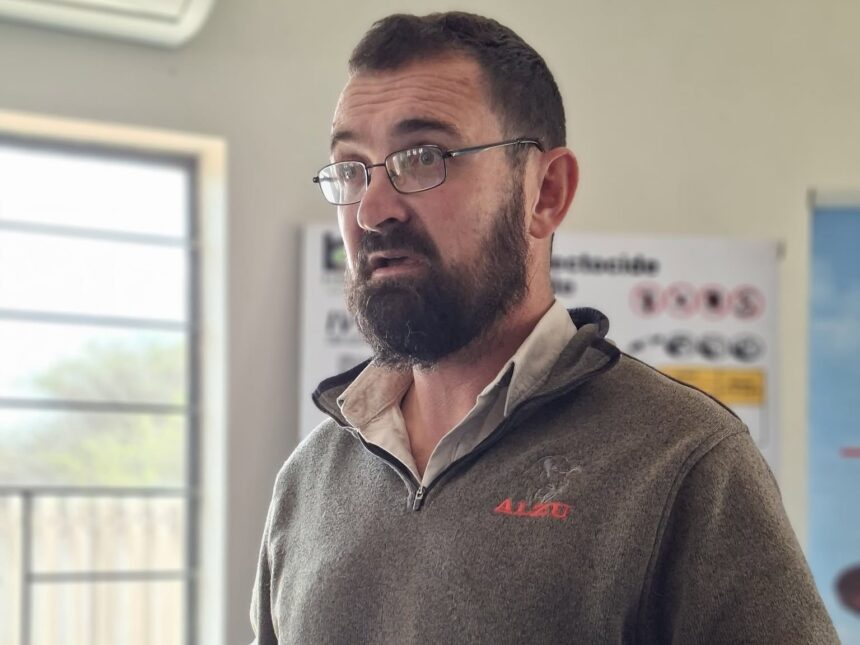
The Department of Agriculture and Rural Development, in collaboration with NTK and Alzu, is hosting a Farmers’ Day today at Makobe Tribal Hall in Mogalakwena, within the Waterberg District, with a focus on strengthening farmers’ knowledge and practical skills in poultry production. The initiative brings agricultural experts closer to farmers who are involved in or interested in broiler and layer production. Participants are receiving practical guidance on important aspects of managing poultry enterprises throughout the production cycle. The engagement also gives farmers an opportunity to ask questions and receive technical advice based on the challenges they encounter in their own operations. By combining expert knowledge with direct interaction, the Farmers’ Day is helping producers build the skills needed to improve flock health, productivity and overall farm management.
Farmers are receiving training from experts representing Alzu, NTK and Kyron Agri, with discussions covering several factors that influence successful poultry production. The sessions are designed to give farmers practical information that they can apply when managing their broiler and layer houses. Participants have also been able to raise questions about poultry management and receive responses from specialists with technical knowledge of the industry. This direct engagement is particularly useful for farmers who may encounter production problems but are unsure about their underlying causes. Access to reliable technical information can help producers avoid preventable mistakes and improve the consistency of their poultry operations.
Temperature and ventilation in poultry housing have emerged as important areas of focus during the training. Farmers were advised against using coal as a primary heat source for chickens because smoke can negatively affect air quality inside poultry houses. Coal combustion can also reduce available oxygen and produce carbon monoxide, creating dangerous conditions for birds. Maintaining suitable temperatures while ensuring adequate ventilation is therefore essential for creating a healthier environment for poultry. Farmers were introduced to the commonly used red heat lamp as a practical heating option, with guidance that the lamp should be positioned approximately one metre above ground level.
Proper temperature management is especially important because poultry are sensitive to environmental conditions, particularly during the early stages of growth. Chicks require appropriate warmth, but excessive heat can also create stress and negatively affect flock performance. Farmers therefore need to monitor conditions inside poultry houses rather than relying only on a fixed heating arrangement. Ventilation must work alongside heating to maintain air quality while preventing conditions that are too cold for the birds. Understanding this balance can help farmers create housing conditions that support healthy growth and reduce environmental stress within the flock.
Kevin Pieterse from Kyron Agri emphasised the importance of management in determining the success of a poultry enterprise. His message highlighted that good flock performance depends on several factors working together rather than one intervention being responsible for production results. These factors include chick quality, lighting, ventilation, temperature, access to sufficient water and feed troughs, bedding, stocking density, cleaning and disinfection. Farmers need to monitor each of these areas consistently because a weakness in one aspect of management can affect the health and performance of the entire flock. Strong daily management therefore forms an essential foundation for productive broiler and layer farming.
Chick quality is one of the factors that can influence the development and performance of a flock from the beginning of the production cycle. Farmers also need to provide suitable lighting programmes and ensure that birds have adequate access to clean water and feed. Stocking density requires careful attention because overcrowding can affect bird movement, access to resources, air quality and overall welfare. Bedding should be maintained properly to help manage moisture and hygiene inside the poultry house. Regular cleaning and disinfection are equally important because poor hygiene can increase the risk of disease and compromise flock health.
Pieterse also stressed the importance of identifying the underlying causes when birds experience health or production problems. His statement, “You treat the disease and the deficiency,” reinforces the need for farmers to look beyond the visible symptoms of illness. A disease may require treatment, but nutritional deficiencies or weaknesses in management can also contribute to poor flock health and reduced productivity. Farmers therefore need to assess factors such as feed quality, water availability, housing conditions, ventilation and general management when investigating problems. Identifying and addressing these deficiencies can help reduce recurring problems and support better flock performance over time.
The training also demonstrates why poultry production requires consistent attention throughout the entire production cycle. Farmers cannot rely on a single intervention to maintain healthy and productive birds because housing, nutrition, hygiene, environmental conditions and flock management are closely connected. Small problems can become more serious when farmers fail to identify them early or do not maintain proper management routines. Regular observation allows producers to notice changes in bird behaviour, feed and water consumption, growth and general health. Responding promptly and seeking professional advice where necessary can help farmers protect their investment and improve production outcomes.
The collaboration between the Department of Agriculture and Rural Development, NTK, Alzu and Kyron Agri provides farmers with access to different areas of agricultural expertise through one practical engagement. Such partnerships can help bridge the gap between technical knowledge and the realities faced by producers at farm level. Farmers can gain useful information while also raising specific concerns and learning how recommended practices can be applied in their own poultry houses. Continued farmer training is important as poultry producers work to improve productivity while managing input costs, animal health risks and operational challenges. Building practical skills can also support farmers who want to develop poultry production into a stronger and more sustainable agricultural business.
The Farmers’ Day at Makobe Tribal Hall reinforces the importance of informed management in successful broiler and layer production. The discussions on heating, ventilation, flock health, nutrition, hygiene, stocking density and general management provide farmers with practical knowledge that can be applied beyond the training session. The emphasis from Kevin Pieterse on addressing both disease and deficiencies also highlights the need to investigate the reasons behind poor flock performance rather than focusing only on immediate symptoms. Effective poultry farming requires farmers to monitor their birds consistently and maintain suitable conditions throughout the production cycle. Through continued collaboration, training and access to agricultural experts, initiatives such as this can help farmers strengthen their poultry enterprises and build more productive, sustainable and commercially viable farming operations.
Join 'Farmers Mag' WhatsApp Channel
Get the latest Farming news and tips delivered straight to your WhatsApp
CLICK HERE TO JOIN