

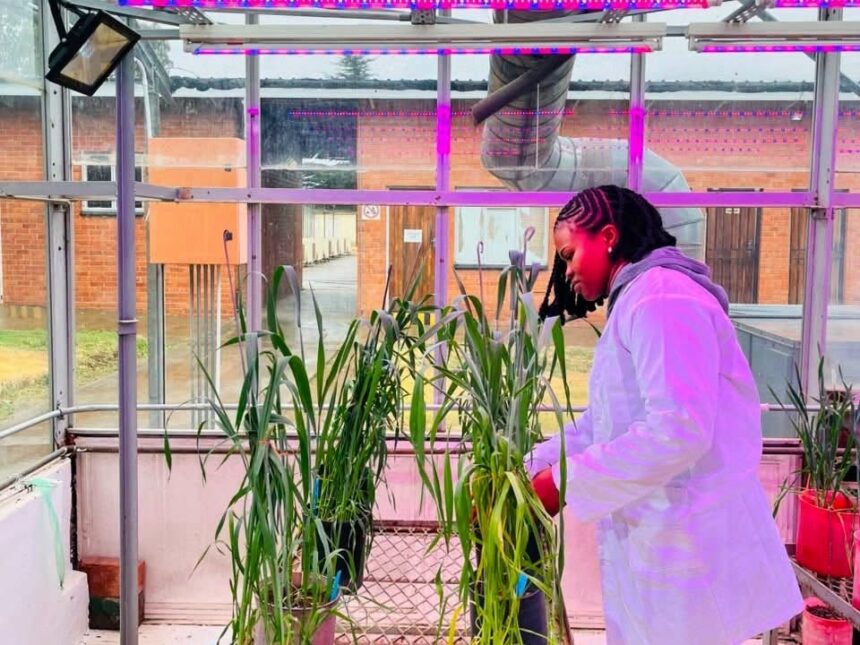
Developing a new wheat variety is a long process that requires breeders to grow plants, assess their characteristics, select the best performers and produce seed for another generation. A single generation of wheat can take about six months to grow, produce seed and be harvested under conventional conditions. When breeders need to repeat this process across several generations, developing a new variety can take many years. This lengthy process can delay the introduction of wheat varieties with improved yield, disease resistance, quality and adaptability. Researchers at ARC Small Grain are working to shorten this timeline through speed breeding technology, giving wheat breeders an opportunity to move through generations much faster.
Speed breeding uses carefully controlled growing conditions to accelerate the development of plants. At ARC Small Grain, researchers use a specialised glasshouse where temperature, light and other environmental conditions can be managed to encourage wheat plants to develop more rapidly. Special lighting plays an important role because the duration and quality of light can influence plant development and flowering. Under these controlled conditions, wheat plants can reach flowering and produce seed sooner than they would under conventional growing conditions. This means breeders can reduce the time between one generation and the next and make more progress within the same period.
The importance of reducing the wheat breeding cycle becomes clearer when considering how many generations breeders may need to develop a new variety. Breeders must repeatedly evaluate plants and select those with desirable characteristics, which can include strong yields, resistance to diseases, tolerance to environmental stresses and suitable grain quality. Each generation provides another opportunity to identify plants carrying combinations of useful traits. However, conventional growing conditions mean breeders must wait for plants to mature before they can harvest seed and begin the next generation. Speed breeding reduces this waiting period, allowing researchers to move through the selection process at a much faster pace.
The technology can also help breeders respond more quickly to changing agricultural conditions. Wheat production faces challenges linked to diseases, changing weather patterns, water availability and other environmental pressures. Farmers need varieties that can perform reliably under the conditions they experience in their production regions. Developing these varieties through traditional breeding can take years, which means there can be a significant delay between identifying a challenge and releasing improved genetic material. By accelerating plant development, speed breeding can help researchers advance promising breeding lines more quickly and potentially shorten the path towards varieties that address emerging agricultural needs.
Controlled environments provide another important advantage because researchers can create consistent conditions for plant development. Field environments are affected by factors such as temperature fluctuations, rainfall and seasonal changes, which can make it difficult to control when plants reach particular stages of development. A speed breeding glasshouse allows researchers to manipulate growing conditions and create an environment designed to encourage rapid development. This gives breeders greater flexibility when planning breeding programmes and producing seed. It can also allow researchers to conduct breeding work during periods when outdoor conditions would normally limit plant growth.
For wheat breeders, faster generation turnover does not mean that careful selection becomes less important. Researchers still need to evaluate plants and identify breeding material with valuable characteristics. Speed breeding simply allows those generations to be produced more quickly, giving breeders more opportunities to make selections within a shorter timeframe. The resulting plants still need to undergo appropriate testing and evaluation before a variety can be considered suitable for farmers. This distinction is important because accelerating the biological development of a plant does not remove the need for rigorous breeding, testing and quality assessment.
The work at ARC Small Grain demonstrates how controlled-environment technology can support agricultural research in South Africa. Wheat remains an important crop, making continued efforts to improve its production valuable for farmers, consumers and the wider agricultural sector. Breeding programmes need to balance productivity with characteristics such as disease resistance, grain quality and adaptation to local growing conditions. Faster breeding cycles can give researchers additional flexibility when working towards these goals. The technology therefore represents an important research tool that can complement conventional breeding approaches rather than replace them.
Speed breeding may also help researchers make better use of time and resources within long-term breeding programmes. When each generation takes several months, researchers have a limited number of opportunities to advance breeding material during a year. Cutting the time required to reach flowering and produce seed can increase the number of generations that researchers can work through over the same period. This can accelerate the identification and development of promising wheat lines. More rapid generation turnover could ultimately help breeding programmes respond faster to the needs of farmers and the agricultural industry.
The potential benefits extend beyond the laboratory or glasshouse because the ultimate purpose of wheat breeding is to develop varieties that can perform effectively in real farming conditions. Improved varieties can support farmers by offering stronger performance against diseases, better adaptation to environmental conditions or improved production characteristics. However, promising material developed through speed breeding still needs to be assessed carefully under relevant field conditions. Researchers must determine whether the characteristics identified under controlled conditions translate into reliable performance in agricultural environments. This process ensures that faster breeding does not come at the expense of quality or practical value for farmers.
The use of a speed breeding glasshouse at ARC Small Grain highlights the growing role of technology in agricultural research. Modern breeding programmes increasingly combine traditional plant breeding knowledge with controlled environments and other scientific tools to improve the efficiency of crop development. Faster generation cycles can help researchers make selections sooner and move useful genetic material through breeding programmes at an accelerated pace. This is particularly valuable when agriculture faces increasing pressure to produce food efficiently while adapting to changing environmental conditions. By investing in technologies that reduce the time required to develop wheat generations, agricultural research institutions can strengthen their ability to support future crop improvement.
Speed breeding does not mean that a new wheat variety will be developed overnight, but it can significantly improve the pace of an inherently lengthy process. A wheat generation that traditionally takes about six months can potentially be completed much sooner under carefully managed speed breeding conditions. Repeating that time saving across multiple generations can make a meaningful difference to the overall breeding timeline. The work being undertaken at ARC Small Grain shows how controlled lighting and glasshouse conditions can help researchers move wheat breeding programmes forward more efficiently. By shortening the time between generations while maintaining careful selection and evaluation, speed breeding could help bring improved wheat varieties closer to farmers who depend on productive and resilient crops.
Join 'Farmers Mag' WhatsApp Channel
Get the latest Farming news and tips delivered straight to your WhatsApp
CLICK HERE TO JOIN




