

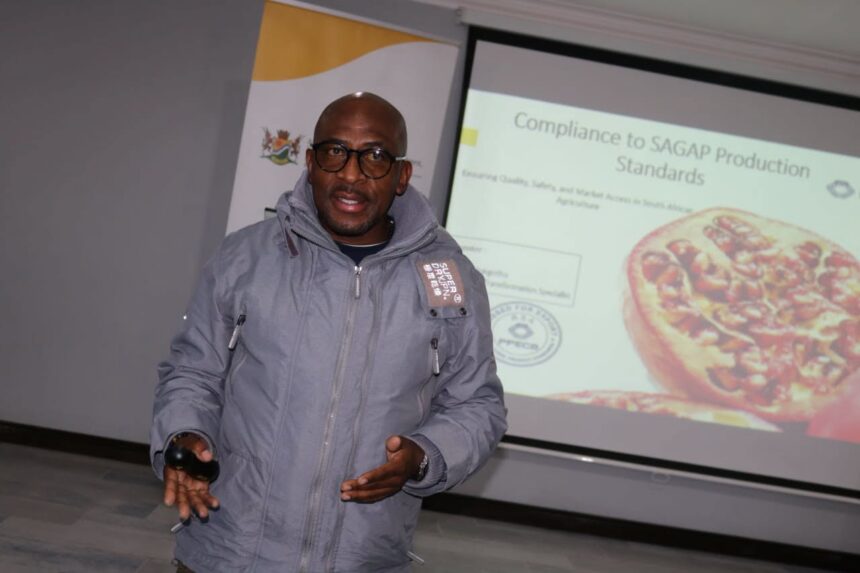
The Perishable Products Export Control Board (PPECB) and the Department of Agriculture, Rural Development, Land and Environmental Affairs (DARDLEA) have taken their ongoing South African Good Agricultural Practices (SA GAP) workshop programme to Nkangala District, bringing important agricultural knowledge closer to producers in KwaMhlanga and surrounding areas. The engagement brought together farmers, municipal officials and other agricultural stakeholders to strengthen understanding of the SA GAP framework and its role in improving farming practices. For producers seeking to expand beyond informal markets, understanding recognised agricultural standards can be an important step towards accessing formal buyers. The workshop focused on practical areas that can help farmers improve farm management, maintain proper records and strengthen traceability. It also highlighted how responsible production practices can support sustainable agriculture while creating opportunities for farmers to participate in more structured agricultural value chains.
SA GAP certification is designed to promote good agricultural practices that support the production of safe, quality agricultural products while encouraging responsible management of farming operations. The framework covers important areas such as traceability, record keeping, food safety, responsible use of agricultural inputs and environmental management. Farmers who follow these practices can strengthen their ability to demonstrate how their products were produced and handled. This information can be particularly important when dealing with formal buyers who require evidence that producers meet specific quality and safety standards. By building farmers’ understanding of SA GAP, workshops such as the one held in Nkangala can help producers prepare their businesses for greater participation in formal agricultural markets.
The involvement of farmers from KwaMhlanga and surrounding areas makes the training particularly relevant to producers who want to strengthen their operations and explore new market opportunities. Formal markets can provide farmers with access to larger and potentially more consistent customer bases, but they often require producers to meet specific standards. These requirements can include proper documentation, consistent production practices, food safety controls and systems that allow products to be traced through the supply chain. Farmers who understand these requirements can begin putting appropriate systems in place before approaching potential buyers. SA GAP training can therefore provide practical guidance for producers who want to move towards more structured and commercially sustainable farming enterprises.
Traceability is one of the key principles associated with good agricultural practices because it allows agricultural products to be tracked through different stages of production and handling. Farmers need to know where their products came from, how they were produced and where they were sent after leaving the farm. Maintaining this information can help identify problems quickly if a food safety or quality concern arises. Traceability systems can also provide buyers with greater confidence because they can verify important details about the products they purchase. For farmers, developing reliable traceability procedures can strengthen farm management while making it easier to meet the requirements of formal supply chains.
Record keeping is another important element of SA GAP and can make a significant difference to how farmers manage their businesses. Producers should maintain accurate records of relevant activities such as planting, input use, chemical applications, harvesting and other production processes. Good records provide evidence that farming practices are being managed responsibly and can help farmers identify patterns within their own operations. They can also make it easier to investigate problems, plan future production and demonstrate compliance during assessments. Although maintaining records requires consistency and discipline, it can help transform farming from an informal activity into a more structured and professionally managed business.
Sustainable farming was also central to the message of the workshop because agricultural production depends on the responsible use of natural resources. Farmers rely on healthy soil, clean water and productive ecosystems to maintain their operations over the long term. Poor management of these resources can reduce productivity and create environmental problems that become increasingly difficult and expensive to address. Good agricultural practices encourage farmers to consider how their production methods affect soil health, water resources and the surrounding environment. Adopting sustainable practices can help producers protect the resources they depend on while maintaining productive farms for future generations.
The workshop also provided an opportunity for agricultural stakeholders to share experiences and discuss some of the practical challenges farmers face when working towards certification. Understanding a standard is important, but farmers also need guidance on how to introduce the required systems into their daily operations. Some producers may need to improve their record keeping, strengthen traceability procedures or review how they manage inputs and farm workers. Engagements with technical experts can help farmers identify gaps and determine practical steps towards meeting the relevant requirements. Bringing producers and agricultural officials together also creates an opportunity to discuss challenges that may require additional support or follow-up.
Municipal officials and other agricultural stakeholders play an important role in strengthening the support available to farmers in local communities. Agricultural development involves more than production alone because farmers also need access to infrastructure, markets, technical knowledge, finance and other services. Collaboration between government departments, municipalities, agricultural organisations and producers can help improve coordination and reduce gaps in support. When farmers know where to obtain information and assistance, they are better positioned to respond to production and market challenges. The Nkangala workshop therefore provided more than technical training, as it also strengthened connections between producers and the institutions involved in agricultural development.
Improved market access remains one of the strongest incentives for farmers to understand and adopt SA GAP principles. Formal retailers, processors and other buyers often require producers to demonstrate that their products meet specific safety and quality standards. Certification can help provide that assurance, although farmers must still maintain the required practices consistently after certification. For producers, entering formal markets can create opportunities to increase sales, expand production and build more stable agricultural businesses. However, market access also brings greater responsibility because farmers must meet buyer requirements and maintain reliable standards throughout the production cycle.
For emerging and small-scale farmers, the transition towards formal markets can appear challenging, particularly when certification requirements involve new systems and additional documentation. Workshops can help make the process more understandable by breaking down the requirements and showing farmers how good practices can be incorporated into everyday farm management. Producers can start by improving basic systems such as record keeping, input management, worker safety and product traceability. These improvements can strengthen the overall operation even before a farmer completes the certification process. With continued technical support and practical guidance, more farmers can become better prepared to participate in formal agricultural value chains.
The SA GAP workshop in Nkangala also reinforces the importance of continued farmer education as agricultural markets become increasingly focused on quality, safety, transparency and sustainability. Producers who understand these expectations are better positioned to adapt their businesses and respond to changing market requirements. Strong agricultural standards can benefit farmers and consumers by promoting safer products and more responsible production practices. At the same time, farmers need accessible support to ensure that standards do not become barriers to participation but instead provide a pathway towards stronger businesses and improved market opportunities. Ongoing collaboration between PPECB, DARDLEA, municipalities and farmers can help achieve this balance.
The decision by PPECB and DARDLEA to take the SA GAP workshop to KwaMhlanga and surrounding areas demonstrates the value of bringing agricultural training directly to farming communities. The engagement has given producers an opportunity to understand how sustainable farming, traceability and proper record keeping can strengthen their businesses and improve their chances of accessing formal markets. For farmers, SA GAP is not simply about meeting certification requirements, but about establishing systems that can improve farm management and build buyer confidence. Continued capacity building will be important for helping more producers understand the framework and work towards meeting its requirements. As these efforts continue across Nkangala District, stronger adoption of good agricultural practices could contribute to more sustainable farms, better market access and a more competitive agricultural sector.
Join 'Farmers Mag' WhatsApp Channel
Get the latest Farming news and tips delivered straight to your WhatsApp
CLICK HERE TO JOIN




