

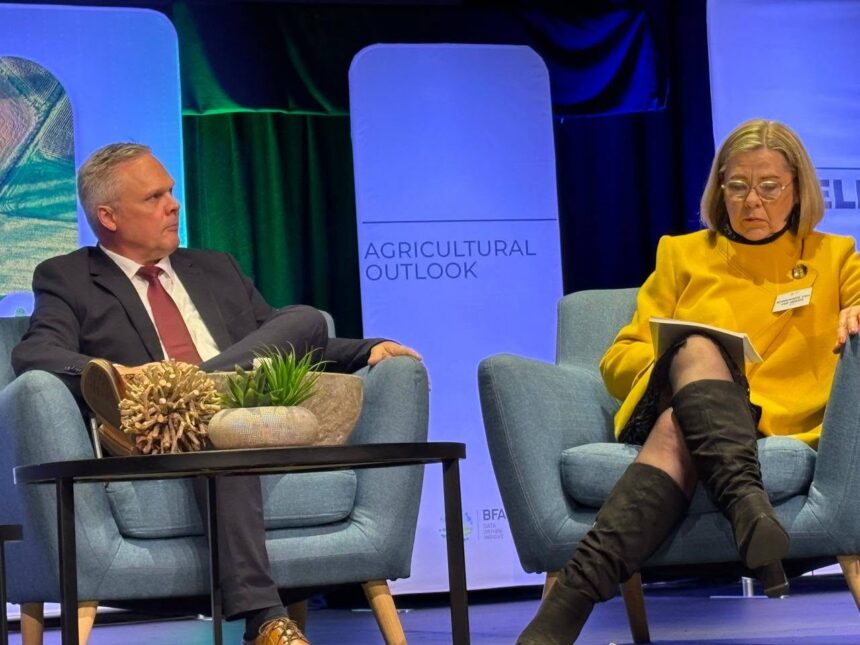
Minister Willie Aucamp delivered the Opening Keynote Address at the Bureau for Food and Agricultural Policy (BFAP) 2026 Baseline Report yesterday, highlighting the growing importance of reliable agricultural data and evidence in shaping the future of South Africa’s food and farming sector. His address placed strong emphasis on the role of the BFAP Baseline Report as a trusted investment compass for stakeholders across agriculture. The report provides valuable insights into long-term trends, policy choices, investment decisions and structural developments that could influence the sector in the years ahead. At a time when agriculture faces changing market conditions, production pressures and evolving policy requirements, access to credible information has become increasingly important. Minister Aucamp’s remarks reinforced the need for decision-makers to use evidence when developing strategies that support agricultural growth, food security and economic resilience.
The BFAP Baseline Report has become an important source of information for stakeholders seeking to understand the direction of South Africa’s agricultural sector. Its value extends beyond presenting statistics because it helps translate complex economic and agricultural trends into information that can support practical decision-making. Farmers, investors, policymakers, agribusinesses and other stakeholders need a clear understanding of expected developments when making decisions that may affect their operations over several years. Agricultural investments often require significant financial commitments and depend on factors such as market demand, production costs, trade conditions and policy certainty. By providing a structured assessment of these factors, the BFAP Baseline Report can help stakeholders assess risks and opportunities before making major decisions.
Minister Aucamp highlighted the report’s importance as an investment compass at a time when the agricultural landscape continues to change. South Africa’s agricultural sector operates within a complex environment influenced by domestic production, international markets, weather conditions, input costs, consumer demand and broader economic developments. These factors can affect farmers and agricultural businesses in different ways, making forward-looking analysis increasingly important. Reliable projections and evidence can help stakeholders identify potential challenges while also recognising areas where investment and innovation could support growth. The ability to anticipate structural changes can also help the sector prepare for developments rather than responding only after they have already affected agricultural operations.
Evidence-based planning is particularly important when considering the relationship between agriculture and food security. A sustainable food system depends on productive farmers, functioning value chains, reliable infrastructure and markets that can connect producers with consumers. Decisions made today can influence the availability and affordability of food in the future, which makes long-term agricultural planning essential. The information contained in reports such as the BFAP Baseline can contribute to a better understanding of the factors that influence food production and agricultural markets. This evidence can support more informed conversations about how South Africa can strengthen its food system while creating opportunities for producers and businesses.
The report also has relevance for agricultural investment because investors need to understand both current conditions and potential future developments. Investment decisions in agriculture can involve land, equipment, technology, processing facilities, irrigation systems, logistics and other long-term assets. Investors therefore need information that helps them assess whether particular opportunities are likely to remain viable as the sector changes. The BFAP Baseline provides analysis that can contribute to this assessment by highlighting expected structural developments and market trends. Minister Aucamp’s focus on the report as an investment compass therefore speaks to the broader need for greater certainty, planning and evidence across the agricultural economy.
Policy decisions also require reliable evidence, particularly when they involve changes that could affect farmers, consumers and agricultural businesses over an extended period. Policymakers must consider how regulations, trade arrangements, support programmes and other interventions could influence production and investment. Strong agricultural policy requires an understanding of the likely consequences of different choices rather than relying solely on short-term developments. The BFAP Baseline can help contribute to this process by providing analysis that places current issues within a longer-term agricultural and economic context. This can support more informed policy discussions and encourage decisions that balance immediate priorities with the need for sustainable sector development.
The importance of evidence becomes even clearer as South Africa’s agricultural sector responds to structural changes. Farmers and businesses are increasingly required to consider productivity, sustainability, technology, market access and changing consumer expectations. Climate and environmental pressures also reinforce the need for agricultural systems that can remain productive under changing conditions. These challenges require investment in new approaches, infrastructure, knowledge and technologies that can improve efficiency and resilience. Reliable agricultural analysis can help stakeholders understand where these pressures may create risks and where they may also present opportunities for innovation and growth.
Minister Aucamp’s keynote address therefore highlighted a broader principle that extends beyond the publication of a single annual report. A resilient agricultural sector requires collaboration between government, farmers, researchers, investors, agribusinesses and other stakeholders. Each group makes decisions that can influence the performance of the wider food and agricultural system. Shared access to credible information can help these stakeholders work from a stronger understanding of the challenges and opportunities facing the sector. The BFAP 2026 Baseline Report provides an important platform for these discussions by bringing evidence and forward-looking analysis into conversations about agriculture’s future.
The report’s role as an investment compass is particularly significant because agricultural development requires long-term thinking. Short-term market movements can influence immediate decisions, but sustainable agricultural investment depends on understanding deeper structural trends. Stakeholders need to consider how production systems, consumer demand, trade, technology, policy and investment conditions may evolve over time. By examining these developments through an evidence-based approach, the agricultural sector can improve its ability to plan for uncertainty. This can ultimately support investment decisions that strengthen productivity, competitiveness and resilience.
The BFAP 2026 Baseline Report also creates an opportunity for stakeholders to engage with the future of South African agriculture using a common evidence base. Such engagement is important because agricultural development involves interconnected decisions across the entire food value chain. What happens at farm level can affect processors, retailers, exporters, consumers and other businesses, while policy and market developments can influence farmers in return. Understanding these connections can help stakeholders make decisions that account for broader consequences rather than focusing only on individual interests. The discussions surrounding the report can therefore contribute to a more coordinated approach to addressing South Africa’s agricultural challenges.
Minister Willie Aucamp’s opening keynote ultimately underscored the value of evidence in building a stronger and more resilient agricultural sector. The BFAP 2026 Baseline Report offers stakeholders information that can support long-term policy choices, investment decisions and responses to structural changes affecting agriculture. In a sector where decisions often have consequences that extend across many years, reliable evidence can provide an important foundation for planning and investment. The report’s continued role as a trusted investment compass can help farmers, businesses, investors and policymakers better understand the road ahead. As South Africa works to strengthen food security, promote sustainable agricultural growth and build resilience, evidence-based decision-making will remain an essential part of preparing the sector for the future.
Join 'Farmers Mag' WhatsApp Channel
Get the latest Farming news and tips delivered straight to your WhatsApp
CLICK HERE TO JOIN




