

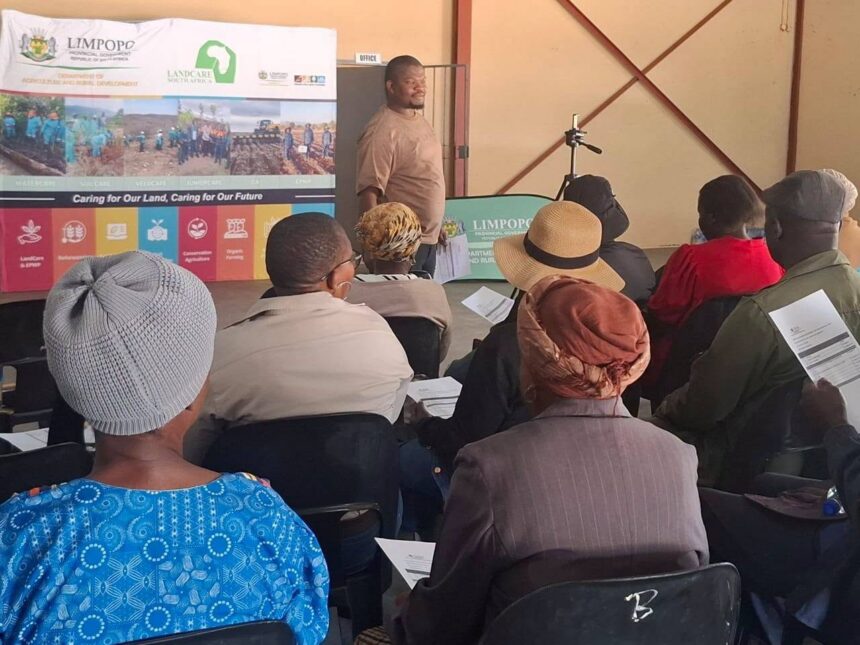
The Limpopo Department of Agriculture and Rural Development (LDARD) has stepped up efforts to help farmers prepare for the growing threat of veld fires and other climate-related disasters. Farmers from the Maruleng Local Municipality recently gathered at Itemeleng Packhouse for an awareness session focused on preventing and managing veld fires, which can cause serious damage to crops, livestock, grazing land and farming infrastructure. The session highlighted how veld fires can threaten food security, disrupt local economic activity and undermine the sustainability of agricultural businesses. Farmers were encouraged to strengthen their disaster preparedness and adopt practices that can reduce the risks associated with changing weather conditions. The engagement also reinforced the importance of cooperation between farmers, government authorities and local agricultural structures in responding to emergencies.
Agricultural Resource Technician Mokobane Samuel from the Mopani West Agro Ecological Zone explained that the awareness session was aimed at improving farmers’ understanding of disaster risk management. The need for this type of training has become increasingly important as climate change affects weather patterns and creates additional risks for agricultural communities. Farmers depend heavily on predictable environmental conditions, but droughts, extreme heat, floods and veld fires can quickly disrupt production plans and damage valuable resources. Providing farmers with information before disasters occur can help them make better decisions and reduce potential losses. The session therefore focused not only on responding to veld fires but also on building a stronger culture of preparedness across farming communities.
Veld fires pose a serious threat to agricultural production because they can spread rapidly across dry vegetation and grazing areas. A single uncontrolled fire can destroy grazing land, crops, fences, farm buildings, equipment and other important assets within a short period. Livestock can also be injured or killed when farmers cannot move animals to safe areas quickly enough. The loss of grazing can create additional pressure on farmers who depend on natural pastures to feed their livestock. Preventing fires and preparing for emergencies can therefore protect both the immediate agricultural operation and the wider food supply chain.
Representing the Mopani District Disaster Management Centre, Pheagane Makgopa encouraged farmers to develop the skills needed to respond effectively to different types of disasters. He highlighted the importance of training and preparedness when dealing with veld fires, droughts and floods. Farmers who understand emergency procedures can act more quickly when a disaster occurs and can make better decisions about protecting people, livestock, crops and infrastructure. Preparedness can also reduce confusion during emergencies because farmers and local response structures are more likely to understand their respective responsibilities. Makgopa’s message reinforced the need for farmers to view disaster management as an ongoing part of farm planning rather than an activity that only becomes important after a crisis begins.
The session also connected veld fire risk to the wider issue of climate change and environmental responsibility. Mphahlele Romeo from the LDARD Disaster Risk Management Directorate explained that certain human activities contribute to damage to the ozone layer and increased air pollution, which accelerate climate change. These environmental pressures can contribute to changing climatic conditions that create additional challenges for agricultural communities. Mphahlele urged communities to adopt environmentally responsible practices that protect natural resources and support the wellbeing of both current and future generations. His message highlighted the importance of recognising that environmental protection and agricultural sustainability are closely connected.
Farmers were also encouraged to become members of their local Farmers’ Protection Associations, commonly known as FPAs. These associations can help farmers coordinate their efforts to prevent and combat veld fires, particularly when fires spread across property boundaries. Effective cooperation is important because fires do not stop at farm boundaries and can quickly move from one property to another. By working through organised structures, farmers can improve communication, coordinate responses and strengthen collective preparedness. Mphahlele also reminded farmers that they must comply with the prescribed requirements for FPA membership and understand their responsibilities under the applicable legislation.
The National Veld and Forest Fire Act, 1998, Act No. 101 of 1998, places responsibilities on landowners regarding the protection of their properties against veld fires. Farmers therefore need to understand their legal obligations and take reasonable steps to reduce fire risks on their land. This includes preparing their properties and maintaining appropriate fire prevention and management measures. Compliance should not be viewed only as a legal requirement but also as an important part of protecting agricultural assets and neighbouring communities. Strong fire management practices can reduce the likelihood of uncontrolled fires and improve the ability of farmers to respond when fires occur.
Selekane Phahladira from LDARD Disaster Risk Management stressed the importance of paying close attention to weather warnings and seasonal forecasts. Early warning information can give farmers valuable time to prepare for conditions that may increase the risk of veld fires, droughts or other disasters. Effective communication channels are essential because warnings need to reach farming communities quickly and in a form that farmers can understand and act upon. Farmers who receive reliable information can adjust their activities, protect vulnerable resources and prepare emergency measures before dangerous conditions develop. Strengthening communication between authorities, agricultural organisations and farmers can therefore play an important role in reducing disaster-related losses.
Seasonal weather forecasts can also help farmers make informed decisions about their farming activities. Forecast information can guide decisions about planting, livestock management, water use and other activities that depend on expected weather conditions. Phahladira noted that above-normal temperatures are anticipated from October 2026 through early 2027, making preparation particularly important for farmers. Higher temperatures can increase pressure on water resources, dry out vegetation and potentially contribute to conditions that make veld fires more difficult to control. Farmers were therefore encouraged to gradually adopt climate-smart agricultural practices that can help reduce the impact of changing climatic conditions.
Climate-smart agriculture can include several practical approaches that help farmers improve resilience while maintaining productivity. Depending on the farming operation, these practices may include improved water management, soil conservation, appropriate crop selection, efficient irrigation and better management of grazing resources. Farmers can also consider ways to protect livestock from extreme weather and maintain sufficient resources for periods of reduced rainfall or increased temperatures. Gradual adoption is important because farmers have different levels of access to finance, technology and infrastructure. By introducing suitable practices over time, farmers can strengthen their resilience while continuing to manage the day-to-day demands of agricultural production.
The awareness session also demonstrated the importance of reporting disasters as quickly as possible. Phahladira urged farmers to report disasters promptly so that government authorities can assess the situation and determine what assistance may be available within their capacity. Early reporting can help officials understand the scale of an incident and identify affected communities, farms, livestock and infrastructure. It can also support more coordinated responses when several areas are affected by the same disaster. Farmers should therefore know the appropriate channels for reporting emergencies and should provide accurate information that can assist authorities in assessing the situation.
The engagement at Itemeleng Packhouse provided farmers in Maruleng with practical information that can help them prepare for a challenging agricultural environment. Veld fires remain a significant risk, but the discussion showed that farmers can take steps to reduce their vulnerability through planning, training, cooperation and responsible land management. The participation of officials from LDARD and the Mopani District Disaster Management Centre also demonstrated the importance of collaboration between agricultural and disaster management authorities. Farmers, government departments and community structures all have roles to play in protecting agricultural resources and maintaining food production. Continued awareness programmes can help ensure that farmers have access to updated information as weather patterns and disaster risks change.
The message from the awareness session is clear: disaster preparedness must become an integral part of sustainable farming in Limpopo. Farmers need to understand their responsibilities, monitor weather information, participate in local protection structures and adopt climate-smart practices that strengthen the resilience of their operations. Government agencies also need to continue providing training, early warnings and appropriate support so that farming communities can respond effectively when disasters occur. Protecting farms from veld fires is not only about preventing property damage, as it also helps protect livestock, food production, household incomes and local economic activity. By combining preparedness, responsible environmental practices and coordinated community action, farmers in Maruleng and across Limpopo can become better equipped to manage the growing risks associated with climate change.
Join 'Farmers Mag' WhatsApp Channel
Get the latest Farming news and tips delivered straight to your WhatsApp
CLICK HERE TO JOIN




