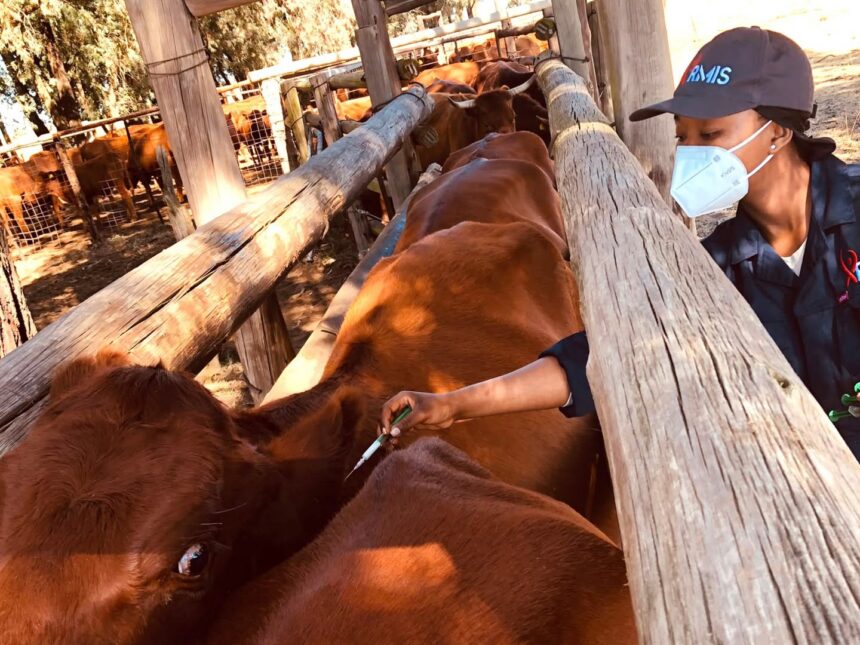
Protecting animal health is essential for maintaining a strong and sustainable livestock industry in South Africa. Disease outbreaks can have devastating consequences for farmers, reducing productivity, disrupting trade and threatening the livelihoods of thousands of people who depend on livestock farming. Preventing and controlling diseases such as Foot-and-Mouth Disease (FMD) requires coordinated action between government, industry organisations, veterinarians and farming communities. During June, Red Meat Industry Services (RMIS) demonstrated the power of this collaborative approach through a large-scale vaccination and livestock traceability campaign. The initiative not only protected thousands of animals from disease but also strengthened biosecurity systems that are critical for the long-term success of South Africa’s livestock sector.
Working alongside State Veterinarians, RMIS Animal Health Technicians carried out an extensive vaccination programme across Gauteng, the Free State and North West. During the month, the team successfully administered 36,856 vaccinations as part of ongoing efforts to combat Foot-and-Mouth Disease. This large-scale operation reflects the commitment of both the public and private sectors to preventing the spread of one of the livestock industry’s most serious diseases. Vaccination programmes remain one of the most effective tools available for reducing disease transmission and protecting vulnerable animal populations. Through careful planning and coordinated implementation, the campaign reached thousands of animals that contribute to South Africa’s beef and livestock production.
Foot-and-Mouth Disease is a highly contagious viral disease that affects cloven-hoofed animals, including cattle, sheep, goats and pigs. Although the disease rarely affects humans, it can spread rapidly among livestock and cause severe economic losses due to reduced productivity, movement restrictions and trade limitations. Outbreaks often lead to significant financial challenges for farmers while also affecting national and international markets. Effective disease control requires early detection, rapid response, vaccination where appropriate and strict biosecurity measures. Continued investment in disease prevention programmes is therefore essential for protecting both farmers and the broader agricultural economy.
Vaccination alone is not enough to maintain effective disease control. Accurate livestock identification and traceability play an equally important role in managing disease outbreaks and protecting animal health. To support the vaccination campaign, RMIS distributed 68,129 Industry Traceability Tags (ITTs) across five provinces. These tags help identify individual animals and allow authorities to trace livestock movements more efficiently when disease investigations become necessary. Strong traceability systems improve the speed and accuracy of disease response efforts while reducing the risk of widespread outbreaks.
Livestock traceability has become increasingly important as modern agriculture places greater emphasis on animal health, food safety and market access. Traceability systems allow authorities and producers to monitor where animals originate, where they move and how they interact with other livestock populations. During disease outbreaks, this information becomes critical for identifying affected areas and implementing targeted control measures. Effective traceability also increases confidence among local and international buyers by demonstrating that livestock can be monitored throughout the production chain. For South Africa’s livestock industry, strong traceability systems support both disease management and long-term export opportunities.
The partnership between RMIS Animal Health Technicians and State Veterinarians highlights the importance of coordinated action in protecting animal health. Disease prevention requires the combined expertise of veterinary professionals, technical advisors and livestock producers working toward a common objective. Animal Health Technicians provide valuable support by assisting with vaccination programmes, disease surveillance and farmer education while extending veterinary services into farming communities. Their collaboration with government veterinary officials strengthens national disease control programmes and ensures that resources are used effectively. Such partnerships improve the efficiency of animal health interventions while increasing their reach across different farming regions.
The success of the vaccination and traceability campaign was also made possible through the valuable support of the FirstRand Empowerment Foundation and Kagiso Trust. Their investment has helped strengthen animal health initiatives, biosecurity measures and livestock traceability systems across South Africa. Public-private partnerships play an increasingly important role in supporting agricultural development, particularly when addressing large-scale challenges that require significant resources and technical expertise. Financial support from development partners allows programmes like these to reach more farmers and protect larger livestock populations. Such collaboration demonstrates how shared investment can create meaningful benefits for the agricultural sector.
Improved animal health delivers benefits that extend well beyond individual farms. Healthy livestock are generally more productive, experience lower mortality rates and contribute to higher-quality meat production. Disease prevention also reduces veterinary treatment costs while helping farmers maintain stable production throughout the year. At a national level, strong animal health programmes protect food security, preserve export opportunities and strengthen consumer confidence in locally produced livestock products. Every successful vaccination campaign contributes to building a healthier and more competitive livestock industry.
Biosecurity remains one of the most important components of disease prevention in modern livestock farming. Farmers are encouraged to implement measures that reduce the risk of introducing or spreading infectious diseases within their herds. These practices include controlling animal movement, maintaining clean facilities, isolating new or sick animals and reporting suspected disease cases promptly. Vaccination programmes work most effectively when combined with good biosecurity management on individual farms. Educating producers about disease prevention remains an essential part of protecting South Africa’s livestock industry from future outbreaks.
The distribution of Industry Traceability Tags also supports the long-term development of a more modern and accountable livestock sector. Reliable animal identification systems improve livestock management while providing valuable production records that support breeding, marketing and herd management decisions. As technology continues to advance, traceability systems are expected to become even more important for both domestic trade and international market access. Investing in these systems today strengthens the industry’s ability to respond to future animal health challenges. It also creates a stronger foundation for sustainable livestock production across South Africa.
The achievements recorded during June demonstrate what can be accomplished through coordinated industry action. The administration of 36,856 vaccinations and the distribution of 68,129 Industry Traceability Tags reflect more than impressive statistics. They represent practical action that protects livestock, supports farmers and strengthens national disease control efforts. Every vaccinated animal and every traceability tag contributes to a more resilient agricultural sector capable of responding effectively to future disease threats. These efforts also reinforce the importance of collaboration between industry organisations, veterinary professionals, government departments and development partners.
The RMIS vaccination and traceability programme serves as a powerful example of how coordinated investment, technical expertise and strong partnerships can strengthen South Africa’s livestock industry. By working alongside State Veterinarians, supporting disease prevention through vaccination and expanding livestock traceability systems, RMIS is helping build a safer and more resilient future for livestock producers. The support provided by the FirstRand Empowerment Foundation and Kagiso Trust further demonstrates the value of collaborative investment in agricultural development. As South Africa continues strengthening its animal health systems and biosecurity measures, initiatives like these will remain essential for protecting farmers, supporting rural economies and maintaining confidence in the country’s livestock sector. Through continued cooperation and sustained commitment, the industry is creating stronger foundations for long-term animal health, food security and agricultural prosperity.
Join 'Farmers Mag' WhatsApp Channel
Get the latest Farming news and tips delivered straight to your WhatsApp
CLICK HERE TO JOIN