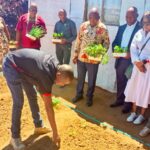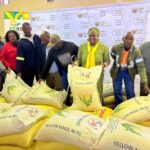
The National Department of Agriculture (DoA) continued its project monitoring programme across the Xhariep District on the second day of its official visit, reinforcing government’s commitment to supporting farmers and strengthening agricultural development in the Free State. Accompanied by the Xhariep District Extension and Advisory Services and technical officials from the Free State Department of Agriculture, Rural Development and Environmental Affairs (DARDEA), the delegation visited several agricultural projects to evaluate their progress and engage directly with farming communities. The monitoring exercise forms part of an ongoing effort to assess the effectiveness of government-funded interventions while identifying areas where additional support may be required. By interacting with farmers on the ground, officials are able to gain a clearer understanding of both the achievements and the challenges experienced by agricultural enterprises. The initiative reflects a practical approach to ensuring that government programmes continue to deliver meaningful benefits to farmers and contribute to sustainable rural development.
The primary objective of the monitoring visit is to evaluate projects implemented through the Xhariep Extension and Advisory Services while assessing whether government support has translated into measurable improvements for beneficiaries. Officials used the opportunity to engage directly with farmers, discuss production challenges and identify practical solutions that can further strengthen farming operations. These visits also provide valuable feedback that helps shape future agricultural policies and development programmes. Understanding the realities faced by farmers enables departments to make informed decisions about resource allocation and technical support. This collaborative approach ensures that public investments continue to support agricultural growth while improving food production and rural livelihoods.
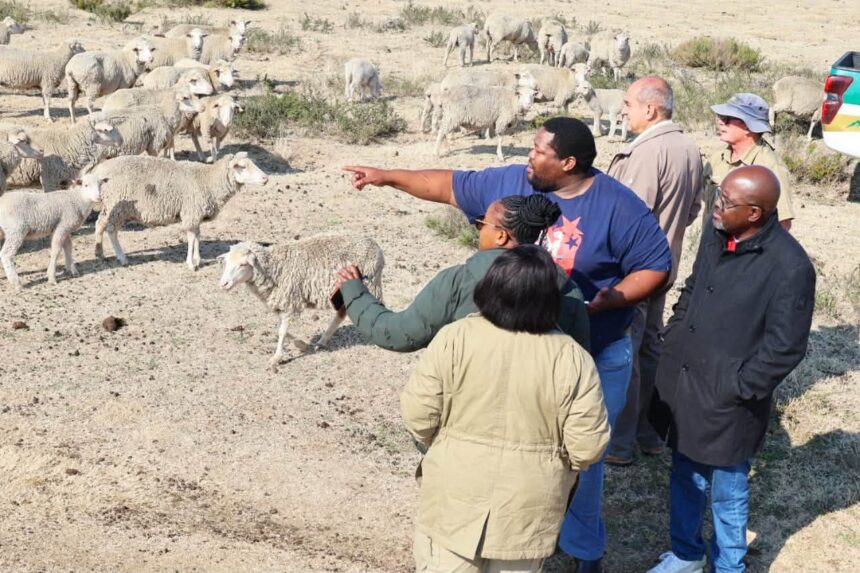
The first stop on the second day’s programme was in Edenburg, located within the Kopanong Local Municipality, where the delegation visited the farming enterprise of Mr Thato Thota. Mr Thota operates a livestock farming business on a 304-hectare municipal commonage under a formal lease agreement. His farming operation consists of both sheep and cattle, making effective grazing management and livestock health essential to the success of his enterprise. During the visit, officials observed how government support has contributed to the growth and sustainability of his farming activities. The visit provided an opportunity to assess the impact of previous interventions while discussing future development opportunities with the farmer.
Mr Thota’s farming journey demonstrates the value of consistent government investment in emerging agricultural enterprises. He has benefited from both financial assistance and technical support provided by DARDEA, enabling him to expand and improve his livestock operation. In recognition of his dedication and success, he was awarded the Provincial Young Farmer Award, an achievement that reflects his commitment to agricultural excellence. Rather than using the prize for short-term expenses, Mr Thota invested the award money in animal feed and medication, strengthening the health and productivity of his livestock. His responsible use of available resources highlights the importance of combining financial support with sound farm management practices.
Government interventions have significantly enhanced the efficiency of Mr Thota’s farming operation by providing essential agricultural equipment and infrastructure. Through departmental support, he has acquired mobile shearing equipment, mobile sheep and cattle handling facilities and a mobile sheep kraal. These assets improve livestock management while reducing labour requirements and operational costs. Additional support included the provision of a one-ton light delivery vehicle and a cattle trailer, allowing for easier transportation of livestock and farming equipment. Together, these investments have improved the productivity, efficiency and long-term sustainability of his farming enterprise.
Following the visit to Edenburg, the delegation travelled to the Zastron Commonage in the Mohokare Local Municipality, where they concluded the day’s programme. The Zastron Commonage includes the Mondague, Verliesfontein and Mooifontein farms, which together cover approximately 3,500 hectares of natural grazing land. The extensive grazing area supports numerous livestock farmers who depend on the commonage for cattle and sheep production. Officials assessed the condition of the grazing land while discussing management strategies with those responsible for overseeing the commonage. The visit demonstrated the importance of responsible land management in maintaining productive livestock farming systems.
Like many communal grazing areas, the Zastron Commonage faces challenges associated with high livestock numbers and increasing pressure on available grazing resources. Animals often graze on pasture that has not reached its full growth potential, creating concerns about long-term veld sustainability. To address this challenge, designated camps are reserved specifically for winter grazing and remain closed until approximately one month before the end of the grazing season. This rotational grazing approach helps preserve valuable pasture while ensuring livestock have access to quality forage during critical periods. Commonage managers also implement strategic livestock sales to reduce grazing pressure and prevent overstocking, helping maintain the health of the natural environment.
Livestock marketing plays an important role in the sustainability of the Zastron Commonage farming system. Farmers primarily market their livestock through established buyers such as Sparta Group and Karan Beef, providing reliable market access for producers. Having access to reputable buyers creates opportunities for farmers to generate stable income while managing herd sizes responsibly. Strategic marketing decisions also support better grazing management by encouraging timely livestock sales when grazing pressure increases. This balance between production and market access contributes to the long-term sustainability of the commonage and its farming community.
The Free State Department of Agriculture, Rural Development and Environmental Affairs has implemented several infrastructure projects at the Zastron Commonage to improve farming conditions. These interventions include the provision of mobile handling facilities for both small and large livestock, making animal management safer and more efficient. The department has also drilled a borehole, installed a windmill and water tank and developed livestock watering infrastructure to improve water availability across the grazing area. Additional investments include the eradication of invasive valbos vegetation and the construction of 12 kilometres of fencing, which supports better grazing management and livestock control. These improvements demonstrate government’s commitment to building productive agricultural infrastructure that supports long-term rural development.
At the conclusion of the second day’s monitoring programme, Ms Fezeka Matebeni from the National Department of Agriculture expressed satisfaction with the progress achieved by the agricultural projects visited throughout the Xhariep District. She noted that the developmental interventions implemented by government are producing positive results and making a meaningful difference in the lives of farmers. According to Ms Matebeni, the monitoring visit is intended to provide a deeper understanding of the realities faced by farming communities while ensuring that government support remains responsive to their evolving needs. She also commended DARDEA for consistently honouring its commitments in supporting agricultural development across the province. Her remarks reinforced the importance of accountability, collaboration and continuous improvement in delivering successful agricultural programmes.
The second day of the Xhariep District monitoring visit highlighted the positive impact that coordinated government support can have on agricultural development and rural livelihoods. From empowering individual farmers like Mr Thato Thota to investing in shared infrastructure at the Zastron Commonage, the initiatives demonstrate a practical commitment to strengthening the agricultural sector. The visits also provided valuable opportunities for government officials to engage directly with farming communities, assess ongoing challenges and identify future interventions that will enhance productivity and sustainability. By focusing on the entire agricultural value chain, from production to market access, the departments are helping create stronger and more resilient farming enterprises. The monitoring programme reaffirms the shared commitment of the National Department of Agriculture and DARDEA to revitalising agricultural projects, promoting sustainable rural development and creating lasting economic opportunities for farming communities across the Xhariep District.
Join 'Farmers Mag' WhatsApp Channel
Get the latest Farming news and tips delivered straight to your WhatsApp
CLICK HERE TO JOIN