Sustainable farming practices took centre stage as leading agricultural experts shared research and practical solutions aimed at helping farmers improve land management, increase resilience and adapt to changing environmental conditions. The presentations focused on science-based approaches that can strengthen agricultural productivity while protecting natural resources for future generations. Topics included sustainable grassland management, changing vegetation patterns in the Karoo, artificial intelligence tools for rainfall analysis and regenerative grazing practices that support climate resilience. The speakers emphasised that modern farming requires informed decision-making supported by scientific research and long-term environmental monitoring. By combining innovation with practical farming experience, these experts demonstrated how producers can better prepare for the challenges of climate change, drought and land degradation.
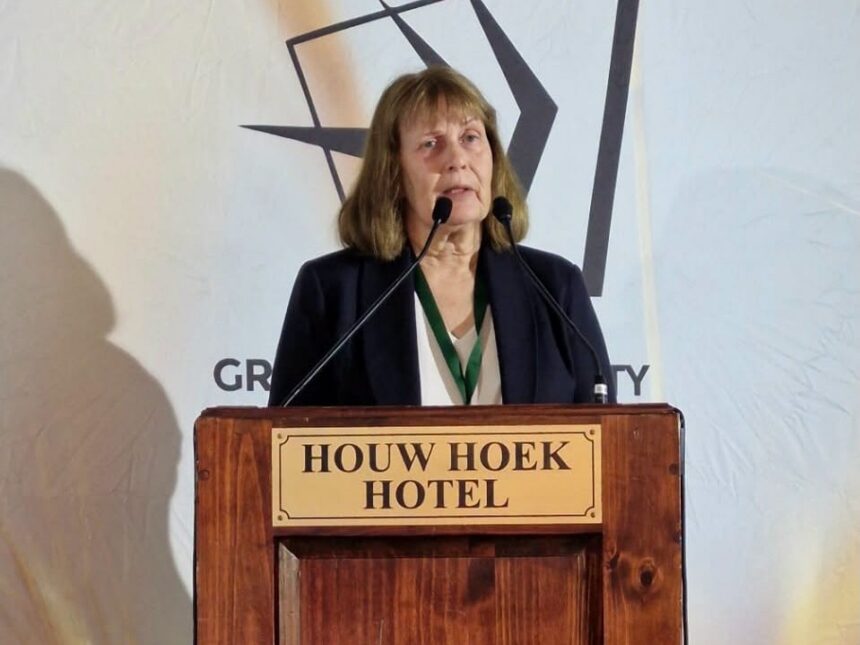
Professor Carol Baldwin of Kansas State University delivered an insightful presentation on the implementation of science management on farmland. Throughout the past two decades, she has dedicated her work to helping farmers, land managers and rural communities improve the health, resilience and sustainability of grasslands. Her research focuses on narrowing the gap between scientific knowledge and practical farming applications so that producers can make better decisions based on reliable evidence. Rather than allowing research to remain within academic institutions, Professor Baldwin advocates for making scientific findings accessible and useful to those working directly on the land. Her approach encourages stronger collaboration between researchers and farming communities, ensuring that scientific discoveries lead to meaningful improvements in agricultural practices.
Healthy grasslands are essential for successful livestock production, biodiversity conservation and long-term environmental sustainability. Well-managed grasslands provide nutritious grazing for livestock, improve water infiltration, reduce soil erosion and support a wide range of plant and animal species. Professor Baldwin explained that sustainable grassland management requires continuous observation of environmental conditions and careful adaptation to changing circumstances. Farmers who regularly monitor grazing pressure, rainfall and vegetation health are better equipped to maintain productive landscapes while protecting valuable natural resources. Applying scientific principles to everyday farming decisions can therefore improve both agricultural profitability and ecosystem health.
Dr Justin Du Toit, a specialist in semi-arid rangeland ecology, presented important research on the changing vegetation patterns across the Karoo. He explained that many areas are experiencing a significant shift from shrub-dominated landscapes towards increasing grass cover. Although greater grass growth may appear beneficial at first glance, the long-term ecological consequences require careful consideration. According to his research, these changes have the potential to fundamentally alter the balance of the Karoo ecosystem if they continue unchecked. Understanding these vegetation dynamics is essential for farmers who depend on healthy rangelands for livestock production.
One of the major concerns highlighted by Dr Du Toit is the possibility that the Karoo ecosystem could become permanently established in this new vegetation state. He warned that once this transition reaches a certain point, reversing it may become increasingly difficult. Long-term observations, combined with the Karoo grass, shrub and fire modelling exercise, suggest that increased grass cover leads to higher fuel loads across the landscape. As more dry grass accumulates, the likelihood of severe and widespread wildfires also increases. These fires can threaten grazing resources, infrastructure, livestock and biodiversity, making proactive veld management more important than ever.
Effective veld management depends on understanding environmental conditions and responding before problems become severe. Dr Du Toit’s research reinforces the importance of monitoring vegetation changes and adapting grazing strategies accordingly. Farmers who recognise shifts in grass and shrub composition can make informed decisions about stocking rates, rotational grazing and fire management. Such proactive management helps maintain healthy rangelands while reducing the risk of ecological degradation. Scientific monitoring therefore becomes a valuable tool for protecting both agricultural productivity and environmental sustainability.
To support better decision-making, Dr Du Toit introduced a freely available artificial intelligence supported rainfall analysis application that he developed together with Jock Danckwerts. The innovative tool allows farmers to analyse rainfall patterns using historical and current weather data. Users can monitor long-term rainfall trends, identify periods of below-average precipitation and assess drought risks before they become critical. Having access to this information enables farmers to adjust grazing management, water planning and stocking decisions based on reliable climate data. Digital tools such as this represent an important step towards more informed and climate-smart farming practices.
The growing role of artificial intelligence in agriculture is creating new opportunities for producers to improve farm management while reducing uncertainty. Accurate rainfall analysis helps farmers prepare for seasonal variability rather than reacting after drought conditions have already affected production. Better forecasting supports more efficient use of grazing resources and allows producers to protect veld condition during challenging seasons. These technologies are becoming increasingly valuable as climate change contributes to greater weather variability across southern Africa. Accessible decision-support tools ensure that scientific information reaches farmers in practical and useful ways.
Dr Amy Schroeder, an ecologist at The African Sustainability Company (TASC), delivered a remote presentation focusing on regenerative grazing and carbon initiatives across southern Africa. She explained how carefully managed grazing systems can improve soil health, restore degraded landscapes and contribute to climate change mitigation. Regenerative grazing encourages the natural recovery of vegetation while improving water retention, increasing biodiversity and supporting healthier ecosystems. Dr Schroeder also discussed the growing importance of carbon initiatives that reward landowners for restoring degraded land and increasing carbon storage within soils and vegetation. These approaches demonstrate how agricultural production and environmental conservation can work together to deliver both ecological and economic benefits.
The restoration of dry lands was identified as one of the most promising strategies for improving resilience in regions affected by climate change and land degradation. Large-scale restoration projects can rebuild soil fertility, improve vegetation cover and enhance the capacity of landscapes to withstand prolonged drought. Healthy ecosystems are better able to capture and store carbon while supporting productive grazing systems for livestock producers. Farmers who adopt regenerative management practices may also benefit from emerging carbon markets and sustainability programmes that recognise responsible land stewardship. Such initiatives provide additional incentives for producers to invest in long-term environmental management.
The presentations delivered by Professor Carol Baldwin, Dr Justin Du Toit and Dr Amy Schroeder highlighted the growing importance of science, innovation and sustainable land management in modern agriculture. From improving grassland health and understanding changing Karoo ecosystems to using artificial intelligence for rainfall analysis and promoting regenerative grazing, each presentation offered practical insights that farmers can apply to strengthen their operations. These science-based approaches help producers respond more effectively to climate challenges while protecting valuable natural resources for future generations. As agriculture continues to evolve, collaboration between researchers, farmers and environmental specialists will become increasingly important in building resilient farming systems. By embracing scientific knowledge and innovative technologies, farmers can improve productivity, reduce environmental risks and ensure the long-term sustainability of South Africa’s agricultural landscapes.
Join 'Farmers Mag' WhatsApp Channel
Get the latest Farming news and tips delivered straight to your WhatsApp
CLICK HERE TO JOIN