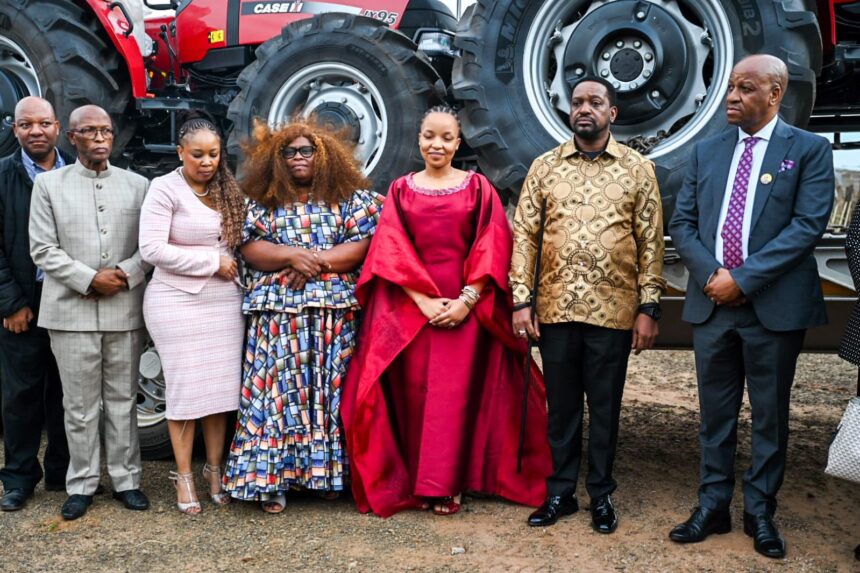
On 29 May, a major agricultural development initiative took place in KwaZulu-Natal as Premier Thamsanqa Ntuli, together with the MEC for the Department of Agriculture and Rural Development, officially handed over two tractors to AmaZulu King Misuzulu kaZwelithini. The tractors will support mechanisation programmes in Nongoma and uPhongolo, two rural areas where farming plays a central role in household survival and local economies. The event was held at the eMashobeni Royal Palace within the Pongola Local Municipality, bringing together traditional leadership and government in a shared effort to strengthen rural development. The initiative forms part of broader provincial efforts to improve food production and reduce poverty in under-resourced communities. It also reflects a growing focus on combining traditional authority structures with modern agricultural support systems.
The tractors are intended to be used by the King’s initiatives as well as agricultural cooperatives operating in Nongoma and Pongola. These areas have long depended on small-scale farming, where limited access to machinery has often restricted productivity. By introducing mechanised tools, the provincial government aims to increase efficiency in land preparation, planting, and overall crop management. The MEC for Agriculture and Rural Development, kaMadlopha-Mthethwa, explained that the programme aligns with the Premier’s vision of transforming rural landscapes into productive green fields filled with crops and vegetable gardens. She highlighted that mechanisation is not only about improving output but also about restoring dignity and economic opportunity in rural households that rely on agriculture for survival.
KaMadlopha-Mthethwa also linked the initiative to findings from the General Household Survey, which identified Zululand as one of the districts most affected by extreme hunger. She noted that many households in the region struggle with consistent access to food, making agricultural support a critical intervention. The two tractors form part of a larger fleet of 24 units that were procured earlier in the year by the provincial government. These machines are being distributed across rural districts to strengthen food security programmes and assist indigent communities. The MEC stressed that the goal is to ensure that rural farmers are equipped with the tools needed to produce more food locally, reducing dependency on external supply chains and improving household nutrition.
The involvement of the AmaZulu Kingdom adds significant cultural and administrative weight to the programme. Traditional leadership remains a key structure in rural KwaZulu-Natal, often serving as the link between government services and local communities. By placing resources under the stewardship of the King and local cooperatives, the initiative aims to ensure broader community participation and accountability. The tractors are expected to be deployed in farming activities that benefit multiple villages, rather than isolated projects, encouraging shared agricultural growth. This approach also supports cooperative farming models that can create employment and strengthen rural economies over time.
The handover event at eMashobeni Royal Palace symbolised more than a transfer of equipment. It represented a coordinated effort between government and traditional leadership to address long-standing challenges of hunger, unemployment, and underdevelopment in rural KwaZulu-Natal. Agriculture remains one of the most viable sectors for economic upliftment in the province, especially in areas where industrial opportunities are limited. By investing in mechanisation, the provincial government is attempting to unlock unused or underutilised land and turn it into productive farmland. The expectation is that increased yields will contribute to both household food security and small-scale commercial farming opportunities.
The handover of tractors to AmaZulu King Misuzulu kaZwelithini marks a practical step toward strengthening rural agriculture in KwaZulu-Natal. It reflects a targeted response to food insecurity challenges identified in vulnerable districts such as Zululand. Through mechanisation, government aims to improve productivity, support cooperatives, and expand access to sustainable farming tools. The collaboration between the provincial government and traditional leadership highlights a shared responsibility in driving rural transformation. If effectively managed, the initiative has the potential to improve food production, reduce hunger, and create long-term economic stability for farming communities in Nongoma, uPhongolo, and surrounding areas.
Join 'Farmers Mag' WhatsApp Channel
Get the latest Farming news and tips delivered straight to your WhatsApp
CLICK HERE TO JOIN