

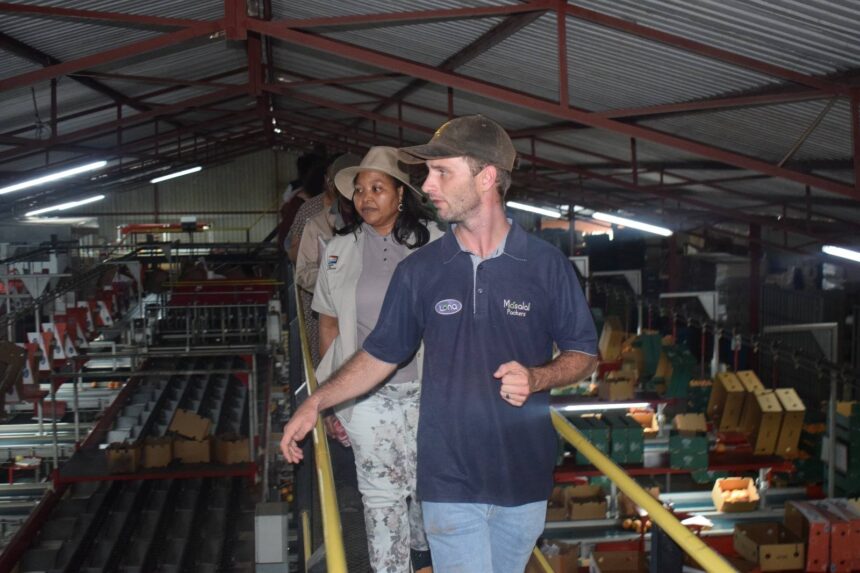
Limpopo’s agricultural sector continues to gain momentum as government and private sector collaboration strengthens large-scale farming projects across the province. A key example of this progress is the 450-hectare orchard development at Majeje Citrus Farm in Ba-Phalaborwa Local Municipality. The project recently hosted a Premier’s Economic Growth Advisory Council site visit led by the Limpopo Department of Agriculture and Rural Development Head of Department, Mme Mpho Mashamba. The visit took place on Tuesday, 29 April, and focused on monitoring implementation progress and assessing infrastructure development. It also highlighted the growing importance of catalytic agricultural projects in driving rural economic transformation. The visit reinforced government commitment to expanding agricultural production and agro-processing in Limpopo.
During the site visit, Mme Mpho Mashamba expressed strong appreciation for the level of stakeholder engagement and the investment already made at the Majeje Citrus Farm. She noted that the project is progressing steadily and delivering visible results that can be measured on the ground. Her remarks emphasized that the farm is not only meeting development expectations but also setting a benchmark for other agricultural projects in the province. She encouraged similar initiatives to study and replicate the operational model used at Majeje. The emphasis on benchmarking reflects a broader strategy to improve efficiency and outcomes across public and private agricultural investments. This approach is designed to ensure that successful projects become reference points for future development.
A major focus of the visit was the impact of the project on surrounding communities. Mme Mashamba highlighted that local residents are already benefiting from the economic activity generated by the farm. These benefits include employment opportunities, skills development, and indirect economic stimulation in nearby areas. The project is seen as a practical example of how agriculture can drive rural development and improve livelihoods. It also demonstrates how large-scale farming can integrate surrounding communities into formal economic systems. This aligns with government priorities aimed at reducing rural poverty through sustainable economic participation.
The Majeje Citrus Farm project forms part of a broader provincial vision to expand agricultural production and agro-processing in Limpopo. The 450-hectare development is designed to increase citrus output while also supporting value-added processing activities in the region. This integrated approach aims to strengthen the entire agricultural value chain, from production to market distribution. Infrastructure development remains a central focus, with key components including electricity supply, irrigation systems, administrative offices, and storage facilities. These elements are critical for ensuring long-term productivity and operational efficiency. The site visit allowed officials to assess progress in these areas and identify any implementation challenges.
Employment creation remains one of the most significant achievements of the project to date. In line with the priorities of the Government of National Unity, particularly job creation, the project has already generated 136 jobs. Of these positions, 72 have been filled by young people, while 47 are held by women. This reflects a strong commitment to inclusive economic participation and youth empowerment within the agricultural sector. The employment structure also shows progress toward gender representation in rural development projects. These outcomes highlight the role of agriculture as a direct driver of job creation in rural economies.
The project also supports broader transformation goals within Limpopo’s agricultural sector. It is aligned with efforts by the department to increase participation of black producers across the agricultural value chain. This includes ownership, production, processing, and distribution components of the sector. By supporting emerging and black-owned producers, the province aims to create a more inclusive and balanced agricultural economy. The Majeje Citrus Farm serves as a model for how large-scale agricultural investments can be structured to support transformation. It demonstrates how targeted development can shift participation patterns in historically unequal sectors.
Infrastructure development at the farm remains a key priority for sustaining growth and productivity. Reliable electricity is essential for irrigation systems, processing equipment, and cold storage facilities. Efficient water management systems are also critical for maintaining citrus production across the 450-hectare site. Administrative offices support coordination and operational management, while storage facilities ensure product quality and market readiness. These infrastructure components are designed to support both short-term productivity and long-term expansion. Continued investment in these systems will determine the farm’s ability to scale successfully.
The visit to Majeje Citrus Farm reflects a broader government strategy focused on catalytic projects that deliver measurable economic impact. These projects are designed to stimulate rural development, create employment, and attract private sector investment. They also serve as anchors for regional economic growth by linking agriculture with infrastructure development and market access. Limpopo’s approach emphasizes practical implementation and ongoing monitoring to ensure that projects remain on track. This model supports accountability while encouraging continuous improvement in project delivery.
The Majeje Citrus Farm development stands as a strong example of how coordinated agricultural investment can transform rural economies. It combines job creation, infrastructure development, and community participation into a single integrated project. The involvement of government leadership through site visits ensures that progress is monitored and supported at a high level. As the project continues to expand, it is expected to play a significant role in strengthening Limpopo’s agricultural output and economic base. Its success reinforces the importance of collaboration between government, industry, and local communities in achieving sustainable development outcomes.
Join 'Farmers Mag' WhatsApp Channel
Get the latest Farming news and tips delivered straight to your WhatsApp
CLICK HERE TO JOIN




