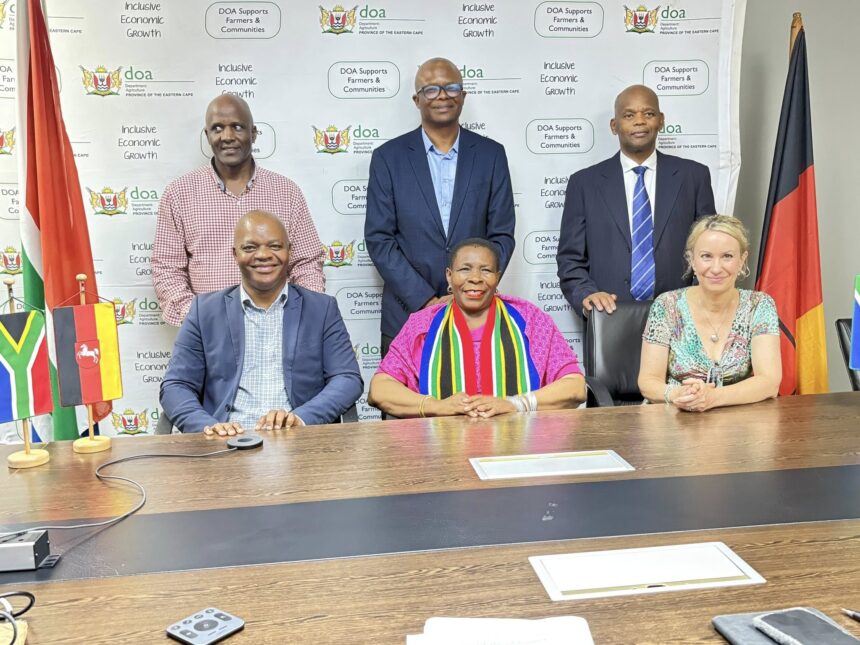
The Eastern Cape Department of Agriculture has taken a significant step in strengthening international collaboration through the signing of a Memorandum of Understanding with the Ministry for Food, Agriculture, and Consumer Protection of Lower Saxony, Germany. Agriculture MEC Nonceba Kontsiwe formalised this agreement alongside Minister Miriam Staudte, marking a renewed commitment to shared agricultural development goals. This Joint Declaration of Intent represents a clear and structured understanding between the two parties, focusing on long-term cooperation and mutual benefit. The ceremony, held at the Eastern Cape Rural Development Agency building in Qonce, brought together key stakeholders to witness a partnership designed to enhance agricultural growth and innovation. This agreement builds on years of cooperation and sets a strong foundation for future progress in the sector.
The partnership focuses on several critical areas that are essential for strengthening agriculture in the Eastern Cape. These include agricultural development, institutional capacity building, human capital development, and advancements in research and technology. By addressing these areas, the agreement aims to improve productivity, strengthen systems, and ensure that the agricultural sector remains competitive and sustainable. Production agriculture is a key component, with a focus on improving farming practices and increasing output across both smallholder and commercial operations. The agreement also places importance on developing professional staff, ensuring that those working within the sector have the skills and knowledge needed to support ongoing growth.
Institutional and human capacity development form a central part of the collaboration, reflecting the need to build strong systems and skilled individuals within the agricultural sector. Through training programmes, knowledge exchange, and professional development initiatives, the partnership aims to enhance the capabilities of agricultural workers, extension officers, and researchers. This approach ensures that improvements are not only made at the production level but are also supported by efficient management and governance structures. The inclusion of agricultural infrastructure development further strengthens the agreement, focusing on building and upgrading facilities according to required specifications. Proper infrastructure supports efficient production, storage, and distribution, all of which are essential for a thriving agricultural economy.
Research and technology development are also key pillars of the Joint Declaration of Intent, highlighting the importance of innovation in modern agriculture. By collaborating on research initiatives, both parties can explore new methods, technologies, and practices that improve efficiency and sustainability. This includes the implementation and management of agricultural projects that are aligned with global standards and local needs. The partnership also extends to social and rural development, recognising that agriculture plays a vital role in improving livelihoods and supporting communities. By integrating social development into agricultural planning, the agreement ensures that growth in the sector translates into real benefits for rural populations.
The principle of reciprocity is at the core of this agreement, with both sides committing to support and promote the success of the partnership within their respective capacities. This balanced approach ensures that knowledge, resources, and opportunities are shared in a way that benefits both the Eastern Cape and Lower Saxony. The involvement of representatives such as Inger Steffen, who attended the signing on behalf of the Lower Saxony Ministry, highlights the importance of continued engagement and collaboration at all levels. By fostering strong relationships and maintaining open communication, the partnership is positioned to deliver meaningful and lasting outcomes.
The signing of this Memorandum of Understanding marks a forward-looking step for agricultural development in the Eastern Cape. It reflects a commitment to building a stronger, more resilient sector through international cooperation, innovation, and capacity building. By focusing on key areas such as production, research, infrastructure, and human development, the agreement creates a comprehensive framework for growth. As both parties work together to implement the Joint Declaration of Intent, the partnership is expected to drive progress that benefits farmers, institutions, and rural communities. This collaboration stands as a clear example of how strategic partnerships can support sustainable agriculture and long-term economic development.
Join 'Farmers Mag' WhatsApp Channel
Get the latest Farming news and tips delivered straight to your WhatsApp
CLICK HERE TO JOIN