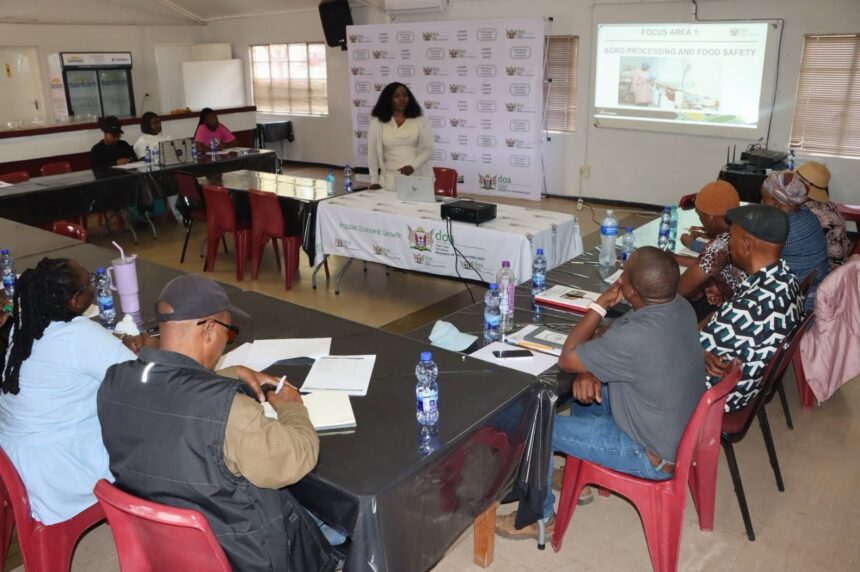
The Eastern Cape Department of Agriculture continues to strengthen its support for commercial farmers through a build-up programme focused on developing agricultural businesses and improving access to markets. The programme brings together farmers from different agricultural commodities for agribusiness training in marketing and agro-processing. It aims to help producers understand what the market expects and how they can improve the value and competitiveness of their products. Through this support, the department seeks to develop and implement a comprehensive commercialisation programme across five districts of the province. The broader goal is to help farmers build financially sustainable businesses while contributing to agricultural development and economic growth in the Eastern Cape.
The programme focuses on more than increasing agricultural production. Farmers also need the business knowledge and practical skills to sell their produce, meet market requirements and manage their operations effectively. Commercialisation requires producers to understand where their products will be sold, who their customers are and what standards buyers expect. Farmers must also identify ways to distinguish their products from competing goods in the market. By addressing these areas, the training aims to help producers move from mainly producing agricultural commodities to operating more structured and market-oriented agribusinesses.
Dr Mfusi Mjonono led the programme and outlined what the department hopes to achieve through its work with farmers. He highlighted the importance of understanding existing markets and knowing where farmers currently sell their produce. Producers also need to understand the requirements of different buyers and identify how their products can offer something distinctive. This includes paying attention to product quality, presentation, consistency and food safety. The programme encourages farmers to consider these factors as part of their overall business planning rather than treating marketing as an activity that only begins after harvesting.
Marketing knowledge plays an important role in helping farmers build reliable commercial operations. Producing good-quality crops or livestock products does not automatically guarantee access to profitable markets. Farmers need to understand customer expectations, supply requirements and the standards that apply to the products they sell. They must also consider how to maintain consistent production so that buyers can rely on regular deliveries. Stronger marketing skills can help producers make better business decisions, identify suitable opportunities and improve the long-term financial performance of their agricultural enterprises.
Babalwa Zangqa from TARDI presented on agro-processing and food safety, two important areas for farmers who want to increase the commercial value of their produce. TARDI provides training to farmers involved in different agricultural commodities and supports the development of their practical agribusiness knowledge. The presentation explained how food safety must be considered throughout the production process, starting with the soil and continuing through planting, harvesting, handling and processing. Maintaining safe practices at every stage helps protect consumers and supports the quality of agricultural products. It also helps farmers understand that food safety is an essential part of building a credible and competitive agricultural business.
Agro-processing offers farmers an opportunity to earn more from their agricultural production by turning raw commodities into products with added value. Instead of selling only unprocessed produce, farmers can explore ways to process their crops or other agricultural products into goods that may achieve higher market prices. This can improve the economic and commercial value of what they produce while creating opportunities to reach different customers. Processing activities can also create employment because additional workers may be needed for preparation, production, packaging and other related tasks. For farming communities, the development of agro-processing can therefore support both business growth and local job creation.
Zangqa also emphasised the need for farmers to follow the applicable agro-processing regulations and food safety requirements. The training highlighted Regulation 707, which addresses food hygiene and food safety standards under the Agricultural Products Standards Act, 1990 (Act 119 of 1990). Understanding and applying the relevant requirements is important for farmers who want to process and sell food products responsibly. Compliance helps producers maintain hygienic working conditions and protect the quality of their products. It can also strengthen buyer confidence and help farmers prepare their businesses for opportunities in more formal markets.
The programme further encouraged farmers to work together when supplying their products to the market. Cooperation can help individual producers combine their output and provide buyers with more consistent volumes. This is particularly important for farmers who may struggle to meet larger orders on their own or maintain regular supplies throughout the year. Working together can also create opportunities to share knowledge, improve planning and strengthen their position when engaging with buyers. By building stronger relationships with one another, farmers can work towards more reliable market participation and better commercial outcomes.
Farmer participation formed an important part of the training, with attendees engaging with the topics and sharing their own experiences. They discussed the challenges they face and the expectations they have as commercial farmers in the Eastern Cape. These discussions allowed participants to connect the information presented during the programme with the realities of running their agricultural businesses. Their contributions also highlighted the importance of training that responds to the needs of producers across different commodities. Open engagement can help farmers identify practical steps to improve their marketing, processing and food safety practices.
The commercialisation programme represents an important effort to support farmers beyond primary production. By combining agribusiness training, marketing knowledge, agro-processing skills and food safety awareness, the Eastern Cape Department of Agriculture aims to help producers develop stronger and more sustainable enterprises. The focus on cooperation and market requirements also encourages farmers to think about long-term business growth and consistent supply. As farmers apply these lessons, they can work towards improving the value of their products, expanding market opportunities and creating employment within their communities. Continued support and practical training will remain important in helping commercial farmers across the province build financially sustainable agricultural businesses.
Join 'Farmers Mag' WhatsApp Channel
Get the latest Farming news and tips delivered straight to your WhatsApp
CLICK HERE TO JOIN