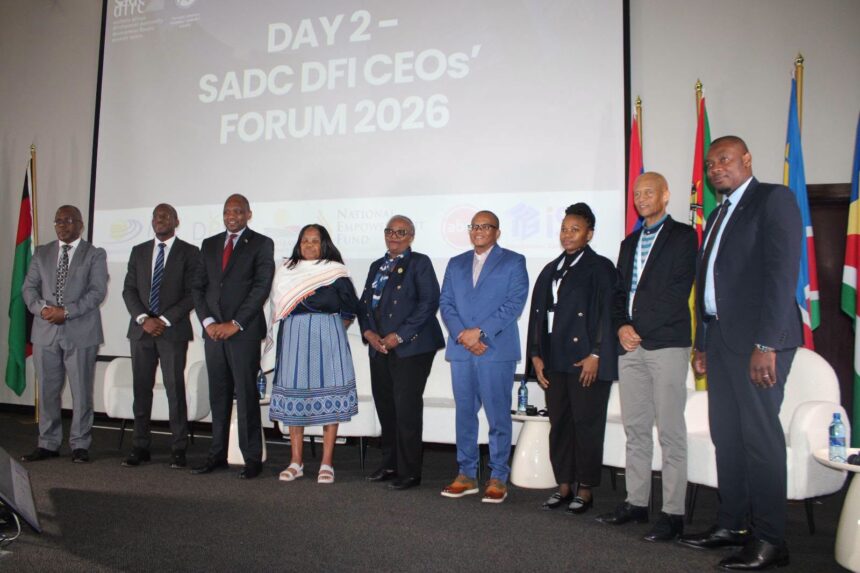
Food and nutrition security remains a major priority for Southern Africa as countries work to ensure that people have reliable access to sufficient, nutritious and affordable food. Speaking at the SADC-DFRC DFI CEOs’ Forum hosted at the Industrial Development Corporation (IDC), Deputy Minister Nokuzola Capa stressed that food and nutrition security cannot be achieved through one intervention or by one sector working alone. She described the issue as multifaceted and multidimensional, requiring governments, financial institutions, farmers, businesses and other stakeholders to coordinate their efforts. Her remarks placed greater emphasis on the need for long-term investment and cooperation across the Southern African Development Community (SADC) region. This approach is increasingly important as agricultural producers and food value chains face pressure to remain productive, competitive and resilient.
“Food and Nutrition Security is a multi-faceted and multidimensional matter which cannot be attained through a single approach,” said Deputy Minister Capa. The statement reflects the complex factors that determine whether communities can access food consistently and affordably. Food security depends not only on agricultural production but also on access to land, water, finance, infrastructure, markets, technology and reliable supply chains. Nutrition security adds another layer because producing enough food does not automatically guarantee that people have access to diverse and nutritious diets. Addressing these challenges therefore requires coordinated action that considers production, processing, distribution, affordability and household access to food.
For farmers, stronger coordination can have a direct impact on the conditions under which they produce and sell agricultural commodities. Farmers need access to finance that matches the realities of agricultural production, including the long periods between investment and returns that are common in farming. They also require infrastructure such as irrigation systems, storage facilities, roads, packhouses and processing facilities to reduce losses and improve their ability to reach markets. When these elements operate as part of a connected agricultural system, producers can have better opportunities to participate in formal value chains and respond to market demand. Greater coordination between institutions can also help reduce duplication and ensure that available resources reach areas where they can support sustainable agricultural activity.
Deputy Minister Capa also highlighted the importance of Development Finance Institutions in strengthening agricultural value chains and supporting farmers and agricultural SMMEs. These institutions can play an important role in providing funding for businesses that may require patient capital and structured financial support to grow. Agricultural SMMEs can include producers, processors, suppliers, aggregators and other businesses involved in moving food from farms to consumers. Supporting these enterprises can help create stronger connections between primary production and downstream activities such as processing, packaging, logistics and retail. A stronger value chain can create additional economic opportunities while helping agricultural products reach consumers in a more efficient and reliable way.
Investment in agriculture also needs to extend beyond individual farms. Food systems depend on a network of businesses and infrastructure that enables farmers to produce, store, transport, process and sell their products. Investment in irrigation, energy, logistics, storage and agro-processing can help address some of the constraints that limit agricultural growth. Financial support for agricultural SMMEs can also encourage more businesses to participate in these areas and create opportunities for local economic development. This makes development finance an important part of efforts to build agricultural systems that can support both production and broader economic participation.
The regional dimension is equally important because food systems do not operate within national borders. SADC countries have agricultural products, markets, resources and production capabilities that can complement one another when regional cooperation functions effectively. Stronger collaboration can support trade, improve access to markets and strengthen regional food supply chains. It can also create opportunities for farmers and agricultural businesses to participate in larger markets rather than relying only on domestic demand. Regional cooperation therefore has the potential to strengthen resilience while supporting agricultural development across Southern Africa.
Sustainable investment will remain central to these efforts because agricultural development requires long-term planning. Farmers need to make investments in land, equipment, livestock, irrigation and other productive assets that can take years to generate returns. Agricultural businesses also need confidence that infrastructure, financing and market opportunities will remain available over time. Development finance institutions can help address some of these challenges by supporting investments that contribute to productive capacity and inclusive economic growth. When investment is combined with effective coordination, it can help strengthen food systems while creating opportunities for farmers and agricultural enterprises.
Food and nutrition security also requires attention to affordability and access. Increasing agricultural production is important, but consumers must still be able to afford the food that reaches the market. This means that policymakers and institutions need to consider the entire food system, from farm-level production costs to transportation, processing, distribution and retail. Efficient value chains can help reduce unnecessary costs and losses while improving the movement of food from producers to consumers. Supporting diverse agricultural production can also contribute to greater availability of nutritious food and help build food systems that serve different communities and markets.
The focus on inclusive growth is particularly relevant for small and emerging agricultural enterprises that often face barriers to finance and market access. SMMEs can contribute to job creation, local food production and the development of rural economies when they receive appropriate support. However, access to finance alone may not be enough if businesses lack technical expertise, infrastructure, market connections or reliable supply chains. A coordinated approach can bring these forms of support together and create stronger foundations for sustainable enterprise development. This can help more agricultural businesses move from small-scale operations into viable participants in formal value chains.
Deputy Minister Capa’s remarks at the SADC-DFRC DFI CEOs’ Forum therefore point to a broader understanding of what is required to strengthen food and nutrition security. The challenge involves farmers, financial institutions, government departments, businesses and regional partners working towards connected objectives rather than pursuing isolated interventions. Stronger investment in agricultural production and infrastructure can support farmers while financing for SMMEs can strengthen processing, distribution and other parts of the value chain. Regional cooperation can further expand opportunities for trade and collaboration across SADC. Building resilient food systems will require sustained commitment, practical investment and coordination that reaches from the farm to the consumer.
Join 'Farmers Mag' WhatsApp Channel
Get the latest Farming news and tips delivered straight to your WhatsApp
CLICK HERE TO JOIN