
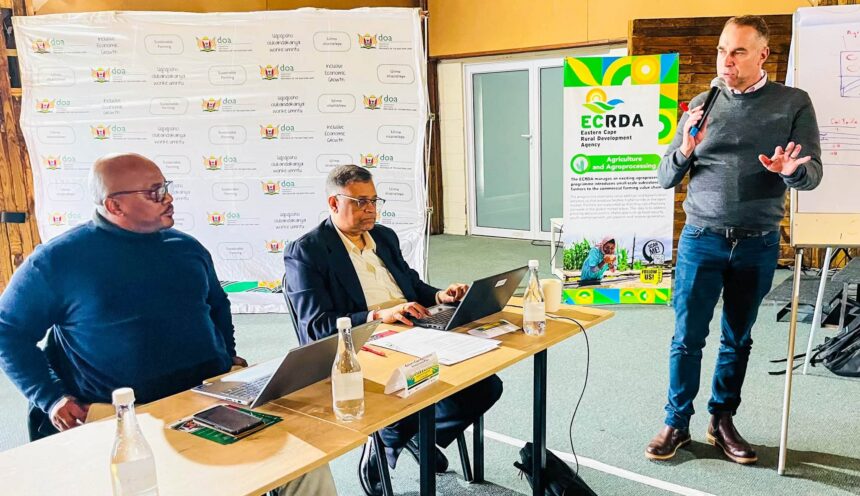
The Eastern Cape Department of Agriculture, through the Eastern Cape Rural Development Agency (ECRDA), has reconvened with the World Bank and other key stakeholders to further align provincial irrigation schemes with the proposed investment approach for the Provincial Irrigation Schemes Revival Programme. The engagement forms part of ongoing efforts to develop a clear investment framework for irrigation schemes across the province. The discussions are focused on creating a practical approach that can guide future investment and improve the use of existing agricultural infrastructure. Irrigation schemes have an important role to play in supporting reliable agricultural production because they provide farmers with access to water beyond dependence on rainfall. The latest engagement therefore places attention on how these schemes can be assessed, prioritised and positioned for future agricultural investment.
A key part of the engagement involved breakaway sessions that examined the different factors that need to be considered when developing an investment approach for irrigation schemes. One of the discussions focused on the privatisation and commercialisation of agricultural industries and how these approaches could potentially be incorporated into the broader revival programme. Participants also looked at the operational condition of different irrigation schemes and considered how they could be assessed according to their current level of functionality. This included considering schemes from those that are least operational to those that are already closer to full production. Such an assessment can help stakeholders understand where different forms of support and investment may be required.
The discussions also placed emphasis on prioritising agricultural commodities that could be supported through investment in the irrigation schemes. Identifying suitable commodities is important because investment decisions need to consider what can realistically be produced, marketed and sustained within each area. Different irrigation schemes have different agricultural conditions, infrastructure, production capacities and market opportunities, meaning that a single approach may not be suitable for every scheme. Commodity prioritisation can therefore help connect infrastructure investment with actual agricultural production opportunities. It can also provide a basis for developing investment plans that take into account production requirements, markets and the long-term operation of each scheme.
The involvement of the World Bank and other stakeholders reflects the need for technical and investment expertise as the province works to strengthen the revival programme. Developing irrigation schemes requires more than repairing infrastructure because long-term sustainability also depends on how production, markets, management and investment are structured. The assessment of each scheme can help determine the type and level of support needed before further investment decisions are made. It can also assist stakeholders in identifying schemes that require infrastructure rehabilitation, improved management or stronger commercial arrangements. This approach is intended to provide a more structured basis for moving irrigation schemes towards productive and sustainable agricultural activity.
For farmers and communities linked to irrigation schemes, the revival programme could create opportunities to bring underused agricultural land back into production. Functional irrigation infrastructure can support more consistent crop production and allow farmers to plan their activities with greater certainty. However, the success of individual schemes will also depend on factors such as access to inputs, reliable infrastructure, markets, finance and effective management. The investment approach being developed therefore needs to consider the full agricultural value chain rather than focusing only on irrigation infrastructure. This is particularly important for ensuring that increased production can translate into sustainable farming businesses and stronger local agricultural economies.
The latest engagement is part of a broader process to determine how Eastern Cape irrigation schemes can be positioned for future investment and commercial activity. By assessing schemes according to their operational status and identifying suitable commodities, stakeholders can develop a clearer picture of where investment may have the greatest practical impact. The discussions around commercialisation and agricultural industries also point to the importance of establishing viable production models that can support farmers and other participants over the longer term. Continued coordination between government, development partners and agricultural stakeholders will be important as the proposed investment approach is refined. The work ultimately aims to provide a structured pathway for revitalising irrigation schemes and strengthening agricultural production across the Eastern Cape.
Join 'Farmers Mag' WhatsApp Channel
Get the latest Farming news and tips delivered straight to your WhatsApp
CLICK HERE TO JOIN