South Africa’s red meat industry is redefining its environmental story through regenerative grazing. Farmers are showing that with the right practices, livestock can restore soil health, enhance biodiversity, and even contribute to climate change mitigation.
Red meat often faces criticism online. Social media, documentaries, and news reports highlight greenhouse gas emissions and land degradation linked to beef, lamb, and goat production. While these concerns are valid, the story is more nuanced. Across the country, producers are adopting sustainable practices to reduce environmental impact and improve land management.
Livestock farming contributes to greenhouse gas emissions, primarily methane, which is about 25 times more potent than carbon dioxide over 100 years. Methane is produced naturally during digestion, a process called enteric fermentation. Overgrazing and poor pasture management can also degrade soil and reduce biodiversity, raising questions about balancing meat consumption with environmental responsibility.
“The perception that red meat is inherently bad for the environment ignores the innovations happening on farms today,” says Enrike Maree, an agricultural communicator. “Many producers are adopting practices that restore soil health and support biodiversity.”
Andrew Ardington, founder of the Regenerative Agriculture Association of Southern Africa, agrees. “Regenerative grazing improves soil health and carbon sequestration. Degraded veld can recover when livestock are managed properly, bringing back grasses, legumes, and forbs that have disappeared over decades of overgrazing.”
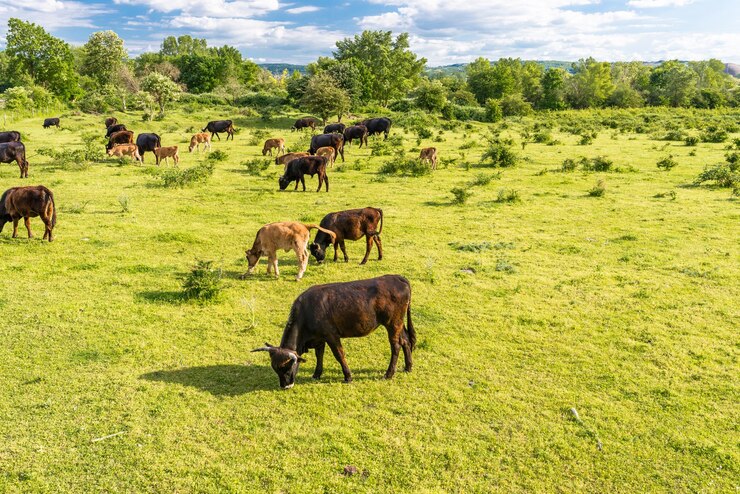
Regenerative grazing is at the heart of this shift. By moving herds strategically, farmers mimic natural grazing patterns, allowing pastures to recover while improving soil structure and sequestering carbon. Rotational grazing, a common method, prevents overgrazing by moving animals between smaller paddocks. Over time, farms can become net carbon sinks, absorbing more carbon than they emit.
“Rotational grazing isn’t just better for soil; it benefits animals too,” Maree adds. “Healthier pastures lead to healthier livestock and a more resilient meat industry.” Ardington notes that regenerative grazing differs from rotational grazing. “It’s about actively managing the interaction between livestock and veld to restore ecosystems, not just following a schedule.”
Reducing the industry’s carbon footprint also involves improving feed quality. High-quality forage and specialized feeds reduce methane emissions by supporting more efficient digestion. Some farmers explore feed additives to further limit methane production. Technology aids this process, with GPS, drones, and precision monitoring helping prevent overstocking and land degradation. Renewable energy and efficient water use also contribute to sustainability.
Ardington emphasizes that feed additives alone cannot solve climate concerns. “When livestock are integrated into regenerative, grass-based systems, they become an environmental asset rather than a liability. Accounting for both emissions and carbon sequestration is critical to understanding their real impact.”
Regenerative grazing also benefits biodiversity. Properly managed farms create habitats for birds, insects, and small mammals and can serve as wildlife corridors. Planting native grasses and shrubs improves forage while supporting pollinators and ecosystem health.
“Technology enables data-driven decisions that help the environment and profitability,” Maree notes. Ardington adds that manure and urine are natural fertilisers when applied to healthy soil, reinforcing nutrient cycles rather than causing pollution.
Consumer choices also influence sustainability. Selecting locally sourced meat and supporting farmers who practice regenerative grazing encourages responsible production. Smarter consumption emphasizes quality over quantity and appreciation for the farm-to-plate story.
Research and innovation underpin these efforts. Universities and industry bodies study genetics, feed efficiency, and sustainable practices. Programs reward farmers for adopting environmentally conscious methods, while youth education initiatives foster awareness of ethical and sustainable meat production.
Red meat is integral to South Africa’s culture, economy, and food security. Millions of rural families depend on livestock, and the industry contributes significantly to local economies. By adopting regenerative grazing and responsible management, farmers demonstrate that environmental stewardship and economic growth can coexist.
“The biggest change we can make is to implement regenerative grazing across as many hectares as possible,” Ardington explains. “Sometimes the real solution is simply managing land better.”
Next time meat appears on your plate, it carries a story of innovation, stewardship, and care for the land. South African red meat producers are proving that sustainable, responsible farming allows consumers to enjoy meat while nurturing the environment.
“The narrative around red meat is changing,” Maree concludes. “With conscious farming and consumer choices, we can enjoy traditional foods while protecting the land for future generations.”
Join 'Farmers Mag' WhatsApp Channel
Get the latest Farming news and tips delivered straight to your WhatsApp
CLICK HERE TO JOIN