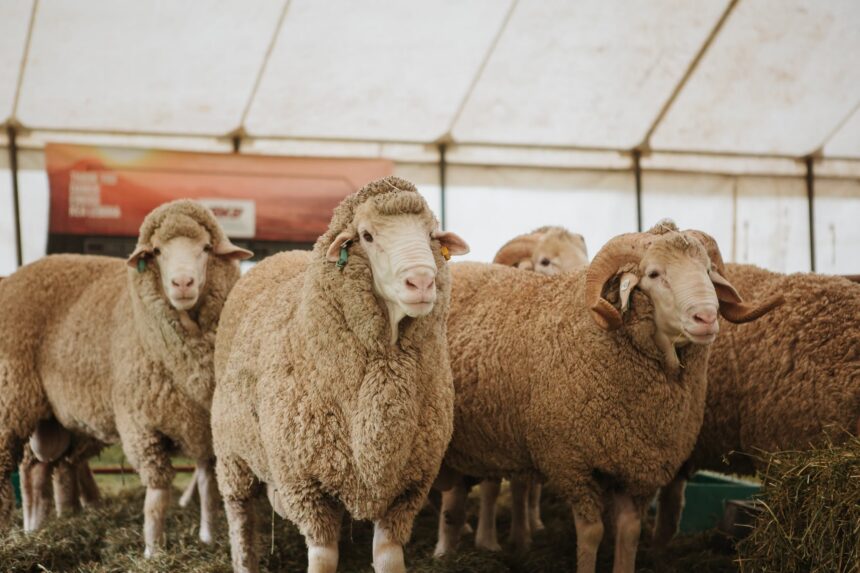
The South African wool market continued to experience downward price pressure, reflecting cautious buyer sentiment and changing conditions in the international wool trade. Despite the overall decline, quality remained an important factor in determining market performance, with longer, certified fine micron Merino wool attracting stronger interest than some other categories. According to Cape Wools, more than half of the 6 110 bales offered at the latest auction consisted of longer, certified fine micron Merino lots, which performed relatively well under the prevailing market conditions. The sale achieved an overall clearance rate of 91,4%, following the withdrawal of 1 015 bales before the auction. These results highlight the continued importance of wool quality, fibre characteristics and international demand in determining prices received by South African wool producers.
The All-Merino indicator declined by 1,8% to close at R229,40/kg, reflecting the pressure experienced across much of the local Merino market. However, the performance of selected fine micron lots demonstrated that buyers remained prepared to pay competitive prices for wool with desirable characteristics. The highest price achieved at the sale was R360,56/kg clean, equivalent to R274,10/kg greasy, for a three-bale lot measuring 15,7 microns. This result illustrates the premium that particularly fine wool can attract when its quality meets buyer requirements. It also reinforces the importance of producing consistent, well-prepared clips that can compete in specialised wool markets.
Buying activity at the auction reflected participation from several established wool buyers. Standard Wool SA purchased the largest quantity, with 1 094 bales, followed by Stucken & Co with 970 bales. G Modiano SA purchased 861 bales, while Tianyu SA acquired 844 bales. The participation of these buyers highlights the role of established trading and processing businesses in the South African wool market. Their purchasing decisions are influenced by factors such as fibre diameter, staple characteristics, processing requirements and demand from international customers. For producers, understanding these market preferences can help inform decisions about wool production, clip preparation and quality management.
The relationship between the South African and Australian wool markets also played an important role in shaping conditions during the trading period. Dawie Kilian of OVK explained that the two markets experienced distinct but closely connected conditions early in the week. The domestic market remained under pressure, with prices declining across most Merino categories. However, the absence of an Australian auction on 27 October meant South African buyers did not have the latest Australian market results available to guide their local purchasing decisions. As a result, domestic pricing was influenced mainly by local supply and demand conditions during that period.
The Australian market is an important reference point for participants in the South African wool industry because both markets operate within a global trading environment. Changes in international prices, processor demand and buyer confidence can influence the expectations of wool buyers and sellers in South Africa. When Australian auction results are unavailable, local market participants may have less information about the latest international price movements. Once Australian auctions resumed, the market continued to show signs of price sensitivity, particularly in broader micron categories. This demonstrated how quickly international developments can influence market sentiment and purchasing behaviour within the local wool trade.
Kilian also highlighted the importance of staple strength when determining the value and processing potential of wool. While fibre diameter and appearance are important quality characteristics, staple strength influences how well wool performs during processing. Wool with inadequate strength is more vulnerable to fibre breakage during manufacturing, which can affect processing efficiency and the quality of the final product. As a result, wool with lower staple strength may attract a discount, even when other characteristics are favourable. This makes staple strength an important consideration for producers seeking to improve the marketability and value of their wool clips.
From a brokerage perspective, Kilian explained that wool with a staple strength measurement below 33 Newtons per kilotex (NKT) is generally regarded as tender wool. A measurement of approximately 35 NKT is considered acceptable, while fleece wool with staple strength exceeding 40 NKT is preferred because it supports better processing performance. These measurements provide useful information about the ability of wool fibres to withstand mechanical handling during manufacturing. Stronger staples generally reduce the risk of fibre breakage and can improve processing outcomes. For wool producers, understanding these measurements can help identify areas where flock management, nutrition and shearing practices may influence clip quality.
The importance of staple strength also highlights why wool testing and objective clip assessment remain valuable tools in modern sheep farming. Visual appearance alone cannot always provide an accurate indication of how wool will perform during processing. Scientific measurements allow buyers and processors to assess fibre characteristics more consistently and make purchasing decisions based on specific quality requirements. Producers who understand the results of their wool tests can use this information to identify strengths and weaknesses within their clips. Over time, this knowledge can support more informed breeding, feeding and flock management decisions aimed at improving wool quality.
International market developments provided further context for the pressure experienced in South Africa. Australian Wool Innovation (AWI) reported that the Australian wool market recorded its sharpest weekly adjustment of the season during the period under review. Reduced buyer confidence coincided with strong resistance from growers to accepting lower prices, creating tension between buying and selling expectations. Despite the correction, the Eastern Market Indicator (EMI) remained at 310 Australian cents, which was 21,9% higher than at the corresponding sale a year earlier. This comparison shows that, although the market experienced a significant short-term adjustment, prices remained above the level recorded during the equivalent period of the previous year.
AWI also reported that better-style, well-measured fine wool continued to outperform lower-style descriptions with high vegetable matter and high mid-break. This reinforced the importance of quality differentiation in the international wool market. Buyers are not simply responding to overall market indicators but are also assessing individual lots according to their suitability for specific processing requirements. Wool with undesirable characteristics may struggle to attract the same level of interest as clean, well-prepared and consistently measured fibre. For South African producers, this highlights the importance of maintaining quality throughout the wool production and preparation process.
Another important development in the Australian market was the sharp decline in standard Chinese top-making wool. However, processor competition increased later in the same week as buyers sought to complete their orders. This increase in purchasing activity helped better-style 17,5- to 18-micron lots perform well despite the generally weaker market. The development illustrates how demand from processors can influence prices within particular micron categories, even when broader market conditions remain uncertain. It also shows that different wool descriptions can experience significantly different price movements during the same auction period.
For South African wool producers, these developments underline the importance of understanding both domestic and international market trends. The local wool market does not operate in isolation, and movements in Australia and other major wool-producing regions can influence buyer confidence and price expectations. At the same time, individual clip characteristics remain critical in determining the prices offered for different lots. Producers who pay attention to fibre diameter, staple strength, vegetable matter and wool preparation can better understand the factors affecting their returns. Access to accurate wool testing and regular market information can also help farmers make informed production and marketing decisions.
The latest auction results reinforce a key message for the South African wool industry: quality remains essential in a market characterised by changing demand and price sensitivity. Although the All-Merino indicator declined and the wider market experienced pressure, longer, certified fine micron Merino wool continued to demonstrate resilience. The strong price achieved for the 15,7-micron lot further highlighted the value buyers place on desirable fibre characteristics. International developments, particularly in Australia, also demonstrated how buyer confidence and processor demand can influence market performance across different wool categories. As producers prepare for future sales, maintaining strong staple characteristics, improving clip preparation and monitoring market trends will remain important. By focusing on consistent wool quality and understanding changing market requirements, South African sheep farmers can strengthen their competitiveness and position themselves to benefit when demand improves.
Join 'Farmers Mag' WhatsApp Channel
Get the latest Farming news and tips delivered straight to your WhatsApp
CLICK HERE TO JOIN