
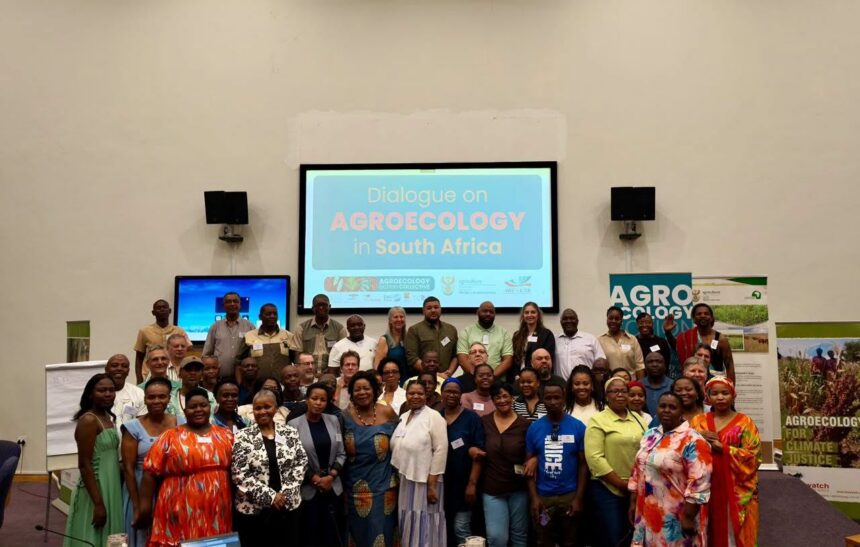
South Africa’s National Department of Agriculture, the Agricultural Research Council, farmers and civil society organisations have come together for a two-day Agroecology Dialogue to explore sustainable farming practices and strengthen the country’s food systems. The dialogue focused on ways to produce food while protecting soil, water, biodiversity and other natural resources essential to agriculture. Participants discussed how research, indigenous knowledge, education and cooperation can support farmers in adopting practices that work with nature. The gathering also examined food sovereignty, market access and the need for stronger support for sustainable agricultural production. Its central message was that building resilient food systems requires more than increasing production, as long-term food security also depends on healthy ecosystems and the active involvement of farming communities.
The dialogue brought together stakeholders from government, agricultural research, farming communities and civil society. Participating organisations included the Agroecology Action Collective, Biowatch and the Surplus People Project. Their involvement created an opportunity to exchange knowledge and discuss practical approaches to agroecology in the South African context. Collaboration between these groups is important because sustainable agriculture involves environmental, economic and social considerations. Farmers need practical knowledge and suitable support, while researchers and policymakers can help develop approaches that respond to local farming conditions and community needs.
Agroecology is an approach to agriculture that applies ecological principles to food production. It considers farms as living systems in which soil health, water availability, biodiversity, crops, livestock and people are connected. Instead of relying only on external inputs, agroecological approaches seek to make better use of natural processes and local resources. Practices may include improving soil organic matter, diversifying crops, protecting beneficial organisms and managing water carefully. The specific methods used depend on local conditions, the type of farming operation and the resources available to producers.
Protecting soil health is an important part of agroecology because productive farming depends on soils that can support plant growth and retain moisture. Poor soil management can contribute to erosion, declining fertility and reduced agricultural productivity. Practices such as maintaining soil cover, rotating crops and adding suitable organic material can help improve soil condition when adapted to local circumstances. Farmers also need to consider how cultivation, grazing and other land uses affect the long-term health of their land. By giving greater attention to soil management, agroecology seeks to support agricultural production while protecting the natural resource base on which future harvests depend.
Water conservation was another important issue within the wider discussion about protecting natural resources. Agriculture relies on reliable water supplies, yet farmers in South Africa operate in a country where rainfall varies considerably across regions and seasons. Efficient irrigation, rainwater management and practices that improve the soil’s ability to retain moisture can help producers manage water more carefully. Protecting rivers, wetlands and other water sources is also important for agriculture and surrounding communities. Sustainable farming approaches must therefore consider both the immediate water needs of crops and livestock and the long-term condition of the ecosystems that supply water.
Biodiversity also plays a role in maintaining productive agricultural landscapes. A variety of plants, insects, birds and soil organisms can contribute to pollination, natural pest control and nutrient cycling. Farming systems that support biodiversity may include crop diversification, maintaining suitable natural vegetation and reducing unnecessary disturbance to habitats. These measures need to be planned according to the needs of each farm and its surrounding environment. Protecting biodiversity can help maintain ecological functions that support food production while contributing to the conservation of South Africa’s natural resources.
The Agroecology Dialogue also explored the contribution of indigenous knowledge systems to sustainable farming. Farmers and communities have developed knowledge about local soils, weather patterns, plants, livestock and natural resource management over generations. This experience can provide valuable insight into farming practices suited to particular environments. Combining local knowledge with scientific research can help identify approaches that are practical, relevant and responsive to changing conditions. Respectful knowledge-sharing also creates opportunities for farmers to contribute their own experience to agricultural research and decision-making.
Research and innovation were among the key themes discussed during the dialogue. The Agricultural Research Council has a role in agricultural research and development in South Africa, making research an important part of conversations about sustainable production. Scientific investigation can help assess the effectiveness of farming methods, identify risks and develop recommendations for different agricultural conditions. Research can also help farmers understand how practices affect soil fertility, water use, crop performance and environmental health. Effective collaboration between researchers and farmers is essential to ensure that findings can be applied in practical farming situations.
Education, training and capacity building were also identified as important areas for strengthening agroecology. Farmers need access to reliable information about sustainable production methods, resource management and changing environmental conditions. Training can help producers evaluate different approaches and decide which practices suit their farms. Extension services, farmer networks and practical demonstrations can support the exchange of knowledge between agricultural professionals and farming communities. Continued learning is particularly important because sustainable farming methods must be adapted to local conditions rather than applied in exactly the same way everywhere.
Market access and sustainable supply chains formed another part of the dialogue. Farmers who adopt environmentally responsible practices still need reliable ways to sell their produce and earn enough income to sustain their businesses. Difficulties accessing markets, transport, storage and suitable buyers can limit the opportunities available to small-scale producers. Strengthening links between farmers, buyers and other participants in the food value chain can help improve the movement of agricultural products from farms to consumers. Discussions about agroecology therefore need to consider both how food is produced and whether farmers can make a viable living from their work.
Food sovereignty was another central theme of the gathering. It refers broadly to the ability of people and communities to shape their food systems and have a meaningful role in decisions about food production, distribution and access. The concept draws attention to the importance of local producers, community participation and access to nutritious food. It also raises questions about how agricultural policies and markets affect farmers and consumers. Supporting food sovereignty involves considering the needs of farming communities alongside the wider goal of ensuring that people can access adequate and appropriate food.
Governance and institutional support were included among the dialogue’s thematic areas. Government departments, research institutions, civil society organisations and farmers each have different roles in supporting sustainable agricultural development. Effective cooperation can help align research, training, policy and practical support with the challenges farmers face. Clear institutional arrangements can also help stakeholders identify priorities and share knowledge more effectively. The dialogue provided a forum for discussing these issues, although the information provided about the event does not specify particular policy decisions, funding commitments or formal agreements resulting from the discussions.
The discussions reinforced the idea that food security cannot be measured by production levels alone. A resilient food system must also protect the resources needed to grow food in the future and support the people responsible for producing it. Soil degradation, water pressures and biodiversity loss can affect agricultural productivity over time, making responsible resource management essential. At the same time, farmers need workable production methods, access to markets and the means to maintain viable businesses. Agroecology offers a framework for considering these connected challenges, while individual practices must be evaluated against local needs, evidence and available resources.
The two-day Agroecology Dialogue brought together government, researchers, farmers and civil society organisations to discuss ways of strengthening sustainable agriculture in South Africa. Its focus on agroecological practices, research, indigenous knowledge, training, market access and institutional support reflected the many factors that shape food systems. The discussions also highlighted the importance of protecting soil, water and biodiversity while supporting the people and communities who produce food. Turning these ideas into lasting progress will require continued cooperation, practical knowledge-sharing and approaches suited to South Africa’s diverse farming conditions. By encouraging collaboration and a stronger focus on natural resources, agroecology can contribute to discussions about a more sustainable and resilient future for South African agriculture.
Join 'Farmers Mag' WhatsApp Channel
Get the latest Farming news and tips delivered straight to your WhatsApp
CLICK HERE TO JOIN