Siyoyisile Indlala Community Farm is demonstrating how sustainable agriculture, agroecology and community-driven innovation can help strengthen food security and create economic opportunities in Soweto. Through practical farming demonstrations, educational activities and community engagement, the farm is showing how people can grow nutritious food, improve soil health and develop agricultural businesses, even where space and resources are limited. The farm recently hosted an Agroecology and Business Event at Faranani Primary School, bringing together MEC Ramokgopa, community members, local farmers, agricultural experts, vendors and other partners interested in sustainable food production. The event highlighted the value of combining traditional farming knowledge with innovative methods that make better use of available resources. It also reinforced the importance of empowering communities with practical skills that support local food production, green entrepreneurship and long-term economic development.
The visit by MEC Ramokgopa provided an opportunity for the Siyoyisile Indlala Community Farm team to demonstrate how simple, affordable and space-saving agricultural techniques can contribute to urban farming. Using recycled materials such as plastic bottles, the team showed how households and community growers can establish productive growing systems in small spaces. These methods can support the cultivation of seedlings, leafy vegetables and tomato plants without requiring extensive farmland. Such approaches are particularly relevant in urban and township communities where access to land, water and agricultural resources may be limited. By making sustainable farming techniques easier to understand and apply, the farm is encouraging more people to explore food production as a practical way to improve household food access and build self-reliance.
Agroecology is central to the farm’s approach because it connects food production with soil health, biodiversity, efficient resource use and the wellbeing of local communities. Rather than focusing only on the quantity of crops produced, agroecological farming considers how farming practices affect the wider environment and the long-term productivity of the land. Techniques such as composting, companion planting, mulching, careful water management and natural soil enrichment can help farmers use resources more effectively. These methods can also reduce dependence on some purchased agricultural inputs when they are suitable for the crops, soil conditions and local environment. Through demonstrations and shared learning, Siyoyisile Indlala Community Farm is helping community members understand how environmentally responsible practices can contribute to productive gardens and more resilient local food systems.
The farm’s seedling propagation activities also highlight the importance of starting crops well before they reach the growing beds. Healthy seedlings give farmers and gardeners a stronger foundation for successful crop establishment, although their performance also depends on suitable growing conditions, water, nutrients and ongoing care. Recycled containers and other low-cost materials can provide practical options for raising seedlings when purpose-built equipment is unavailable. By learning how to prepare growing media, manage moisture and care for young plants, community members can develop skills that are useful in home gardens and small agricultural enterprises. Producing seedlings locally may also create opportunities for people to sell plants to other growers, schools and community projects, turning a practical farming skill into a potential source of income.
Vermiculture, also known as worm farming, was another important feature of the event. This method uses suitable earthworms to help break down organic materials into nutrient-rich worm castings that can be used to improve soil. When managed properly, vermiculture can support the recycling of selected food scraps and other appropriate organic materials that might otherwise become waste. Worm castings can contribute organic matter and nutrients to growing media, helping farmers improve soil structure and support plant growth. Demonstrating these techniques allows community members to see how waste management and food production can work together in a circular system. For urban farmers, composting and vermiculture can offer practical ways to make better use of available organic resources while reducing the amount of waste sent for disposal.
During the site visit, the team also demonstrated the potential use of human urine as a source of nutrients for agricultural production. Human urine contains plant nutrients, particularly nitrogen, as well as phosphorus and potassium in varying concentrations, which can make it a potential resource for nutrient recovery when handled appropriately. The team described a process involving fermentation over seven days, presenting it as a way to transform urine into a liquid fertiliser for crops. However, fermentation and a change in pH alone do not guarantee that a product is free from pathogens or other hazards, and the nutrient content can vary. Safe use requires appropriate handling, sanitation controls, suitable treatment and application methods that account for the crops being grown and the potential risks to people and the environment. This demonstration opened an important discussion about resource recovery and zero-waste agriculture while highlighting the need for evidence-based safety practices whenever human waste-derived materials are considered for food production.
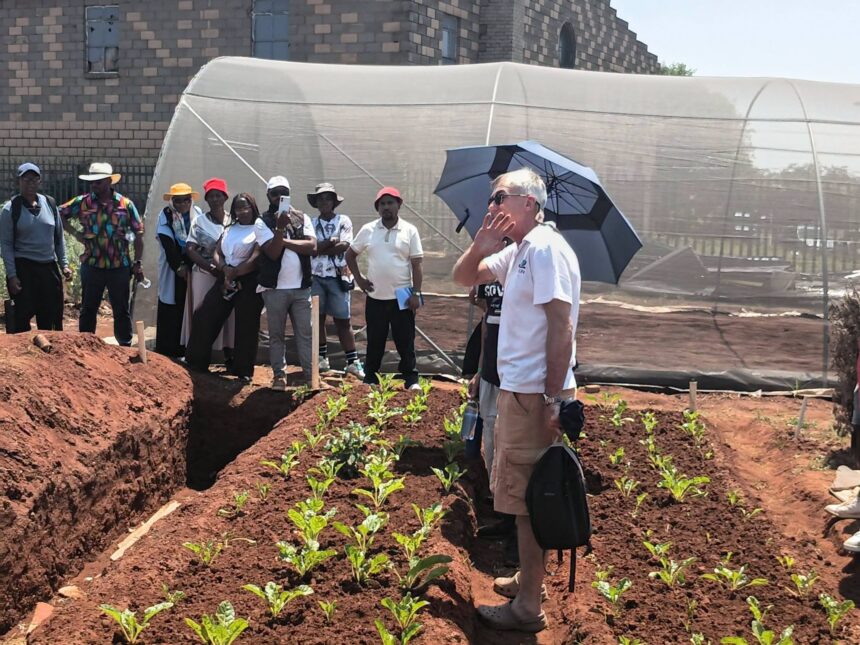
Field demonstrations and guided tours gave visitors an opportunity to see agroecological farming methods in practice. Participants explored crop fields, raised beds and greenhouse systems while learning about soil preparation, crop management and the practical considerations involved in maintaining productive growing areas. Raised beds can help organise growing space and, when designed appropriately, improve drainage and soil management. Greenhouses can provide greater control over growing conditions, although their success depends on factors such as ventilation, temperature, irrigation and effective crop management. The demonstrations helped connect agricultural knowledge with practical decisions that farmers and gardeners make every day. By allowing visitors to observe the systems directly and ask questions, the event created an opportunity for learning that can be difficult to achieve through theory alone.
Deep trenching and soil enrichment were also important themes in the farm’s educational activities, including a masterclass led by Professor Naudé Malan, who shared expertise in agroecology and urban agriculture system design. Deep trenching involves preparing growing areas and incorporating suitable organic matter into the soil to improve its structure, moisture retention and biological activity. When properly planned and maintained, this approach can support long-term soil improvement and provide crops with a more favourable growing environment. Its effectiveness depends on local soil conditions, drainage, the materials used and the availability of water, so it must be adapted to the needs of each site. The masterclass also explored how deep trenching can be combined with techniques such as shade tunnels, precision irrigation and companion planting to improve the overall performance of small-scale farming systems. This integrated approach shows how combining appropriate practices can help urban farmers make better use of limited land and strengthen the productivity of community growing spaces.
The farm’s focus on sustainable agriculture also creates opportunities for business development and local entrepreneurship. The Agroecology and Business Event featured local producers and sustainable businesses selling and showcasing fresh produce, seedlings, specialised soils, natural spices and handcrafted goods. These stalls gave entrepreneurs an opportunity to present their products, engage with potential customers and connect with other people working in the local agricultural economy. Markets of this kind can help small businesses build visibility while encouraging residents to support local producers. They also demonstrate that agroecology extends beyond growing crops, as it can create opportunities in processing, packaging, distribution, retail and agricultural services. By bringing farming and entrepreneurship together, Siyoyisile Indlala Community Farm is helping community members explore how sustainable food production can contribute to household income and broader economic participation.
Community participation remained central to the event, with residents, farmers, young people and other visitors taking part in discussions and practical learning activities. These interactions created space for people to exchange experiences, raise questions and explore shared challenges relating to food security and agricultural enterprise. Dialogue sessions also focused on youth mentorship, sustainable business models and ways to strengthen community-led development across Johannesburg, particularly in Protea Glen and the wider Soweto area. Involving people from different backgrounds can help ensure that agricultural initiatives respond to local needs and draw on the knowledge already present within communities. Such collaboration is especially valuable when people are learning how to establish gardens, develop small businesses or improve their farming practices with limited resources. The farm’s educational activities therefore support not only food production but also stronger relationships, shared learning and local problem-solving.
Youth empowerment is another important part of building a sustainable community food system. Practical agricultural training can introduce young people to crop production, soil management, composting, water conservation and the business opportunities associated with food growing. These skills may help them establish home gardens, contribute to community projects or explore agriculture-related work and enterprise development. Exposure to innovative techniques can also encourage young people to view farming as a field that can incorporate science, technology, environmental responsibility and entrepreneurship. For these opportunities to develop into lasting outcomes, training needs to be supported by continued mentorship, access to suitable resources and pathways to markets. By creating opportunities for young people to learn alongside experienced farmers and agricultural practitioners, community farms can help build the knowledge and confidence needed for the next generation of food producers.
The work taking place at Siyoyisile Indlala Community Farm reflects the growing importance of urban agriculture in addressing food access and environmental challenges. Community farms can provide practical spaces for residents to learn how food is produced, improve their understanding of nutrition and explore ways to reduce household food costs. They can also demonstrate how small growing areas can be used productively through careful planning, appropriate crop choices and efficient management of water and soil. However, successful urban agriculture requires ongoing effort, including reliable access to water, suitable land, safe growing materials and the knowledge needed to maintain healthy crops. Partnerships with public institutions, agricultural experts, community organisations and local businesses can help strengthen these foundations. By sharing practical knowledge and encouraging cooperation, community farms can contribute to more resilient neighbourhoods and a stronger local food system.
The Agroecology and Business Event at Siyoyisile Indlala Community Farm demonstrated how sustainable agriculture can bring together food production, environmental care, skills development and local economic opportunity. From recycled-container gardening and seedling propagation to vermiculture, deep trenching and business networking, the activities showed that practical innovation can make farming more accessible to communities. The visit by MEC Ramokgopa and the contributions of Professor Naudé Malan and other participants also highlighted the value of knowledge sharing and collaboration. Continued support for community-led agricultural initiatives can help residents develop useful skills, strengthen local enterprises and explore more sustainable ways to produce food. Through its commitment to agroecology and community empowerment, Siyoyisile Indlala Community Farm is helping plant the seeds of a future in which local people have greater opportunities to grow food, build livelihoods and contribute to a more food-secure South Africa.
Join 'Farmers Mag' WhatsApp Channel
Get the latest Farming news and tips delivered straight to your WhatsApp
CLICK HERE TO JOIN