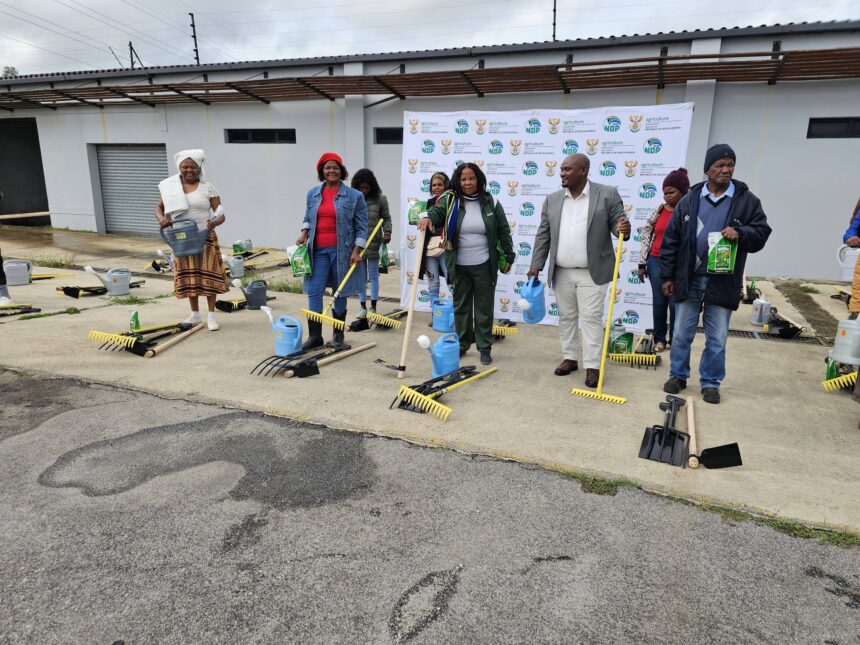
Hope and practical support reached subsistence farmers in Kariega within the Nelson Mandela Bay Metropolitan Municipality today as Deputy Minister Nokuzola Capa led a distribution of gardening implements under the National Department of Agriculture’s Food Security at Household Level Programme. The initiative focused on improving household food production through direct support to communities that rely on small scale farming for survival and nutrition. Farmers received tools that help them expand and maintain productive home gardens. The programme aims to strengthen food access at household level while building long term resilience in vulnerable communities. It reflects a wider national effort to reduce hunger through sustainable, community driven agriculture.
The intervention took place in the Nelson Mandela Bay Metropolitan Municipality where many households depend on subsistence farming to supplement daily food needs. Deputy Minister Nokuzola Capa engaged directly with residents and emphasized the importance of using the provided implements effectively to ensure lasting impact. The focus was not only on handing over tools but also on encouraging active participation in food production at household level. Communities were reminded that consistent gardening practices can reduce dependency on external food sources. The message reinforced that even small garden spaces can contribute meaningfully to household nutrition and income stability when properly managed.
The programme is designed to support practical farming at home by improving access to essential implements such as spades, watering tools, and planting equipment. These resources allow households to prepare soil, plant crops, and maintain gardens more efficiently throughout the growing season. Officials stressed that food security begins at household level and grows stronger when communities take ownership of their own production. The initiative also promotes skills development, encouraging families to learn basic agricultural techniques that improve yields over time. By combining tools with knowledge, the programme builds capacity that can last beyond a single planting cycle. This approach helps communities move toward more stable and self reliant food systems.
The impact of the initiative is expected to extend beyond immediate food production by strengthening community resilience and dignity. When households produce their own food, they gain greater control over nutrition and reduce vulnerability to rising food prices. The programme also encourages cooperation among neighbours who share gardening knowledge and resources to improve results. Over time, these small gardens contribute to broader food security goals across the region. The department’s approach shows that sustainable change can begin with simple interventions at household level. As more families participate, the vision of food secure and self reliant communities becomes increasingly achievable.
Join 'Farmers Mag' WhatsApp Channel
Get the latest Farming news and tips delivered straight to your WhatsApp
CLICK HERE TO JOIN