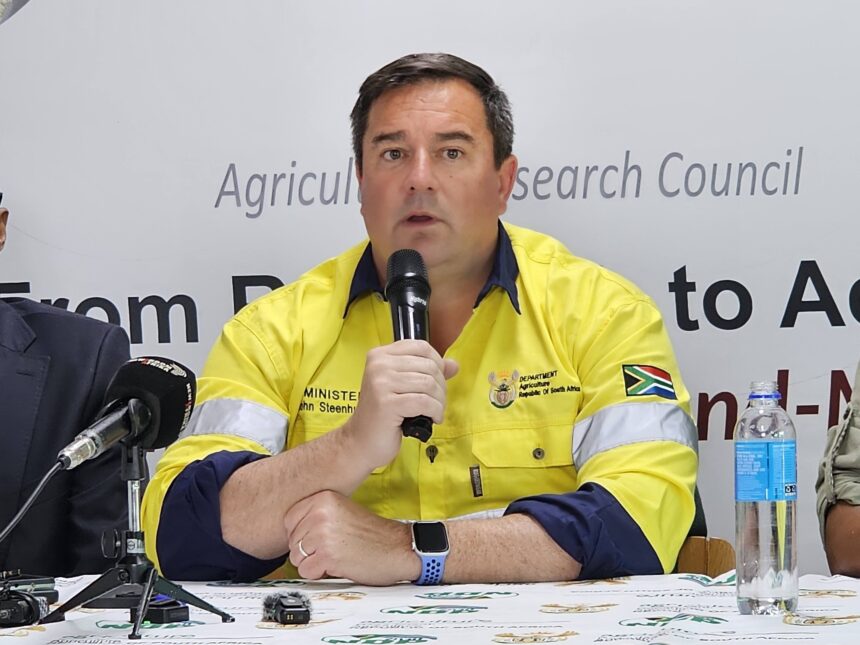
Minister of Agriculture John Steenhuisen has confirmed that the first batch of one million high potency Foot and Mouth Disease vaccine doses from Biogénesis Bagó in Argentina will arrive in South Africa this weekend. This delivery forms part of a broader agreement that will see an additional five million doses land in March. The vaccines are central to the Department of Agriculture’s revised national strategy to contain and eliminate Foot and Mouth Disease. South Africa has a national herd of more than 14 million cattle, and the plan now focuses on proactive mass vaccination. The goal is clear. The country must transition to FMD Free Status with Vaccination to stabilise the livestock industry and protect export markets.
The arrival of vaccines from Argentina strengthens existing supply channels. The Botswana Vaccine Institute remains a key partner and has already delivered two million doses since the recent outbreak. It will continue to supply vaccines on a monthly basis to support the national rollout. Additional doses will come from Dollvet in Turkey through its local agent Dunevax. By the end of March, more than five million vaccine doses from three international suppliers will have entered South Africa, significantly boosting the country’s response capacity.
Local production has also resumed after years of limited output. In 2025, Minister Steenhuisen instructed the Agricultural Research Council to accelerate development of a locally produced FMD vaccine capable of protecting livestock for up to 12 months. On 6 February 2026, the ARC handed over 12 900 locally produced doses, the first batch in more than 20 years. These vaccines have already been distributed to provinces for immediate use. The ARC has committed to producing 20 000 doses per week and plans to scale up to 200 000 doses per week in 2027. This shift reduces long term reliance on imports and strengthens national biosecurity.
The vaccination campaign targets at least 80 percent of the national herd by December. To meet this target, veterinary capacity is expanding across the country. Under the Animal Diseases Act, private veterinarians can now register to administer vaccines as part of the official rollout. This move increases manpower and speeds up access in rural and high risk areas. Minister Steenhuisen has urged farmers, transporters and consumers to work together to contain the spread of the virus. He stressed that strict movement controls and biosecurity compliance remain essential to protect livelihoods and food security.
The Department of Agriculture has launched a dedicated FMD Control Centre to support farmers during the outbreak. From Wednesday, producers can call the toll free FMD Support Line on 0860 246 640 for guidance on symptoms, movement permits, vaccine availability and farm biosecurity practices. The department has also activated a WhatsApp channel to share verified updates in real time. These tools aim to improve communication and reduce misinformation during a critical phase of the vaccination drive.
As of 16 February 2026, a total of 865 outbreaks had been reported to the World Organisation for Animal Health. Of these, 836 remain open while 27 have been officially closed. The Free State leads with 249 total outbreaks, followed by KwaZulu Natal with 222 and Gauteng with 191. North West has recorded 106 outbreaks, Mpumalanga 63 and the Eastern Cape 18. Limpopo has 10, the Western Cape 3, and the Northern Cape 1. These figures show the scale of the challenge and reinforce the urgency of rapid vaccination and strict disease management.
All infected properties are placed under immediate quarantine once disease is suspected. Movement of live cloven hoofed animals and unprocessed animal products is prohibited. Farmers must implement strict on farm biosecurity measures to prevent further spread. Where animals are not properly contained or cooperation is lacking, authorities may declare a Disease Management Area. In such cases, all properties within that defined epidemiological unit face uniform movement restrictions and controls. These measures limit transmission and help restore confidence in South Africa’s animal health system.
Minister Steenhuisen has described the vaccine rollout as the first step in restoring stability to the livestock sector. Farmers form the backbone of the agricultural economy and generate essential foreign income through exports. The success of this campaign depends on compliance, coordination and speed. If each role player acts responsibly, South Africa can regain control of the outbreak. The path toward FMD Free Status with Vaccination now depends on disciplined execution and sustained support across the value chain.
Join 'Farmers Mag' WhatsApp Channel
Get the latest Farming news and tips delivered straight to your WhatsApp
CLICK HERE TO JOIN