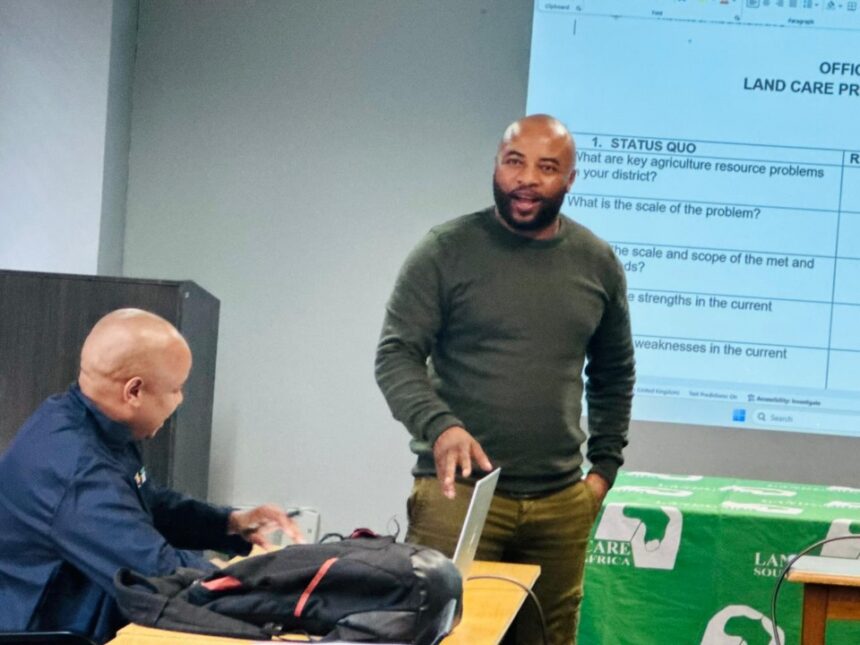
The Department of Agriculture’s LandCare Programme has made significant progress in improving land productivity and supporting sustainable farming practices at Rietbron Commonage Farm in Ward 8 of the Dr Beyers Naudé Local Municipality. The site is recognised as one of the municipality’s key anti-poverty areas, where agricultural development plays a central role in supporting local livelihoods. A recent project evaluation was conducted to assess progress since the programme’s implementation during the 2024/25 financial year. The initiative focuses on restoring grazing land, improving livestock production and strengthening environmental sustainability. It also aims to address long-standing challenges that affect agricultural productivity in rural communities.
A major focus of the LandCare Programme at Rietbron Commonage Farm has been the eradication of Jointed Cactus and other invasive cactus species. These invasive plants have historically reduced grazing capacity and negatively affected the quality of mohair produced by Angora goats in the area. The removal of these species is essential for restoring natural grazing land and improving livestock performance. Farmers in the region depend heavily on mohair production as a key source of income and economic stability. By improving land conditions, the programme directly supports the long-term viability of one of the most important agricultural activities in the district.
The programme has also provided a wide range of agricultural inputs and support services aimed at strengthening farming capacity. These include technical assistance, capacity building initiatives and training focused on sustainable land use and natural resource management. Green job opportunities have been created through the implementation process, allowing local residents to participate in land rehabilitation activities. Skills development programmes have also helped community members gain practical experience in conservation agriculture and environmental management. These interventions are designed to ensure that land restoration efforts continue beyond the lifespan of the project itself.
Additional support has been provided through the Comprehensive Agricultural Support Programme, which is currently assisting with the development of essential farm infrastructure. This includes fencing to protect grazing areas, stock-water systems to improve livestock hydration and dipping facilities to support animal health. These improvements are critical for ensuring efficient farm management and reducing livestock losses. The infrastructure development also strengthens disease control measures and improves overall productivity. Together, these investments contribute to building a more resilient and sustainable farming system in the area.
Beyond the farm level, the Department continues to extend its support to the wider community through household food security initiatives and agricultural development programmes. These efforts include home industry support, agricultural education and skills training aimed at improving livelihoods and reducing poverty. Community members are encouraged to participate in food production activities that improve household nutrition and generate small-scale income opportunities. The integration of farming support with social development programmes helps strengthen rural resilience. This holistic approach ensures that agricultural progress benefits both commercial farmers and vulnerable households.
The success of these initiatives is largely driven by Agricultural Advisor Ayanda Nyambali from Extension and Advisory Services, who serves Wards 1, 7 and 8 within the municipality. Nyambali plays a key role in coordinating service delivery, providing technical guidance and supporting farmers in implementing best practices. His work ensures that farmers receive continuous support and that government programmes are effectively implemented at grassroots level. Regular engagement with farmers has helped improve adoption of sustainable farming techniques and improved land management practices. His contribution highlights the importance of extension services in driving agricultural development.
The LandCare Programme at Rietbron Commonage Farm demonstrates the impact of targeted agricultural interventions in restoring degraded land and improving rural livelihoods. By addressing invasive species, improving infrastructure and supporting farmer development, the programme is strengthening the foundation for long-term agricultural productivity. The combined efforts of government departments, support programmes and local advisors are helping to build a more sustainable farming environment. These initiatives are not only improving livestock production but also contributing to broader economic development in the region. As implementation continues, the programme is expected to further enhance food security, environmental sustainability and income generation for communities in the Dr Beyers Naudé Local Municipality.
Join 'Farmers Mag' WhatsApp Channel
Get the latest Farming news and tips delivered straight to your WhatsApp
CLICK HERE TO JOIN