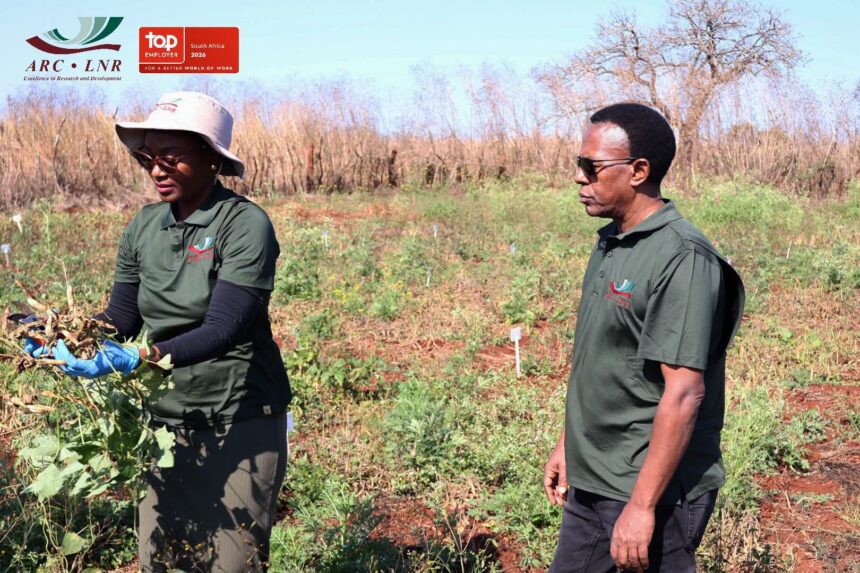
As climate change continues to place pressure on agricultural production, developing farming solutions that improve crop resilience, protect soil health and strengthen food security has become increasingly important. Smallholder farmers, in particular, need affordable and sustainable technologies that can help them maintain production under challenging environmental conditions. In response to these needs, the Agricultural Research Council’s Plant Health and Protection (ARC-PHP), through its Biological Nitrogen Fixation (BNF) Unit, is exploring the potential of nitrogen-fixing rhizobia to improve drought tolerance and productivity in different dry bean varieties. The research focuses on combining climate-resilient bean varieties with beneficial microbial inoculants to support healthier plants and more sustainable farming practices. Through science-based agricultural research, the initiative aims to contribute to improved dry bean production, healthier soils and stronger food security in farming communities.
Dry beans are an important food crop because they provide valuable nutrients, particularly plant-based protein, dietary fibre and essential minerals. They form part of the diets of many households and contribute to food and nutrition security. Their importance extends beyond household consumption, as dry bean production also creates opportunities for smallholder farmers to generate income and participate in agricultural markets. However, bean production can be affected by several environmental challenges, including insufficient rainfall, high temperatures and declining soil fertility. These conditions can reduce crop growth, affect yields and make production less predictable. Research into improved bean varieties and sustainable production technologies is therefore important for helping farmers manage these challenges.
A key focus of the ARC-PHP research is the role of nitrogen-fixing rhizobia in supporting dry bean production. Rhizobia are beneficial soil bacteria that can form a symbiotic relationship with leguminous plants, including beans. Through this relationship, the bacteria live in specialised structures called root nodules, where they convert atmospheric nitrogen into forms that plants can use for growth. This natural process is known as biological nitrogen fixation. Nitrogen is an essential nutrient for plant development because it contributes to the formation of proteins, enzymes and chlorophyll. By improving the availability of nitrogen through biological processes, effective rhizobia can support plant growth while reducing dependence on some forms of synthetic nitrogen fertiliser.
The use of beneficial microbial inoculants offers an opportunity to improve the efficiency of biological nitrogen fixation in agricultural production. These inoculants contain selected microorganisms that can be applied to seeds or planting materials to encourage beneficial interactions between plants and soil bacteria. When compatible and effective rhizobia establish a relationship with bean plants, they can support nitrogen acquisition and contribute to improved crop development. However, the effectiveness of inoculation depends on several factors, including the bean variety, the microbial strain, soil conditions and environmental conditions. This makes scientific research and appropriate strain selection essential for developing inoculants that perform reliably under different farming conditions. The ARC-PHP’s research is therefore important in identifying microbial solutions that can support sustainable dry bean production.
Drought tolerance is another important aspect of the research because water shortages remain a major challenge for crop production in many agricultural areas. Dry bean plants require sufficient moisture during important growth stages to support root development, flowering, pod formation and grain filling. Prolonged water shortages can interfere with these processes and reduce final yields. Although rhizobia do not eliminate the effects of drought, effective plant-microbe interactions may contribute to improved plant nutrition and physiological performance under certain environmental conditions. Research into different combinations of bean varieties and rhizobial strains can help identify associations that perform better when water availability is limited. Such findings could contribute to the development of more resilient dry bean production systems.
Selecting climate-resilient bean varieties is equally important in addressing the challenges associated with changing climatic conditions. Different dry bean varieties may respond differently to drought, temperature variations and soil conditions. Some varieties may demonstrate better adaptation to particular production environments, while others may perform well under more favourable conditions. Identifying suitable varieties can help farmers make informed decisions about which crops to plant according to their local growing conditions. When climate-adapted varieties are combined with compatible microbial inoculants, researchers can investigate whether these complementary approaches improve crop performance and production stability. This integrated research approach recognises that successful crop production depends on both plant genetics and the biological conditions surrounding plant roots.
Improving soil health is another important objective of research into biological nitrogen fixation. Healthy soils provide the nutrients, water and physical conditions required for successful crop production. However, continuous cultivation, erosion and poor soil management can reduce soil fertility and affect agricultural productivity over time. Biological nitrogen fixation offers a natural process through which atmospheric nitrogen can enter agricultural systems and support plant nutrition. Legume crops can also contribute to crop rotation systems by providing opportunities to improve nitrogen management between successive crops, although the amount of nitrogen remaining in the soil depends on crop management and how much plant material is returned to the soil. Integrating legumes and suitable microbial inoculants into farming systems can therefore contribute to more efficient nutrient management and sustainable soil management practices.
The research also has important implications for smallholder farmers who often face financial and environmental constraints that affect their production decisions. Access to fertilisers, irrigation infrastructure and other agricultural inputs can be limited, making affordable production technologies particularly valuable. Microbial inoculants offer potential benefits because they use naturally occurring biological processes to support plant nutrition. However, their practical value depends on product quality, affordability, correct application and effectiveness under local farming conditions. Farmers also need appropriate guidance on selecting suitable bean varieties and applying inoculants correctly. Research institutions play an important role in evaluating these technologies and translating scientific findings into practical recommendations that farmers can use.
The combination of climate-resilient dry bean varieties and beneficial microorganisms also supports broader efforts to promote sustainable agriculture. Modern agricultural research increasingly recognises the importance of working with natural biological processes to improve productivity while reducing unnecessary pressure on environmental resources. Biological nitrogen fixation is one example of how microorganisms can contribute to nutrient management in farming systems. By investigating effective rhizobial strains and their interactions with different bean varieties, researchers can develop a better understanding of how microbial technologies may support agricultural production. Such innovations can complement good farming practices, including appropriate crop rotation, soil conservation and responsible water management. Together, these approaches can help build farming systems that are better equipped to respond to environmental challenges.
Food security remains an important consideration behind the development of improved dry bean production technologies. Reliable production of nutritious crops helps households maintain access to essential food supplies while creating opportunities for agricultural income. Dry beans are particularly valuable because they provide an affordable source of plant-based nutrition and can be incorporated into different meals. Improving their productivity and resilience could therefore benefit both farmers and consumers. Research that addresses drought-related production risks and soil fertility challenges can contribute to more stable agricultural systems. Supporting smallholder farmers with suitable crop varieties and science-based microbial technologies is one way of strengthening local food production and improving the resilience of rural communities.
The Agricultural Research Council’s Plant Health and Protection programme continues to demonstrate the importance of scientific research in addressing agricultural challenges. Through the Biological Nitrogen Fixation Unit, investigations into nitrogen-fixing rhizobia and dry bean varieties are contributing to the search for practical solutions that support crop productivity and climate resilience. The research brings together plant selection, beneficial microorganisms and soil health as connected elements of sustainable agricultural production. While the performance of specific varieties and microbial combinations requires scientific evaluation under relevant growing conditions, the work provides an important foundation for developing technologies suited to farmers’ needs. Sharing research findings and translating successful innovations into accessible agricultural practices will be essential for ensuring that farmers benefit from these developments.
Developing climate-resilient agriculture requires solutions that improve crop performance while protecting the natural resources on which farming depends. The ARC-PHP’s research into nitrogen-fixing rhizobia and dry bean production highlights the potential of agricultural biotechnology and beneficial soil microorganisms to support this objective. By investigating the combination of suitable bean varieties and effective microbial inoculants, the research aims to improve drought resilience, strengthen biological nitrogen fixation and promote healthier soils. These efforts are particularly relevant to smallholder farmers who need sustainable ways to maintain production under changing climatic conditions. Continued investment in agricultural research, microbial innovation and climate-adapted crops will be important in building more productive farming systems, strengthening food security and supporting resilient agricultural communities across South Africa.
Join 'Farmers Mag' WhatsApp Channel
Get the latest Farming news and tips delivered straight to your WhatsApp
CLICK HERE TO JOIN