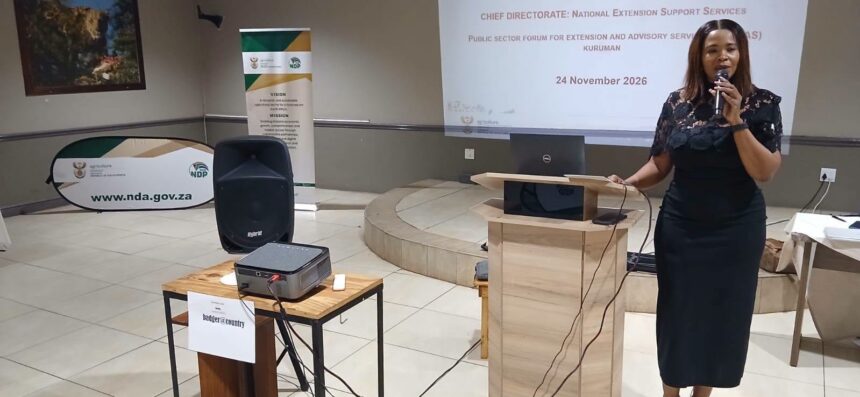
Behind every successful and thriving agricultural sector is a strong network of extension professionals who help farmers access the knowledge, skills and resources they need to improve their productivity and livelihoods. Agricultural extension and advisory services play a vital role in connecting research, government policies and practical farming activities. They ensure that farmers receive relevant information, technical guidance and support to make informed decisions about their agricultural operations. From improving crop production and livestock management to adopting sustainable farming practices and responding to climate-related challenges, extension professionals contribute directly to agricultural development. Recognising their importance, the National Department of Agriculture is convening the annual Public Sector Forum for Extension and Advisory Services (PSFEAS) in Kuruman, Northern Cape, to strengthen the delivery and effectiveness of agricultural extension services across South Africa.
The annual Public Sector Forum for Extension and Advisory Services provides an important platform for public sector stakeholders to assess progress in implementing the National Policy on Extension and Advisory Services (NPEAS). The policy provides a framework for improving the quality, accessibility and effectiveness of extension and advisory services in the agricultural sector. Its implementation is essential to ensuring that farmers receive consistent, relevant and practical support, regardless of their location or the scale of their farming operations. Through the forum, stakeholders have an opportunity to review existing programmes, identify areas that require improvement and establish strategic priorities for future interventions. This collective approach helps ensure that agricultural extension services respond to the changing needs of farmers and contribute meaningfully to national agricultural development objectives.
Agricultural extension professionals serve as an important link between farmers, government institutions, agricultural researchers and other industry stakeholders. Their responsibilities extend beyond providing technical advice because they also help farmers understand new agricultural technologies, improve production methods and manage the challenges associated with running farming businesses. They work directly with farming communities to identify production constraints, share practical solutions and encourage the adoption of improved agricultural practices. For emerging farmers and smallholder producers, access to reliable extension support can make a significant difference in building agricultural knowledge and improving farm performance. By strengthening relationships with farmers, extension professionals help create an environment where knowledge sharing, innovation and continuous learning become part of everyday agricultural activities.
One of the key priorities of the PSFEAS is addressing the challenges that affect the delivery of extension and advisory services. Agricultural extension professionals often work in communities with different production systems, infrastructure limitations and resource requirements. These conditions can make it difficult to provide consistent support to all farmers, particularly those in remote rural areas. Limited resources, inadequate equipment, transport constraints and the growing demand for specialised agricultural knowledge can also affect service delivery. Addressing these challenges requires coordinated planning, appropriate resource allocation and stronger institutional support. The forum provides an opportunity for stakeholders to discuss these concerns and identify practical measures that can improve the working conditions and effectiveness of extension personnel.
Improving the quality of agricultural extension services also requires continuous professional development and access to updated technical information. Agriculture is constantly changing as new technologies, production methods and environmental challenges influence how farmers operate. Extension professionals must therefore have the necessary skills and knowledge to provide accurate advice on crop management, livestock production, soil health, water conservation, pest control and farm management. Training opportunities, knowledge-sharing platforms and partnerships with agricultural research institutions can help strengthen their technical capacity. When extension professionals receive appropriate training and institutional support, they are better equipped to translate agricultural research into practical solutions that farmers can apply in their daily operations.
Climate change is another important issue that highlights the need for effective agricultural extension services. Farmers across South Africa face challenges associated with changing rainfall patterns, prolonged droughts, extreme temperatures and unpredictable weather conditions. These factors can affect crop yields, livestock health, water availability and overall farm profitability. Extension professionals play an important role in helping farmers understand climate risks and adopt appropriate adaptation strategies. Through practical guidance, they can promote water-efficient irrigation, soil conservation, climate-resilient crop varieties and improved livestock management practices. Strengthening advisory services can therefore help farming communities prepare for environmental uncertainties while protecting agricultural resources and maintaining production.
The forum also creates opportunities for stakeholders to share experiences, successful interventions and lessons learned from different agricultural regions. Agricultural conditions vary across provinces and farming communities, making collaboration essential for identifying approaches that can be adapted to different local circumstances. Sharing practical experiences allows extension professionals and policymakers to learn from programmes that have delivered positive results and understand why certain interventions have faced difficulties. This exchange of knowledge can support better programme planning, improve coordination and reduce the duplication of efforts. It also encourages stronger relationships between government departments, agricultural institutions and other organisations involved in supporting farmers.
Effective extension and advisory services are particularly important for promoting inclusive agricultural development. Smallholder farmers, emerging producers and rural farming communities often require targeted support to overcome barriers that limit their participation in the agricultural economy. These barriers may include limited access to technical information, production resources, markets and financial services. Extension professionals can help farmers understand available opportunities, improve production standards and strengthen their ability to participate in agricultural value chains. By ensuring that advisory services reach farmers with different needs and levels of experience, government can contribute to broader economic participation, rural development and improved household livelihoods.
The implementation of the National Policy on Extension and Advisory Services also requires strong coordination between government structures and other agricultural stakeholders. Effective agricultural development cannot depend on isolated interventions because farmers often face several interconnected challenges. Extension services must therefore work alongside agricultural research, training programmes, infrastructure development, market access initiatives and financial support mechanisms. A coordinated approach allows farmers to receive more comprehensive assistance and helps government institutions use available resources more effectively. The PSFEAS offers an important opportunity to strengthen this cooperation and provide strategic direction for improving agricultural support programmes.
Ultimately, the success of agricultural extension services should be measured by the practical improvements they bring to farmers and their communities. These improvements include better production practices, increased agricultural knowledge, improved farm management and greater resilience to economic and environmental challenges. Extension professionals must be supported with the resources, training and institutional capacity required to deliver meaningful services. Policymakers and public sector stakeholders also have an important responsibility to ensure that the commitments discussed at the forum translate into measurable improvements on the ground. Continued engagement, accountability and collaboration will be essential to achieving the objectives of the National Policy on Extension and Advisory Services.
The annual Public Sector Forum for Extension and Advisory Services in Kuruman, Northern Cape, represents an important opportunity to strengthen the foundation of agricultural support in South Africa. By assessing policy implementation, addressing service delivery challenges and sharing practical solutions, the forum can help guide improvements in the way extension and advisory services reach farming communities. Strong extension systems are essential for building farmers’ knowledge, encouraging innovation and supporting sustainable agricultural production. Investing in extension professionals means investing in the people who help farmers turn information into practical results. A well-supported network of agricultural extension professionals will contribute to stronger farming communities, improved food production and a more productive, inclusive and resilient agricultural sector in South Africa.
Join 'Farmers Mag' WhatsApp Channel
Get the latest Farming news and tips delivered straight to your WhatsApp
CLICK HERE TO JOIN