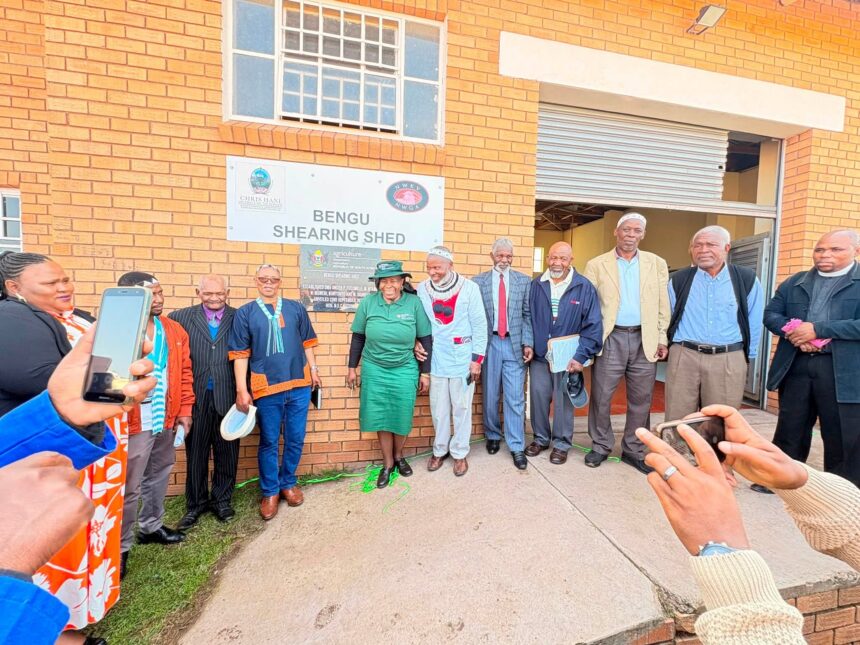
Wool farmers in the Bengu community are demonstrating the economic potential of rural livestock farming, with annual wool sales exceeding R1 million. The achievement highlights how organised agricultural production can create income opportunities while strengthening the role of rural communities in the agricultural economy. It also shows why infrastructure development matters across the agricultural value chain, particularly for farmers who need appropriate facilities to process and prepare their products for market. The farmers have received a new shearing shed from the district municipality, providing infrastructure intended to strengthen wool production and improve their participation in agricultural value chains. This development represents an important step in supporting local wool farmers as they work to build productive and sustainable livestock enterprises.
The value of more than R1 million in annual wool sales provides a clear indication of the commercial activity already taking place within the Bengu farming community. Wool production forms part of the broader livestock economy, connecting sheep farmers with shearing services, wool handling, buyers, transport and other activities required to move agricultural products towards markets. When farmers can produce and market wool consistently, the benefits can extend beyond individual farming households to other participants in the local agricultural economy. Higher levels of agricultural activity can create demand for services and strengthen connections between rural producers and established markets. The Bengu example therefore illustrates how livestock farming can contribute to rural economic activity when farmers have productive assets, market opportunities and suitable infrastructure.
A shearing shed plays a practical role in the wool production process because sheep need to be shorn efficiently and the wool needs to be handled appropriately after shearing. A suitable facility can provide a dedicated environment where farmers can conduct shearing activities in a more organised manner. Better facilities can also help create more structured conditions for handling, sorting and preparing wool before it enters the next stages of the value chain. The new facility provided to the Bengu farmers is intended to strengthen wool production and support their participation in agricultural markets. Its value therefore extends beyond the physical building because it forms part of the infrastructure required to support a functioning wool production system.
Infrastructure remains one of the important factors influencing agricultural development in rural areas. Farmers require more than land and livestock to operate successful agricultural enterprises, as production also depends on facilities, equipment, roads, water, storage, transport and access to markets. Where appropriate infrastructure is limited, farmers can face additional operational difficulties and may struggle to capture the full value of their products. Investment in agricultural facilities can help address some of these constraints by creating better conditions for production and handling. The new shearing shed in Bengu demonstrates how targeted infrastructure can support a specific stage of the agricultural value chain while contributing to wider rural development objectives.
The wool value chain begins with sheep farming but extends through several stages before wool reaches its final market. Farmers must maintain healthy sheep, manage their flocks and ensure that shearing takes place under appropriate conditions. Once sheep are shorn, the wool requires proper handling so that it can move efficiently through subsequent stages of the supply chain. Buyers and processors depend on wool being presented in a condition that allows it to be assessed and marketed according to relevant requirements. Strengthening facilities at the farm and community level can therefore help farmers participate more effectively in a value chain that connects rural production with wider markets.
For wool farmers, the timing and organisation of shearing can also influence how efficiently they manage their livestock enterprises. Shearing is a recurring activity that requires planning, labour and suitable equipment or facilities. A dedicated shearing shed can give farmers a central location for this important operation and can help bring greater organisation to the shearing process. It can also provide a shared resource for farmers in the community where the facility is used collectively. Such infrastructure can become an important agricultural asset when farmers use it effectively and maintain it over time.
The Bengu farmers’ annual wool sales also highlight the importance of moving from subsistence-oriented production towards stronger commercial participation where conditions allow. Commercial agriculture requires farmers to understand their production costs, manage their livestock effectively and maintain relationships with buyers and other value chain participants. Reliable production and consistent quality can help farmers build stronger market relationships over time. Infrastructure can support this process by improving the conditions under which agricultural products are prepared for market. The combination of productive livestock farming, organised wool production and suitable facilities can therefore create opportunities for rural farmers to strengthen their businesses.
Agricultural infrastructure can also support collective action among farmers. A shared shearing facility can bring producers together around a common production activity and create opportunities for greater coordination. Farmers can exchange knowledge, discuss production challenges and work together to improve how they participate in the wool value chain. Collective use of infrastructure can also make it easier to maintain facilities and coordinate certain agricultural activities, although the effectiveness of such arrangements depends on sound management and cooperation among users. Strong farmer organisations and responsible management can help ensure that infrastructure continues to deliver value beyond its initial investment.
The economic significance of the Bengu wool industry should also be considered in the context of rural livelihoods. Income generated through livestock farming can support households and contribute to economic activity within rural communities. Farmers may use agricultural income to cover household needs, reinvest in livestock, improve infrastructure or purchase inputs and equipment. When agricultural enterprises become more productive, the resulting economic activity can have effects beyond the farm itself. The more than R1 million in annual wool sales therefore represents not only the value of a particular agricultural product but also an example of the income-generating potential of organised rural livestock production.
The development of the new shearing shed can help create a stronger foundation for future wool production in the community. However, infrastructure alone does not guarantee increased production or higher income. Farmers also need access to appropriate technical knowledge, livestock management practices, reliable markets and effective agricultural support services. The facility will be most valuable when it is integrated into a broader approach that supports productivity and responsible management of the wool enterprise. Continued attention to flock health, grazing, shearing practices, wool handling and market participation can help farmers make productive use of the new infrastructure.
The Bengu example also demonstrates why agricultural development should consider the full value chain rather than focusing only on primary production. A farmer may have healthy livestock and produce valuable wool, but the ability to capture economic value also depends on what happens after production. Facilities for shearing and handling can influence how efficiently farmers move their products into the market. Transport, market access, buyer relationships and financial management are also important components of a functioning agricultural value chain. Supporting several parts of this system can help rural farmers participate more meaningfully in commercial agriculture.
For South Africa’s rural agricultural economy, livestock production remains an important source of economic activity and livelihoods in many communities. Sheep farming can provide farmers with products such as wool and livestock while creating links with agricultural service providers and downstream industries. Developing rural infrastructure can help address practical constraints that limit the ability of producers to participate fully in these markets. At the same time, farmers need to continue improving production practices and managing their enterprises as businesses. The experience of the Bengu community shows how these different elements can come together to create a stronger foundation for rural agricultural development.
The more than R1 million generated annually through wool sales by farmers in the Bengu community provides an important example of the economic potential within rural livestock farming. The new shearing shed adds practical infrastructure that is intended to strengthen wool production and improve farmer participation in the agricultural value chain. Its development highlights the connection between productive livestock, suitable facilities, organised farming and access to markets. Sustaining the benefits will require farmers to maintain productive flocks, use the facility effectively and continue strengthening their participation in the wool value chain. With appropriate infrastructure and continued agricultural support, the Bengu community’s wool production can remain an important source of rural economic activity and demonstrate the wider value of investing in agricultural infrastructure.
Join 'Farmers Mag' WhatsApp Channel
Get the latest Farming news and tips delivered straight to your WhatsApp
CLICK HERE TO JOIN