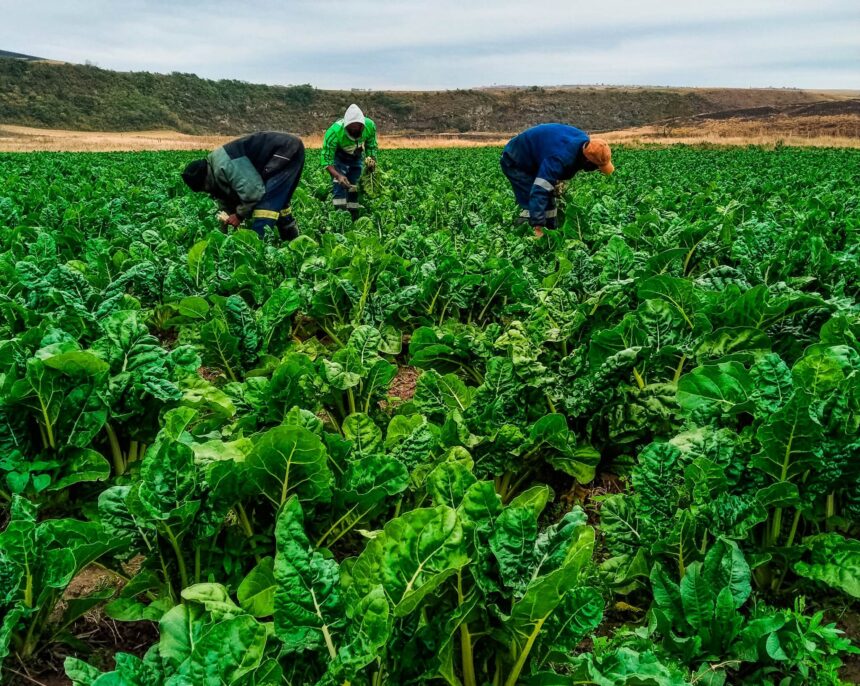
Amajabangqa Primary Co-op in Lusikisiki, within the Ingquza Hill Local Municipality, has transformed its farming operation from a small cabbage-producing enterprise into an intensive irrigated mixed vegetable producer covering more than 10.5 hectares. The cooperative’s growth shows how access to finance, infrastructure, mechanisation and reliable markets can help rural farmers increase production and build stronger agricultural businesses. Led by Ms Ntsaphokazi Mshumpela, the five-member cooperative previously operated on only 2.5 hectares and focused mainly on cabbage production. Limited working capital, inadequate fencing and challenges with mechanisation restricted the cooperative’s ability to expand its fields, diversify crops and maintain consistent supply to customers. Today, Amajabangqa is producing potatoes, cabbage and pumpkin on a much larger scale while creating employment opportunities for people in the Lusikisiki community.
The cooperative’s expansion represents a significant change in the scale and diversity of its agricultural production. Amajabangqa has increased its cultivated area from 2.5 hectares to more than 10.5 hectares under intensive irrigated mixed vegetable production. Its current production plan includes 3 hectares of potatoes, 4 hectares of cabbage and 3.5 hectares of pumpkin. This diversification gives the cooperative a broader production base instead of depending mainly on a single vegetable crop. It also provides opportunities to supply different products to customers and strengthen the commercial side of the farming operation.
Before receiving support, the cooperative faced several challenges that affected its ability to grow. Working capital was limited, making it difficult to meet the ongoing costs associated with a larger farming operation. The lack of adequate fencing also presented an infrastructure challenge, while limited access to mechanisation made it harder to expand production efficiently. These constraints affected the cooperative’s ability to increase its cultivated area and maintain the level of production required to serve customers consistently. For a rural agricultural enterprise, these challenges can make it difficult to move from small-scale production towards a more commercially focused operation.
Working capital is particularly important in vegetable farming because production requires spending before income is generated from sales. Farmers need resources to manage planting, crop establishment, field operations, harvesting and other production requirements throughout the growing cycle. When working capital is insufficient, even farmers with productive land and access to markets can struggle to maintain consistent operations. Ms Mshumpela described working capital as the “lifeblood of any business” and said that the funding helped address this challenge. For Amajabangqa, improved access to finance has therefore supported the cooperative’s ability to operate on a larger production scale.
Infrastructure has also played an important role in the cooperative’s development. Through support from ECRDA, Amajabangqa gained access to infrastructure including fencing and mechanisation. These improvements have helped create conditions for the cooperative to expand its farming activities beyond the limited area it previously cultivated. Mechanisation can also help farmers manage larger fields and carry out production activities more efficiently. For a cooperative seeking to participate in commercial agriculture, access to suitable infrastructure can provide an important foundation for sustained growth.
The expansion into potatoes, cabbage and pumpkin demonstrates the cooperative’s move towards diversified vegetable production. Each crop contributes to a farming operation that now covers a significantly larger area than before. Producing several crops can also allow a cooperative to respond to different market requirements and production opportunities. However, diversification requires careful planning because farmers must manage the needs of different crops while maintaining production quality. Amajabangqa’s current crop mix reflects the scale of its expanded operation and its focus on intensive irrigated vegetable farming.
Market access has become another important part of Amajabangqa’s development. The cooperative has secured formal offtake agreements with SPAR, Boxer and the Eyoluntu Farming Project. These arrangements provide a clearer connection between production and potential buyers, which is particularly important when farming at a commercial scale. Farmers need markets that can absorb their produce if increased production is to translate into sustainable business activity. Formal offtake agreements can help strengthen that connection by giving agricultural enterprises defined commercial relationships with buyers.
Reliable markets are especially important for vegetable farmers because fresh produce needs to move through the supply chain efficiently. Farmers must plan production around expected demand while also managing harvesting and delivery requirements. Having established buyers can provide a stronger basis for making production decisions and planning the use of available land. It can also encourage farmers to improve consistency because commercial customers require dependable supply. Amajabangqa’s market relationships therefore form an important part of its transition from a smaller farming operation into a more commercially oriented cooperative.
The cooperative’s growth is also having an effect beyond its five members. Amajabangqa now consistently employs 10 people and provides additional temporary work for seven workers. The employment opportunities are primarily benefiting young people and women from Lusikisiki. This means that the expansion of the farming operation is creating opportunities for local residents to participate directly in agricultural work. The cooperative’s development therefore demonstrates how growth in a rural farming enterprise can contribute to local economic activity as well as food production.
The involvement of young people and women is particularly relevant in rural agricultural development. Employment on farms can provide practical experience and an entry point into the agricultural value chain. As agricultural enterprises expand, they can create opportunities in production and other activities connected to the movement of farm products to markets. Consistent employment also gives local workers a chance to participate in an established farming operation rather than relying only on short-term opportunities. Amajabangqa’s workforce growth shows how investment in a rural agricultural business can have benefits that extend into the surrounding community.
The cooperative’s experience also highlights the relationship between finance and productive capacity. Funding alone does not automatically create a successful farming enterprise, but appropriate financial support can help address constraints that prevent farmers from using their productive potential. In Amajabangqa’s case, support helped address working capital needs while also providing access to fencing and mechanisation. These elements have supported the cooperative’s expansion from 2.5 hectares to more than 10.5 hectares of intensive irrigated production. The result is a farming operation with a wider crop mix, stronger market connections and a larger workforce.
For farmers in rural areas, the Amajabangqa example demonstrates why agricultural development needs to consider more than access to land. Productive farming also depends on the ability to finance operations, protect production areas, access appropriate machinery and connect with reliable markets. When one of these elements is missing, farmers can struggle to increase production even when they have land and farming experience. Addressing several constraints at the same time can create better conditions for agricultural enterprises to grow. Amajabangqa’s experience shows how these different pieces can work together in the development of a commercial farming operation.
The cooperative’s progress also underlines the importance of planning when expanding agricultural production. Moving from 2.5 hectares of mainly cabbage production to more than 10.5 hectares of mixed vegetables requires greater attention to production management and market supply. The expansion into potatoes, cabbage and pumpkin means the cooperative must coordinate different production activities across its available land. Its formal relationships with buyers provide an important commercial connection for this larger production base. Continued attention to production efficiency, market requirements and business management will remain important as the cooperative operates at its expanded scale.
Amajabangqa Primary Co-op’s journey from a small cabbage operation to a larger irrigated mixed vegetable enterprise illustrates the potential of targeted agricultural support in rural communities. The cooperative has expanded its production area, diversified into potatoes and pumpkin, improved infrastructure and strengthened its access to commercial markets. It has also created consistent employment for 10 people while providing additional temporary work for seven others, mainly young people and women from Lusikisiki. Its experience shows that rural agricultural enterprises can grow when key constraints such as working capital, fencing, mechanisation and market access are addressed. For farmers and agricultural cooperatives seeking to scale up production, the Amajabangqa story provides a clear example of how investment in the right areas can support stronger participation in commercial agriculture and create wider economic opportunities in the community.
Join 'Farmers Mag' WhatsApp Channel
Get the latest Farming news and tips delivered straight to your WhatsApp
CLICK HERE TO JOIN