

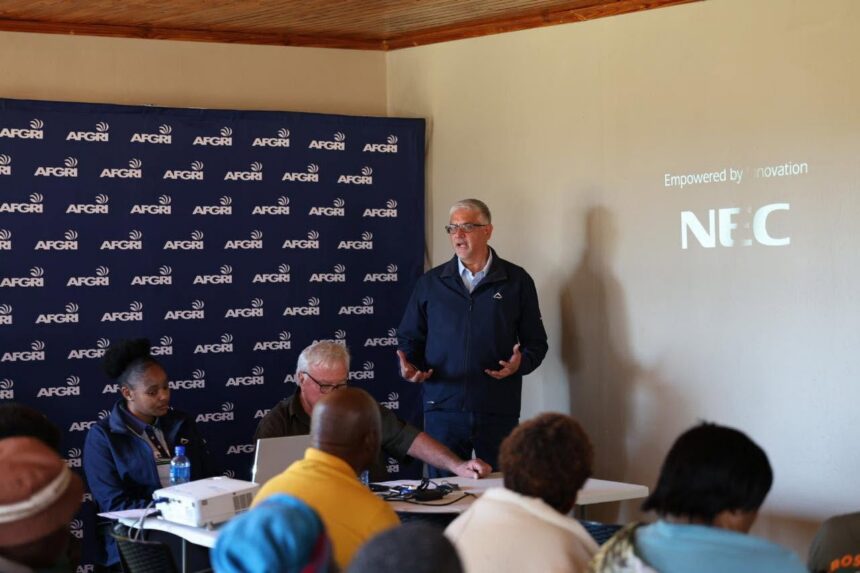
Collaboration between agricultural organisations and government continues to play an important role in helping farmers improve productivity and build sustainable businesses. AFGRI recently hosted the Gauteng Department of Agriculture and Rural Development Farmer Information Day at the Witklip Trial Farm in Bronkhorstspruit, bringing farmers and agricultural stakeholders together around practical opportunities for growth. The event showcased how innovation, technology, training and specialised agricultural services can support farmers across different stages of their development. It also highlighted the value of trial facilities and agronomy services in helping producers make informed decisions about production and crop performance. Through initiatives such as this, farmers can gain access to knowledge and resources that can contribute to stronger yields and more commercially sustainable operations.
The Witklip Trial Farm provided an appropriate setting for demonstrating how agricultural research, testing and practical knowledge can support farmers in their day-to-day operations. Trial facilities allow agricultural professionals and farmers to evaluate production approaches and gain a better understanding of how different practices perform under specific conditions. This information can help producers make more informed decisions about inputs, crop management and farming techniques. For farmers seeking to improve productivity, access to practical information can be an important part of reducing uncertainty and improving farm performance. Bringing these resources closer to farmers also creates opportunities for knowledge exchange between producers, agricultural specialists and industry organisations.
Agronomy services were among the areas highlighted during the Farmer Information Day, reflecting the importance of technical support in modern agriculture. Agronomy focuses on the science and management of crop production, including factors such as soil health, crop nutrition, planting practices and pest management. Farmers can use agronomic guidance to better understand the conditions affecting their crops and make decisions based on technical information. Effective agronomy can also support more efficient use of agricultural inputs, which can have an impact on production costs and overall profitability. By combining technical expertise with practical farming experience, producers can develop strategies that are better suited to their specific operations.
Training and mentorship also formed an important part of the farmer development focus demonstrated at the event. Farmers need more than access to agricultural products and equipment if they are to build sustainable commercial enterprises. They also need business knowledge, technical skills and guidance that can help them manage challenges and identify opportunities. Mentorship can provide farmers with access to experienced professionals who can share knowledge about production, planning and commercial decision-making. Ongoing training can further help producers adapt to changing technologies, market conditions and agricultural practices.
Technology is becoming increasingly important in the agricultural sector as farmers look for ways to improve productivity and manage resources more efficiently. Digital tools, agricultural equipment and data-driven systems can provide producers with information that supports better decision-making. Technology can also help farmers monitor crops, manage inputs and respond more quickly to production challenges. However, access to technology is most valuable when farmers also understand how to use it effectively within their own operations. The focus on technology at the Witklip Farmer Information Day therefore reflects the growing need to combine innovation with practical training and support.
Farmer development is particularly important for producers who are working to transition from smaller-scale operations towards commercial agriculture. Building a commercially successful farm requires careful planning, consistent production and an understanding of markets and financial management. Farmers must also manage risks associated with weather, input costs, changing demand and other factors that can affect profitability. Access to reliable agricultural information can help producers make better decisions and strengthen the resilience of their businesses. Events that connect farmers with service providers and agricultural specialists can therefore contribute to the development of stronger farming enterprises.
The collaboration between AFGRI and the Gauteng Department of Agriculture and Rural Development demonstrates the potential of partnerships to support agricultural development. Government has an important role in creating programmes and opportunities that support farmers, while private sector organisations can contribute specialised services, technology, expertise and commercial networks. When these resources are brought together, farmers can gain access to a broader range of support. Collaboration can also help ensure that agricultural development initiatives remain connected to the practical realities faced by producers. The Farmer Information Day provided a platform where these different areas of expertise could come together around a shared focus on farmer success.
The event also highlighted the importance of supporting farmers throughout the agricultural value chain. Farming involves much more than production in the field, as producers must consider inputs, finance, technology, agronomy, storage, logistics, marketing and market access. Gaps in any part of this chain can affect the performance of the overall farming business. A full value-chain approach can help farmers identify and address these different requirements in a more coordinated way. AFGRI’s commitment to supporting farmers across their journey reflects the need for agricultural services to extend beyond individual products and provide broader solutions for commercial development.
For farmers, access to a full range of agricultural services can simplify the process of finding appropriate support for different stages of their operations. Producers can benefit from combining agronomy services with training, mentorship, technology and other forms of assistance. This integrated approach can help farmers connect technical decisions with broader business objectives. For example, improving crop yields can have limited value if production costs remain too high or if farmers lack access to reliable markets. Sustainable commercial success requires producers to consider productivity, efficiency and profitability together.
Farmer information days can also play an important role in creating direct communication between agricultural businesses and producers. These events give farmers an opportunity to ask questions, learn about available services and see agricultural technologies or practices in a practical setting. They also allow organisations to better understand the challenges farmers are facing in different regions and farming systems. This exchange of information can help service providers develop solutions that are more relevant to producers’ needs. Stronger communication between farmers, government and the private sector can ultimately contribute to a more connected agricultural industry.
The emphasis on sustainable businesses is particularly relevant as farmers face increasing pressure to manage resources carefully while remaining commercially viable. Sustainable farming requires producers to consider long-term productivity rather than focusing only on immediate returns. Soil health, efficient input use, responsible water management and appropriate production practices can all contribute to the long-term performance of a farm. At the same time, farmers need strong business systems that allow them to manage costs and respond to market conditions. The combination of agricultural sustainability and commercial discipline can help farms remain productive and competitive over time.
Innovation can further support farmers as they respond to the changing demands of agriculture. Trial farms such as Witklip can provide an environment where new approaches and technologies are assessed before farmers consider adopting them on a larger scale. This practical evaluation can help producers understand potential benefits and limitations while reducing some of the uncertainty associated with adopting new practices. Innovation also extends beyond technology, as it can include new production methods, management systems and approaches to farmer development. Sharing these innovations with farmers can help accelerate the adoption of practices that have the potential to improve productivity and business performance.
The presence of the Gauteng Department of Agriculture and Rural Development at the Farmer Information Day also reinforces the importance of coordinated agricultural development within the province. Gauteng’s agricultural sector includes a wide range of producers, from emerging farmers to established commercial enterprises. Each group can face different challenges and require different forms of support. Programmes that encourage collaboration between government and agricultural businesses can help create opportunities for knowledge transfer and capacity building across these different groups. Supporting farmers at various stages of development can contribute to a stronger and more inclusive agricultural economy.
AFGRI’s involvement in the event reflects its continued focus on providing farmers with support across the agricultural value chain. A full value-chain offering can help producers access services and expertise that address both production requirements and broader commercial objectives. The company’s emphasis on agronomy, training, mentorship and technology demonstrates how agricultural support can extend beyond the supply of farming inputs. For farmers, having access to multiple forms of support can help them make more informed decisions and build stronger operations. The goal is ultimately to help producers improve their performance while developing businesses that can remain sustainable in the long term.
The Farmer Information Day at the Witklip Trial Farm in Bronkhorstspruit has demonstrated what can be achieved when government, agricultural organisations and farmers work together around a shared goal. The event brought attention to the role of trial facilities, agronomy services, training, mentorship and technology in helping farmers improve yields and strengthen their businesses. It also reinforced the importance of supporting producers across the full agricultural value chain rather than addressing individual challenges in isolation. Through continued collaboration and access to practical expertise, farmers can be better positioned to make informed production and business decisions. AFGRI’s commitment to supporting farmers on their journey towards commercial success, together with government’s focus on farmer development, can contribute to a more productive, innovative and sustainable agricultural sector in Gauteng.
Join 'Farmers Mag' WhatsApp Channel
Get the latest Farming news and tips delivered straight to your WhatsApp
CLICK HERE TO JOIN




