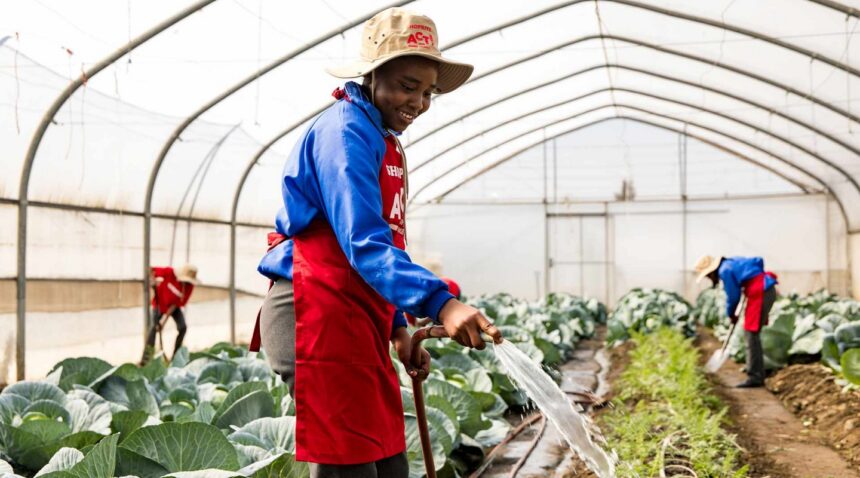
In the heart of Reiger Park, east of Johannesburg, two horticultural tunnels at Oosrand Commerce and Entrepreneurship School are doing far more than producing vegetables. Rows of spinach, cabbage, tomatoes, green peppers, chillies and eggplant are giving learners the opportunity to experience agriculture as a practical skill, a potential career and a pathway to entrepreneurship. The programme is helping young people understand how food is produced while showing them how farming can contribute to household incomes, community development and food security. Since the Shoprite Foundation established the tunnels two years ago, learners have harvested approximately 5,000 units of crops while gaining experience that extends beyond the classroom. The project demonstrates how practical agricultural education can equip young people with skills they can use at school, at home and in future farming businesses.
Before the horticultural tunnels were established, agricultural studies at the school were largely theoretical, limiting the opportunity for learners to apply what they were learning in practical situations. The new tunnels have changed that by giving learners direct access to growing crops and managing an agricultural production environment. Agricultural studies educator Joyce Ngcobo says the tunnels can accommodate her entire class of 42 learners, something that was not possible with the school’s previous smaller tunnel. This means learners can participate directly in planting, caring for crops, harvesting and other practical activities rather than simply learning about farming from textbooks. The experience gives them a better understanding of the work, planning and responsibility required to produce food successfully.
The results of the programme are already visible in the quantities of vegetables being produced and sold within the community. Ngcobo says the school now produces enough vegetables to supply people in Reiger Park and the neighbouring Ramaphosa informal settlement, with spinach proving particularly popular among customers. The income generated from produce sales is reinvested into the programme through the purchase of gardening resources such as compost and seedlings. This creates a practical cycle in which agricultural production supports the continued operation of the school’s farming activities. The project also demonstrates to learners that a vegetable garden can become a small business when production, marketing and financial management are considered alongside farming skills.
The vegetables also contribute to the school’s feeding programme, providing fresh produce that can be used to supplement meals prepared for learners. Kitchen employees provide lunch to approximately 90% of the school’s 2,200 learners, making the agricultural project directly relevant to the nutritional needs of the school community. Producing some of the food used in the feeding scheme gives learners a clear example of how agriculture can support food security at a local level. It also allows learners to see the connection between growing crops and providing nutritious food to people. This practical experience can help them understand that agriculture is not only about commercial farming but also about strengthening communities and improving access to food.
The skills developed at school are also reaching learners’ homes. Some learners have started growing seedlings and vegetables in their own yards where space allows, while others are selling produce to neighbours. These activities show how agricultural education can extend beyond the school grounds and become part of household life. Learners can share what they have learned with parents and other family members, creating an informal exchange of agricultural knowledge within the community. Ngcobo says parents are learning from their children about planting vegetables and watering gardens in the evening rather than during the hottest part of the day. The programme is therefore influencing farming practices at household level while encouraging families to consider small-scale food production.
For Ngcobo, who has spent years working as an educator, teaching agriculture has also changed her own understanding of the sector. She says the experience challenged her previous perception that farming was mainly an occupation for men. Her goal is now to encourage young women to consider owning farms, pursuing agricultural careers and becoming active participants in food production and rural and urban economic development. This focus on girls is particularly significant because agriculture offers opportunities across many areas, including crop production, farm management, agribusiness, processing, marketing and agricultural science. By exposing young women to practical farming skills at school, the programme is helping challenge traditional ideas about who can participate and succeed in agriculture.
The school’s agricultural programme is also giving learners opportunities to gain formal qualifications alongside their practical experience. When agriculture was introduced into the curriculum, former natural sciences and life sciences teacher Farida Beckweitz embraced the opportunity to become involved in the subject. Beckweitz, a 40-year-old mother of two and former learner at the school, has become one of the educators driving the programme forward. Earlier this year, she and Ngcobo qualified as occupational trainers, allowing them to support learners in developing practical skills aligned with workplace standards and technical requirements. Their additional training strengthens the school’s ability to provide learners with agricultural education that has value beyond the classroom.
The programme’s first cohort has already produced encouraging results, with nine of the 10 learners completing Level 1 and Level 2 crop production certificates. Since 2024, more than 1,700 learners have participated in practical agricultural training at the school. These figures demonstrate the scale of the programme and its potential to influence a significant number of young people over time. The school wants learners to leave with more than a matric certificate by giving them practical and vocational skills that can support further education, employment or entrepreneurship. In the longer term, the school hopes to extend agricultural training to unemployed parents in the community, creating an opportunity to transfer these skills to adults who are also looking for ways to improve their livelihoods.
For Beckweitz, the horticultural tunnels have transformed the way agricultural education takes place. Practical work allows learners to experience the satisfaction of planting something, caring for it and watching it develop into a harvest. Learners have become enthusiastic about experimenting with simple growing projects, including regrowing onions from cut-off tops in water or soil. These small experiments can teach important lessons about plant growth while encouraging curiosity and problem-solving. When learners return to class excited because a plant they started growing at home is developing, they are seeing first-hand how agricultural knowledge can produce tangible results.
The school has also deliberately encouraged more girls to participate in the agricultural programme. Beckweitz acknowledges that the school initially selected mostly girls because educators wanted to challenge traditional attitudes about gender and farming. She recalls encountering the belief that boys and men would naturally be better suited to agricultural work, but the growing participation of girls is helping challenge that assumption. Today, girls outnumber boys in the programme, giving them greater visibility in an area that has often been viewed as male dominated. Their participation can help reshape perceptions of agriculture while showing younger learners that women can become farmers, agricultural entrepreneurs, technicians, managers and leaders.
The school is now looking beyond primary production and considering how learners can participate in agricultural processing and value addition. Beckweitz hopes to establish an on-site processing facility where learners could pickle chillies, carrots and other vegetables and sell the products under the school’s name. Such a facility would expose learners to another important part of the agricultural value chain, including processing, packaging, branding, marketing and sales. Value addition can increase the economic potential of agricultural products by turning fresh produce into products that can be stored, marketed and sold in different ways. Introducing these concepts at school could help learners understand that agricultural entrepreneurship involves much more than growing crops.
The impact of the programme can also be seen in the experiences of former learners. Former learner Sello Mokena, now 20, from the Ramaphosa informal settlement, says the agricultural programme helped develop his passion for farming. He has transformed his small backyard into a productive vegetable garden and donates some of the produce to a local school. His experience demonstrates how practical agricultural education can continue influencing learners after they leave the classroom. It also shows how a small growing space can become a useful source of food and a way for young people to contribute to their communities.
Mokena’s decision to donate vegetables to a local school also highlights the social impact that young farmers can have beyond their own households. Agriculture can provide opportunities for income generation, but it can also help people address food insecurity in their communities. When young people develop the skills to grow vegetables, they can use those skills to support their families, sell produce or assist community organisations. This creates a broader understanding of farming as both an economic activity and a tool for social development. The example also reinforces the importance of giving young people practical agricultural knowledge while they are still at school.
The Shoprite Foundation’s investment in the horticultural tunnels has created a platform for the school to combine education, food production and entrepreneurship. The project has produced thousands of crops while providing practical training to learners and supporting the school feeding scheme. It has also created opportunities for learners to sell produce, develop home gardens and share agricultural knowledge with their families. According to Shoprite Foundation Director Maude Modise, the results demonstrate the lasting impact that practical education can have on young people, particularly when it combines skills development with real community benefits. The project shows how partnerships between schools and organisations can help create practical learning environments that prepare young people for economic participation.
The future plans at Oosrand Commerce and Entrepreneurship School point to an agricultural programme that could continue expanding beyond the existing tunnels. Increasing production, introducing processing and providing training to more community members could create additional opportunities for skills development and entrepreneurship. The school’s experience also shows that urban and township communities can participate meaningfully in agriculture even when access to land is limited. Horticultural tunnels, school gardens and backyard production can provide practical alternatives for growing food in areas where large farming plots are not available. With appropriate training, resources and market connections, these small-scale activities can contribute to household food security while introducing young people to the wider agricultural economy.
The story of Oosrand Commerce and Entrepreneurship School demonstrates the value of practical agricultural education in preparing the next generation of farmers and entrepreneurs. The horticultural tunnels have turned agricultural studies from a largely theoretical subject into an experience where learners plant, grow, harvest, sell and learn from the results of their work. The programme is producing fresh vegetables, supporting the school feeding scheme, generating income for gardening resources and spreading agricultural knowledge into surrounding households. It is also challenging gender stereotypes by encouraging girls to see farming and agricultural careers as opportunities for themselves. As learners gain confidence and practical skills, the project is showing that agriculture can help young people build livelihoods, strengthen food security and contribute to the economic development of their communities.
Join 'Farmers Mag' WhatsApp Channel
Get the latest Farming news and tips delivered straight to your WhatsApp
CLICK HERE TO JOIN