

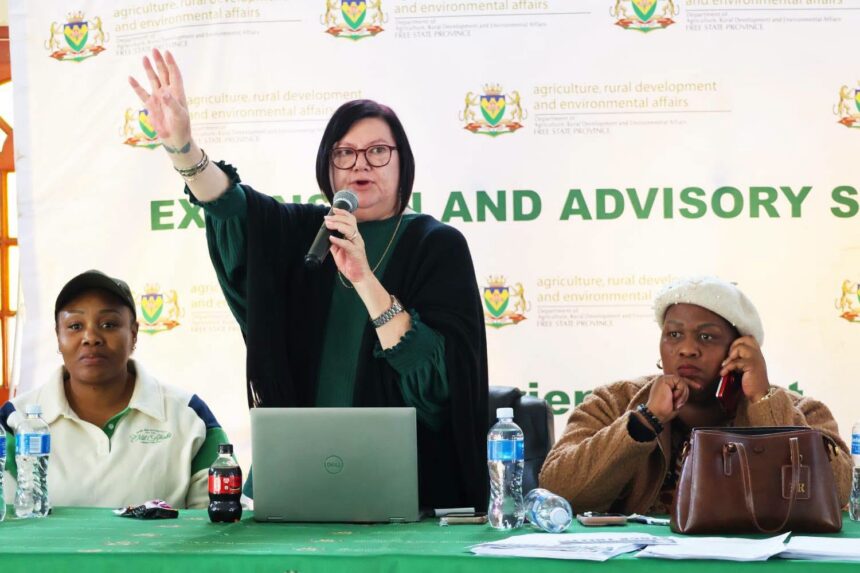
The Free State MEC for Agriculture, Rural Development and Environmental Affairs, Ms Elzabe Rockman, has engaged farmers in Bethulie as the provincial government continues efforts to address challenges affecting the agricultural sector. The farmers’ engagement session was held at Cloetespark Hall in Bethulie, within the Kopanong Local Municipality in the Xhariep District. Local farmers and key stakeholders gathered to discuss challenges affecting agricultural production, rural livelihoods and the sustainability of farming operations in the area. The engagement provided farmers with an opportunity to raise concerns directly with the MEC and representatives from government departments and other institutions. It also gave the Department of Agriculture, Rural Development and Environmental Affairs (DARDEA) an opportunity to explain available support programmes and explore practical responses to issues affecting the local farming community.
The engagement forms part of DARDEA’s ongoing efforts to maintain direct communication with farmers and better understand the conditions under which they operate. Direct engagement with farming communities allows government officials to hear about challenges that may not always be fully reflected in administrative reports or programme assessments. It also creates an opportunity for farmers to receive information about government services, funding opportunities, training and other forms of agricultural support. The session brought together stakeholders with responsibilities across animal health, policing, land reform, disaster management and farmer development. This approach recognises that agricultural development depends on several interconnected factors and requires cooperation between different institutions.
Among the dignitaries attending the engagement were the Executive Mayor of Xhariep District Municipality, Cllr Irene Mehlomakulu, and the Mayor of Kopanong Local Municipality, Cllr Xolani Tseletsele. Their participation highlighted the importance of cooperation between provincial and local government when addressing agricultural challenges in rural communities. Farmers often rely on different levels of government for services such as infrastructure, water provision, disaster management, agricultural support and local development. Coordination between these institutions can help prevent duplication and ensure that farmers are directed to the appropriate support structures. The presence of municipal leadership also provided an opportunity for local concerns to be considered within broader development planning for Bethulie and the surrounding agricultural communities.
The programme included presentations on several issues that have a direct impact on farmers and rural livelihoods. Ms Mavis Dlanga, a Control Animal Health Technician from DARDEA, addressed farmers on Foot-and-Mouth Disease (FMD), an important livestock health concern that requires effective monitoring and responsible animal management. Constable Motang from the South African Police Service spoke about stock theft, which remains a serious threat to livestock owners and can cause substantial financial losses. Ms Maggie Shasha from the Department of Land Reform and Rural Development provided information on land acquisition, while Mr Jacob Josiah from Disaster and Fire Services addressed fire prevention and mitigation. Ms Angie Sepeesa from Xhariep District Municipality also presented information on farmer support programmes available to agricultural producers.
The discussion on Foot-and-Mouth Disease was particularly relevant for livestock farmers because animal health directly affects production, movement and market opportunities. Farmers need accurate information about disease prevention, reporting procedures and responsible livestock management to reduce the risks associated with animal health outbreaks. Veterinary and animal health officials also play an important role in helping farmers understand measures that can protect livestock and limit the spread of diseases. Regular communication between farmers and animal health authorities can improve disease surveillance and ensure that potential problems receive attention as early as possible. The inclusion of FMD in the engagement programme therefore provided farmers with an opportunity to strengthen their understanding of an issue that can affect both individual farming operations and the wider livestock economy.
Stock theft emerged as another major concern during the meeting, with farmers highlighting the persistent impact of livestock crime on their livelihoods. Livestock represents a significant economic asset for many rural households and commercial producers, meaning the loss of animals can undermine years of investment and reduce a farmer’s ability to maintain production. Stock theft can also create additional costs for farmers who need to strengthen security, improve livestock identification or recover stolen animals. Cooperation between farmers, SAPS and other relevant authorities remains important in preventing crime and improving responses when animals disappear. The participation of Constable Motang provided a platform for farmers to discuss the problem directly with law enforcement and to consider ways of strengthening cooperation around livestock security.
Farmers also raised concerns about water provision, inadequate fencing and deteriorating livestock handling facilities. These infrastructure challenges can affect the ability of farmers to manage livestock safely and maintain productive agricultural operations. Reliable water supplies are particularly important in rural farming areas where livestock depend on accessible sources of water throughout the year. Proper fencing can help farmers manage grazing areas, prevent livestock from straying and support more effective management of commonage land. Functional livestock handling facilities are equally important because farmers and animal health officials need suitable infrastructure for activities such as inspections, vaccinations, identification and other livestock management procedures.
Agricultural education and training also featured prominently in the concerns raised by farmers. Farmers called for the reintroduction of agricultural education in schools while also highlighting the need for practical agricultural training. Providing young people with agricultural knowledge can help them understand the opportunities available within farming and the wider agricultural value chain. Training can also help existing farmers improve their technical knowledge, business management skills and ability to adopt more effective production methods. The emphasis on youth education is particularly important because the long-term sustainability of rural agriculture depends on developing a new generation of farmers, agricultural workers and entrepreneurs.
The farmers further raised concerns about overgrazing, livestock kraals and access to tractors. Overgrazing can place pressure on grazing resources and reduce the condition of land when livestock numbers exceed the capacity of available grazing areas. Proper livestock kraals can assist farmers with animal management while providing a controlled environment for certain livestock activities. Access to tractors and agricultural machinery can also make a significant difference to farmers who need to prepare land, maintain fields or carry out other production activities. These concerns demonstrate that farmers require a combination of infrastructure, equipment, technical assistance and responsible resource management to improve agricultural productivity.
Access to land and funding opportunities were also identified as important areas requiring attention. Land remains a central issue for agricultural development because farmers need secure and suitable land to establish or expand productive enterprises. However, access to land alone does not guarantee agricultural success, as farmers also require capital, infrastructure, equipment, skills and reliable markets. Funding programmes can help address some of these barriers by supporting production inputs, infrastructure development and business expansion where farmers meet the relevant requirements. Providing farmers with clear information about available funding opportunities can therefore help them identify potential sources of support and prepare stronger applications.
Veld fire prevention and protection was another important issue raised during the engagement, particularly given the potential damage that uncontrolled fires can cause to grazing land, livestock, infrastructure and agricultural resources. Farmers need practical information about fire prevention, preparedness and coordinated responses when fires occur. Disaster and fire services can play an important role in helping communities understand their responsibilities and improve their readiness for fire-related risks. Effective prevention can include appropriate firebreaks, equipment, communication systems and cooperation between neighbouring land users. The participation of Disaster and Fire Services at the Bethulie engagement provided an opportunity to place these concerns directly on the agenda and discuss ways to reduce risks to agricultural communities.
In responding to the concerns raised by farmers, MEC Rockman emphasised the importance of unity among commonage farmers and called for meaningful participation by young people and women. Strong cooperation among farmers can make it easier to implement agricultural programmes, manage shared resources and address common challenges. The MEC also acknowledged ongoing conflicts within the two commonage structures in Bethulie, noting that these divisions continue to hinder effective service delivery and agricultural development. Where farmers share commonage resources, disagreements can make it difficult to reach decisions and implement programmes efficiently. Rockman stressed that collaboration and unity are essential if government interventions are to produce meaningful results and improve farmers’ livelihoods.
The emphasis on youth and women’s participation also reflects the need for agricultural development to create opportunities for a wider range of community members. Young people can contribute new skills, business ideas and technological approaches to agriculture, while women already play important roles across many areas of agricultural production and rural economic activity. Creating meaningful opportunities for these groups can strengthen participation in the agricultural economy and support broader community development. Government programmes can have a greater impact when farmers and community members actively participate in shaping and implementing them. The Bethulie engagement therefore highlighted both the challenges facing farmers and the importance of building an inclusive agricultural sector.
The farmers also used the occasion to showcase their agricultural offerings, giving the engagement an important commercial and community dimension. Showcasing local products allows farmers to demonstrate their capabilities and highlight the range of agricultural activities taking place in Bethulie. It can also help create greater awareness of local production and encourage connections between farmers, government officials, potential buyers and other stakeholders. Such opportunities are valuable because agricultural development depends not only on production but also on the ability of farmers to access markets and generate sustainable income. The participation of Bethulie farmers demonstrated their willingness to contribute to the local agricultural economy and to engage constructively with government.
Farmers expressed their appreciation for the MEC’s engagement and described the session as an important platform for addressing their concerns. Direct communication between government and farming communities can help strengthen relationships and create a better understanding of the practical realities faced by farmers. The issues raised in Bethulie show that agricultural development requires attention to infrastructure, animal health, security, land, education, skills, equipment, water, fire prevention and financial support. Addressing these challenges will require sustained cooperation between DARDEA, municipalities, law enforcement agencies, land reform authorities, disaster management services and farmers themselves. Continued engagement can help ensure that government interventions remain responsive to the needs of farming communities.
The Bethulie farmers’ engagement demonstrates the value of bringing government officials and agricultural communities together to discuss challenges and identify practical solutions. MEC Elzabe Rockman’s engagement provided farmers with an opportunity to raise issues affecting their daily operations while allowing government stakeholders to respond within their areas of responsibility. The concerns around water, fencing, livestock facilities, stock theft, land access, agricultural education, training, machinery, funding and veld fires highlight the wide range of issues that influence the success of rural agriculture. Addressing these challenges will require unity among farmers, meaningful participation from young people and women and strong cooperation across government and community structures. With continued dialogue and coordinated action, the engagement can contribute to stronger agricultural support, improved rural livelihoods and more sustainable agricultural development in Bethulie and the wider Xhariep District.
Join 'Farmers Mag' WhatsApp Channel
Get the latest Farming news and tips delivered straight to your WhatsApp
CLICK HERE TO JOIN




