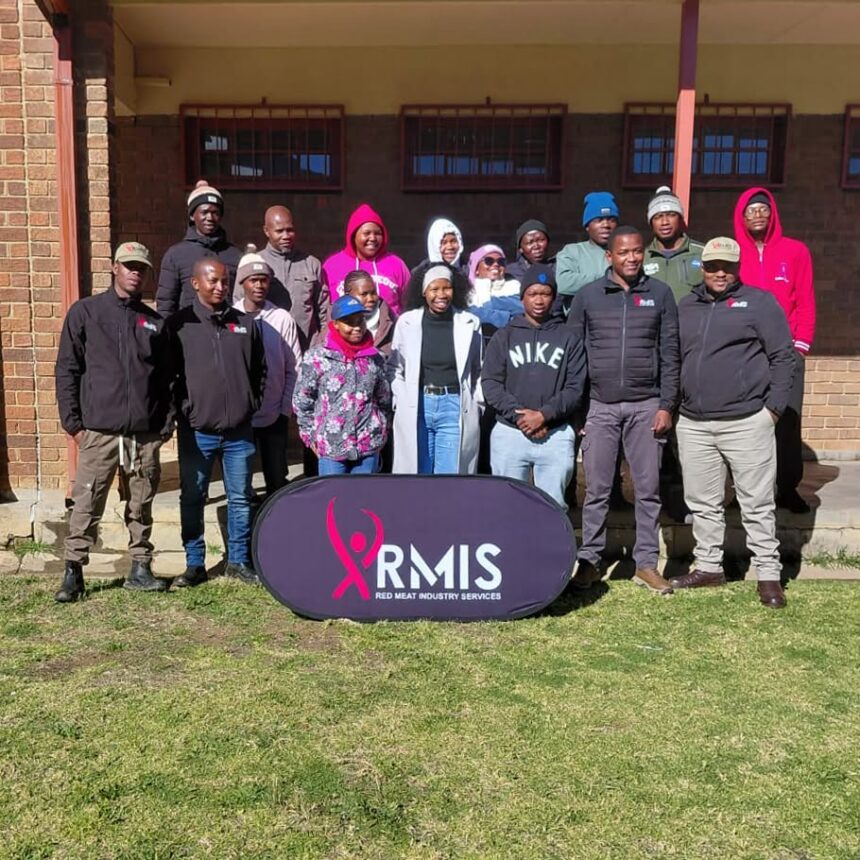
The Red Meat Industry Services (RMIS) continues to strengthen South Africa’s livestock sector by equipping farmers with practical knowledge that improves animal health and farm productivity. From 1 to 3 July, RMIS hosted a three-day Basic Herd Health Management Training programme in Wepener, bringing together farmers who were eager to enhance their livestock management skills. The training focused on providing participants with practical techniques that can be applied directly on their farms to improve herd health, reduce disease risks and increase overall production. By combining technical expertise with hands-on learning, the programme created an environment where both experienced and aspiring farmers could build valuable knowledge. The initiative highlights RMIS’s ongoing commitment to supporting sustainable livestock farming and strengthening the country’s red meat industry.
The training was presented by RMIS Livestock Technical Advisor and Assessor Frans Dolamo, whose extensive experience in livestock production provided participants with practical insights into effective herd health management. He was supported by John Matsoso, RMIS Livestock Technical Advisor for the Northern Cape and Free State, along with two RMIS Junior Livestock Technical Advisors, also known as Animal Health Technicians. Together, the team delivered a comprehensive programme that covered key areas of livestock health, disease prevention and effective herd management. Their combined expertise ensured that participants received practical guidance based on real farming challenges faced by livestock producers across South Africa. The collaborative approach also gave farmers the opportunity to ask questions, share experiences and receive advice tailored to common herd management issues.
Basic herd health management plays a vital role in the success of any livestock farming operation. Healthy animals are generally more productive, grow more efficiently and are better able to withstand disease challenges. Farmers who understand the importance of regular health monitoring, vaccination programmes, parasite control and proper nutrition are more likely to maintain profitable herds over the long term. Training programmes such as this help farmers identify health problems early, implement preventative measures and reduce losses caused by disease outbreaks. By investing in farmer education, RMIS is helping improve both animal welfare and the economic sustainability of livestock enterprises.
One of the most encouraging aspects of the training was the strong participation of young and aspiring farmers. Throughout the three-day programme, participants actively engaged in discussions, asked thoughtful questions and demonstrated a genuine desire to improve their farming practices. Their enthusiasm reflected a growing interest among the next generation of livestock producers to adopt modern farming techniques and improve the performance of their herds. Young farmers play a critical role in the future of South African agriculture, and providing them with practical training helps build confidence and encourages long-term success. The willingness of these participants to learn also creates opportunities for knowledge sharing within their own farming communities.
Interactive learning formed an important part of the programme, allowing participants to connect classroom theory with practical livestock management techniques. Farmers were encouraged to share their own experiences, discuss challenges faced in different farming environments and explore practical solutions together with the trainers. This type of learning environment promotes collaboration and allows participants to benefit from both expert guidance and peer experiences. By creating opportunities for open discussion, the training helped strengthen relationships among farmers while encouraging continuous learning. Such engagement is essential for building resilient farming communities capable of adapting to changing agricultural conditions.
Effective herd health management extends beyond treating sick animals. It involves developing management systems that prevent disease, improve nutrition, support reproductive performance and maintain high animal welfare standards. Farmers who regularly monitor their livestock can identify health concerns before they become serious problems, reducing treatment costs and improving production outcomes. Proper record keeping, biosecurity measures and planned vaccination schedules also contribute to healthier herds and stronger business performance. The knowledge shared during the RMIS training provides participants with practical tools that can improve decision making and support sustainable livestock production.
Training initiatives like this also contribute to the broader development of South Africa’s red meat value chain. Healthy livestock form the foundation of quality meat production, benefiting farmers, processors, retailers and consumers alike. As more farmers adopt improved herd health practices, the industry becomes more competitive, productive and resilient. Educational programmes that focus on practical skills help strengthen food security while supporting rural economic development through improved agricultural productivity. Continued investment in farmer training remains an important strategy for building a sustainable and profitable livestock sector.
The success of the programme was also made possible through the valuable support of the Wepener Study Group. Led by Nthabi Mokhatla, the study group played an important role in coordinating the training and ensuring that the programme ran smoothly throughout the three days. Their commitment and effective organisation created a welcoming environment that encouraged participation and learning. Partnerships between industry organisations and local farming groups help extend the reach of agricultural education while strengthening relationships within farming communities. Such collaboration demonstrates the importance of working together to achieve long-term improvements in the livestock sector.
The RMIS Basic Herd Health Management Training in Wepener demonstrates the value of practical agricultural education in empowering farmers and strengthening South Africa’s livestock industry. By bringing together experienced technical advisors, enthusiastic young farmers and supportive local partners, the programme delivered knowledge that can have lasting benefits for livestock production and herd health. Participants left with improved skills, greater confidence and practical techniques that can be applied directly on their farms. As RMIS continues to invest in farmer development through initiatives like this, it is helping build a more productive, sustainable and resilient red meat industry. The strong participation and positive engagement seen during the training show that South Africa’s livestock sector has a committed new generation of farmers ready to drive future growth and agricultural success.
Join 'Farmers Mag' WhatsApp Channel
Get the latest Farming news and tips delivered straight to your WhatsApp
CLICK HERE TO JOIN