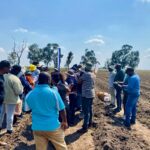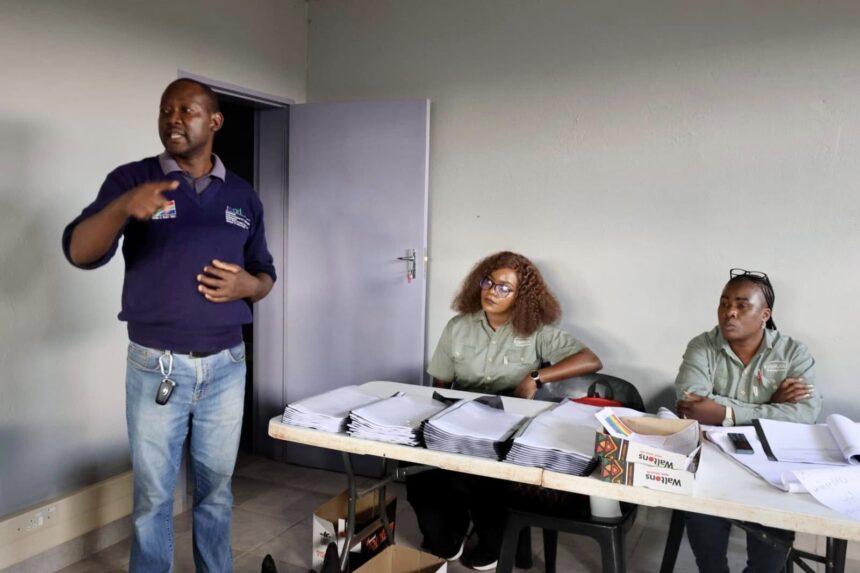
The Department, through the Directorate of Sustainable Resource Use Management under the Subdirectorate of Disaster Risk Reduction, is currently running a targeted training programme to equip emerging farmers with essential farm and veld fire fighting skills. The training is taking place from 04 to 07 May 2026 at Makweleng Auction Pan in Mabeskraal within the Moses Kotane Local Municipality in the Bojanala District. This initiative responds to the growing risk of veld fires that threaten farmland, grazing areas, and rural livelihoods across the region. A total of 59 farmers from different villages are participating in the programme, reflecting a strong community commitment to disaster preparedness. The focus is on building practical skills that farmers can apply immediately in their own environments. This intervention is part of a broader strategy to reduce fire-related damage and strengthen rural resilience.
Participants in the training were carefully selected based on their exposure to high-risk fire zones. Farmers from areas identified as vulnerable to veld fires were prioritised by the Bojanala District Coordinator, Thabo Mooketsi. This targeted approach ensures that those most likely to be affected receive the necessary skills and knowledge first. The group is made up of 95% male and 5% female participants, all of whom have shown willingness to actively contribute to fire prevention efforts in their communities. The demographic composition also highlights ongoing challenges around gender representation in farming roles. Despite this, the programme encourages inclusive participation and knowledge sharing across all community members.
The core objective of the training is to equip farmers with practical and life-saving skills to prevent, control, and respond to veld fires effectively. Participants are being trained on how to identify early signs of fire risk, create firebreaks, and use basic firefighting techniques in rural environments. The programme also covers safe methods of responding to active fires without putting lives and property at unnecessary risk. Farmers are being taught how to coordinate with local authorities and report fire incidents quickly to ensure faster response times. This improves overall disaster management and reduces the spread of uncontrolled fires. The training is designed to be hands-on so that participants can apply what they learn directly in the field.
Knowledge transfer is a key component of the programme, with participants expected to share what they learn with other community members. This approach helps extend the impact of the training beyond the 59 farmers attending the sessions. By passing on skills, farmers become local leaders in disaster risk reduction within their villages. This creates a multiplier effect that strengthens overall community resilience to veld fires. It also encourages collective responsibility in managing fire risks across grazing lands and farmlands. Community-based knowledge sharing is seen as one of the most effective ways to sustain long-term behavioural change.
At the end of the training programme, farmers will receive compliance certificates as proof of their participation and skills acquisition. These certificates recognise their readiness to respond to veld fire incidents in a safe and controlled manner. In addition to certification, participants will also be provided with protective clothing to support their operational safety during fire response activities. This equipment is essential in reducing injury risks when dealing with high-temperature environments and unpredictable fire conditions. The provision of protective gear ensures that farmers are properly equipped to act when emergencies arise. It also reinforces the importance of safety in all disaster response activities.
The initiative reflects a broader commitment by the Department to strengthen disaster risk reduction capacity in rural communities. Veld fires remain a significant threat in agricultural areas, often leading to loss of grazing land, livestock, and infrastructure. By investing in training and equipment, the Department is helping farmers become the first line of defence against these disasters. This proactive approach reduces dependence on emergency response teams and improves local preparedness. It also supports sustainable farming by protecting essential natural resources. Strengthening local capacity is key to reducing long-term environmental and economic losses.
The veld fire training programme in Moses Kotane represents an important step toward building safer and more resilient farming communities. By equipping emerging farmers with practical skills, safety equipment, and formal recognition, the Department is empowering them to take active roles in disaster prevention and response. The initiative not only addresses immediate fire risks but also promotes long-term awareness and responsibility within rural areas. As knowledge spreads through communities, the impact of the training is expected to grow beyond the initial participants. Stronger preparedness will lead to reduced fire damage and improved agricultural stability. This programme reinforces the importance of continuous investment in disaster risk reduction for sustainable rural development.
Join 'Farmers Mag' WhatsApp Channel
Get the latest Farming news and tips delivered straight to your WhatsApp
CLICK HERE TO JOIN