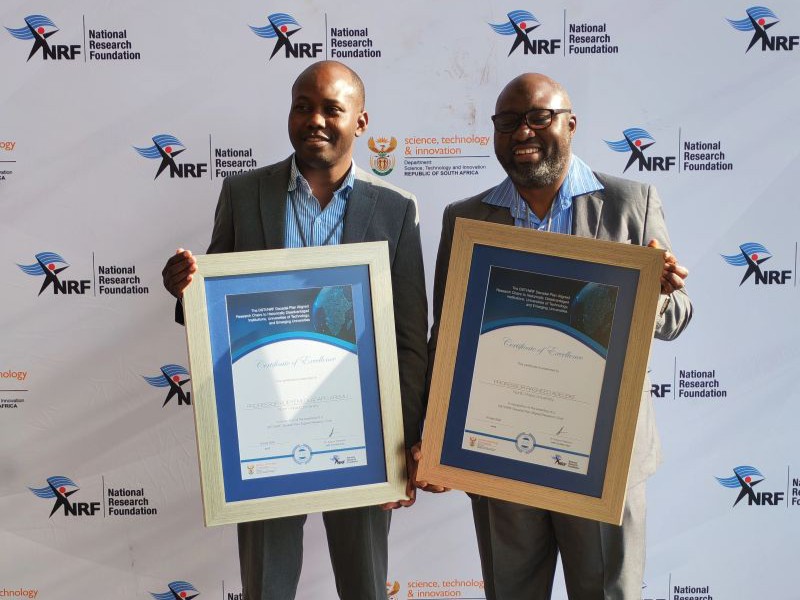
The North-West University has reinforced its role in agricultural innovation by awarding two major research chairs to Adeyemi Oladapo Aremu and Rasheed Adeleke under the South African Research Chairs Initiative. This development marks a strategic investment in science that directly supports farmers and strengthens food security systems in South Africa. The announcement came from the National Research Foundation during the national launch of the Decadal Plan Aligned Research Chairs. The event took place at the Council for Scientific and Industrial Research in Pretoria on 16 April 2026. It brought together policymakers, academics, and international stakeholders who are focused on advancing research that addresses real agricultural challenges.
The introduction of 41 new research chairs across the country signals a strong national commitment to science-driven development. These chairs focus on key areas such as agriculture, sustainability, and innovation, all of which are critical to improving food production systems. The event was attended by Blade Nzimande, along with university leaders and global partners. This level of participation shows the importance placed on research as a tool for economic growth and resilience. For farmers, these investments are not abstract, as they lead to practical improvements in productivity and resource management. The programme is designed to ensure that research outcomes move beyond academic settings and reach the people working on the land.
The SARChI programme remains one of the country’s most important funding instruments for building scientific leadership. It supports long-term research that delivers measurable impact, especially in sectors like agriculture where innovation is essential. At North-West University, the new chairs will focus on producing knowledge that farmers can apply in their daily operations. This includes improving soil health, increasing crop yields, and developing sustainable farming methods. The programme also encourages collaboration between scientists, government, and industry stakeholders. This integrated approach ensures that research remains relevant and aligned with national priorities.
At the Mahikeng Campus, Prof. Aremu’s research focuses on indigenous knowledge systems, medicinal plants, and underutilised crops. His work is important for smallholder and emerging farmers who rely on diverse cropping systems to manage risk and increase income. By studying indigenous plants, he aims to unlock new value chains that can create economic opportunities in rural areas. His research combines traditional knowledge with modern biotechnology to improve both productivity and sustainability. This approach helps preserve cultural practices while also introducing scientific advancements. It also supports biodiversity, which is essential for long-term agricultural resilience.
Prof. Aremu has emphasized that indigenous crops can play a major role in improving food security. These crops are often well adapted to local conditions and require fewer inputs compared to conventional crops. By promoting their use, farmers can reduce costs and improve yields under challenging conditions. His research also explores the medicinal value of plants, which can open additional income streams. This is particularly relevant in rural communities where traditional medicine remains widely used. The integration of these elements creates a holistic approach to farming that supports both livelihoods and environmental sustainability.
At the Potchefstroom Campus, Prof. Adeleke’s research focuses on agricultural and environmental microbiology. His work addresses key challenges such as soil degradation, plant diseases, and declining fertility. By studying plant-microbe interactions, he aims to develop natural solutions that improve crop health and yield. This includes the use of beneficial microbes to enhance soil quality and control diseases. These methods reduce the need for chemical inputs, which lowers production costs and minimizes environmental impact. His research supports the shift toward climate-smart and regenerative agriculture.
Prof. Adeleke has highlighted the importance of healthy soils as the foundation of productive farming systems. Without proper soil management, crop yields decline and long-term sustainability becomes difficult. His work in bioremediation also focuses on restoring damaged soils and improving their capacity to support crops. This is critical in areas affected by overuse or poor management practices. By providing practical and affordable solutions, his research helps farmers improve productivity without increasing financial pressure. These innovations are essential for building resilient agricultural systems in the face of climate change.
The leadership at North-West University has made it clear that these appointments align with a broader strategy to support agriculture and rural development. Vice-chancellor Mzubanzi Bismark Tyobeka has emphasized the importance of linking research to real-world impact. The university has invested in platforms such as the Living Lab for Sustainable Agriculture in Potchefstroom. It also uses facilities like Pienaarskraal Farm and Molelwane Farm in Mahikeng to test research under actual farming conditions. These sites allow researchers to refine technologies before they are introduced to farmers. This process ensures that solutions are practical, effective, and easy to adopt.
The university’s Agri Hub further strengthens this connection by providing farmers with access to knowledge, innovation, and technical support. This initiative is developed in collaboration with government and aims to improve farmer capacity at multiple levels. It offers training, demonstrations, and support services that help farmers apply new techniques. By bridging the gap between research and practice, the university ensures that scientific advancements translate into real benefits. This model creates a continuous cycle of learning and improvement within the agricultural sector. It also builds trust between researchers and farming communities.
The expansion of research capacity through SARChI plays a vital role in shaping the future of agriculture in South Africa. Farmers face increasing challenges such as climate change, rising input costs, and limited access to resources. Research-driven solutions provide a pathway to address these issues in a structured and sustainable way. The work of Prof. Aremu and Prof. Adeleke will contribute to improved crop varieties, better soil management, and more efficient production systems. These outcomes have a direct impact on food security and rural livelihoods. They also support the broader goal of building a competitive agricultural economy.
The appointment of these research chairs positions North-West University as a key player in agricultural innovation. It strengthens the link between science and farming, ensuring that research delivers tangible results. With continued investment in knowledge and collaboration, the university is set to expand its influence in the sector. Farmers stand to benefit from new technologies, improved practices, and better access to information. This development reflects a clear commitment to using science as a tool for growth and sustainability.
Join 'Farmers Mag' WhatsApp Channel
Get the latest Farming news and tips delivered straight to your WhatsApp
CLICK HERE TO JOIN