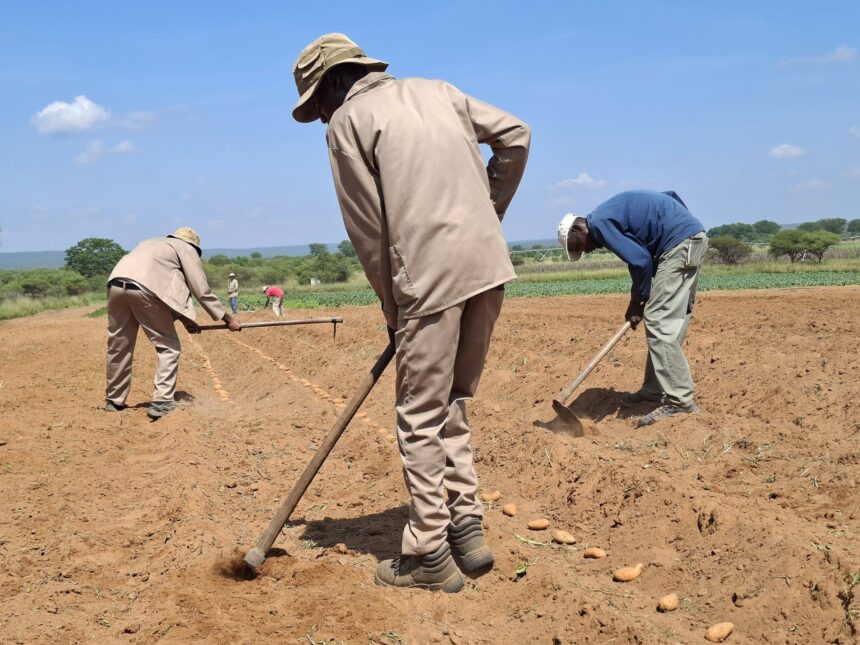
Farmers in Limpopo are gaining hands on skills through a focused agricultural training session led by Potato South Africa in partnership with Limpopo Department of Agriculture and Rural Development in the Waterberg District. The practical demonstration is taking place at the Rust de Winter Service Centre as part of the Mohaumelo Enterprise project in Bela Bela. This initiative brings together local farmers, extension officers, and development partners to strengthen potato production skills at grassroots level. Farmers participating under the Seriti Institute through the SEF programme are also actively involved in the session. The training focuses on practical learning, with direct field application aimed at improving both productivity and long term sustainability.
The demonstration places strong emphasis on correct manual potato planting techniques, which remain widely used by small scale and emerging farmers. Trainers guide participants through each step, starting with soil preparation and proper bed formation to ensure optimal root development. Farmers learn how to select quality seed potatoes, manage spacing, and plant at the correct depth to support healthy growth. These techniques are critical because poor planting methods often lead to low yields and inconsistent crop performance. By focusing on these fundamentals, the programme aims to address common gaps that limit productivity in local farming systems.
Participants are also introduced to best practices that improve crop management beyond planting. This includes guidance on irrigation timing, weed control, and early pest monitoring. Trainers explain how small adjustments in daily farm practices can lead to measurable improvements in output. For example, consistent spacing and proper soil coverage can directly affect tuber size and uniformity. These insights help farmers move from basic subsistence production toward more market oriented farming. The session encourages farmers to apply these methods immediately within their own operations.
The involvement of multiple stakeholders strengthens the impact of the programme. Potato South Africa provides industry expertise and technical knowledge based on national production standards. The Limpopo Department of Agriculture and Rural Development supports coordination and extension services that connect farmers to resources. The Seriti Institute contributes by mobilizing farmers through its SEF programme and supporting enterprise development. This collaboration ensures that farmers receive both training and ongoing support. It also builds a stronger link between community level production and broader agricultural systems.
For farmers in the Waterberg District, access to practical training is essential for improving livelihoods. Many operate with limited resources and rely on traditional methods that may not deliver consistent results. By introducing structured planting techniques, the programme helps reduce risk and improve efficiency. Better yields can lead to increased income and greater food security at household level. Over time, these improvements can support local economic growth and strengthen rural communities. The training also encourages knowledge sharing among farmers, which extends the benefits beyond the immediate participants.
The Mohaumelo Enterprise project serves as a platform for demonstrating how targeted support can drive agricultural development. It shows that combining technical training with community engagement creates stronger outcomes. Farmers are more likely to adopt new practices when they see results in a real working environment. The Rust de Winter Service Centre provides this setting, allowing participants to learn by doing rather than through theory alone. This approach increases confidence and improves the chances of long term adoption.
Sustainability remains a key focus of the initiative. Trainers emphasize efficient use of inputs such as water, seed, and labor to reduce waste and protect resources. Farmers learn how proper planting techniques can lower the need for corrective measures later in the season. This reduces costs and improves overall farm management. Sustainable practices also help maintain soil health, which is critical for future production cycles. These lessons align with broader efforts to build resilient farming systems in South Africa.
This practical demonstration in Bela Bela highlights the value of targeted training and collaboration in agriculture. It equips farmers with clear, actionable skills that can improve crop performance and income potential. The involvement of industry bodies, government, and development organizations creates a strong support network for participants. As farmers apply what they have learned, the benefits will extend to their communities and local markets. Continued investment in such initiatives will play a key role in strengthening South Africa’s agricultural sector and ensuring sustainable food production.
Join 'Farmers Mag' WhatsApp Channel
Get the latest Farming news and tips delivered straight to your WhatsApp
CLICK HERE TO JOIN