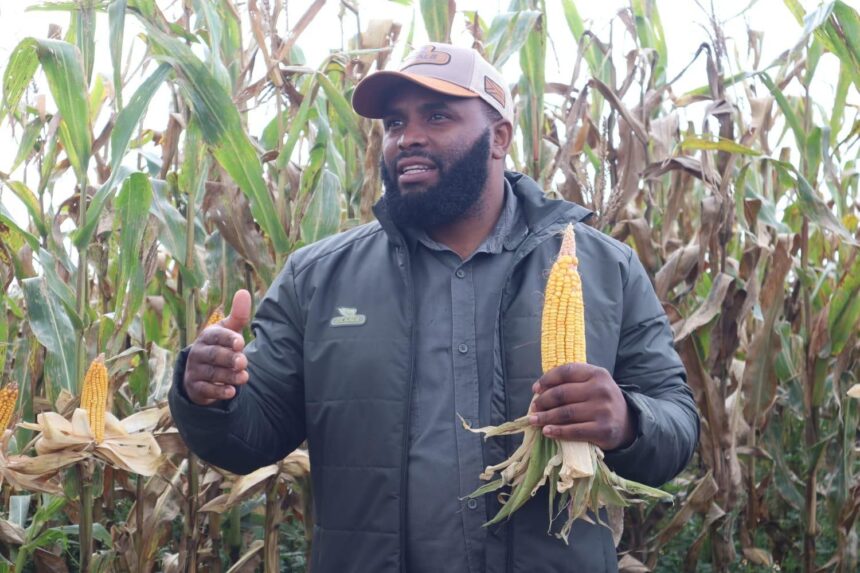
A successful Crop Farmers Day was held at Ngwenya Farm along the Ermelo-Amsterdam road in the Gert Sibande District, bringing together farmers, agricultural experts and stakeholders to improve knowledge sharing and strengthen maize production systems. The event focused on practical farming techniques that support higher yields, better soil management and improved crop protection strategies. Ngwenya Farm, owned by Mr and Mrs Ngwenya, currently has 80 hectares of maize planted for the season, making it an important demonstration site for commercial and developing farmers in the area. The gathering created an opportunity for farmers to engage directly with experts and learn methods that can be applied in their own production systems. It also reinforced the importance of collaboration in building a stronger and more sustainable agricultural sector in the region.
Stakeholders from Grain SA, Msukaligwa Local Municipality and local farming communities attended the event to support technical development and share farming knowledge. Their presence highlighted the value of partnerships in addressing challenges faced by grain producers, especially in areas such as input costs, soil fertility and pest management. Farmers were able to interact with specialists and ask practical questions about their own production challenges. The event also served as a platform for strengthening relationships between commercial suppliers, government representatives and small-scale farmers. This type of engagement helps ensure that agricultural knowledge reaches farmers at all levels of production.
Key technical presentations formed the core of the Crop Farmers Day, focusing on crop protection, soil health, seed technology and modern farming systems. Participants received detailed guidance on how to improve maize production through better agronomic practices. Crop protection discussions emphasised the importance of managing weeds, pests and diseases early in the production cycle to avoid yield losses. Soil health was also highlighted as a foundation of successful farming, with experts encouraging farmers to prioritise soil testing and balanced nutrient management. Stewardship principles were introduced to ensure responsible use of agricultural inputs and sustainable farming practices over time.
Bayer played a central role in the programme by presenting different hybrid maize seed varieties available to farmers. These seeds are designed to improve yield performance, drought tolerance and disease resistance under varying climate conditions. Farmers were encouraged to select seed varieties that match their local soil and rainfall conditions to maximise productivity. The presentation also highlighted how hybrid seeds contribute to more reliable harvests compared to traditional seed varieties. This information helped farmers understand the importance of investing in quality seed as a key driver of agricultural success.
Farmers also received practical advice on pre-plant weed management, which is a critical step in ensuring successful crop establishment. The use of Roundup was discussed as a method for burning weeds before planting, especially when preparing fields for maize production. Proper timing and application were emphasised to avoid damage to soil health and ensure effective weed control. The discussion also included the use of chemicals such as Decis Forte, Bullet and Roundup Powermax as part of integrated crop protection strategies. These inputs were explained in the context of responsible usage to ensure both crop safety and environmental protection.
The event also introduced farmers to modern agricultural approaches such as Khula and smart farming systems, which focus on improving efficiency through technology and data-driven decision-making. These methods help farmers plan better planting schedules, manage inputs more effectively and monitor crop performance throughout the season. Smart farming tools were presented as a way to reduce waste and improve profitability in maize production. Farmers were encouraged to adopt new technologies gradually while combining them with traditional knowledge and experience. This balanced approach supports long-term agricultural development in rural farming communities.
Soil management was another key focus area, with experts stressing the importance of maintaining soil fertility for consistent maize production. Farmers were advised to conduct regular soil testing to determine nutrient levels and identify deficiencies before planting. This helps ensure that fertiliser applications are accurate and cost-effective, reducing unnecessary input expenses. Healthy soil was described as the foundation of sustainable crop production and long-term farm productivity. Farmers were also encouraged to adopt conservation practices that protect soil structure and reduce erosion.
The Crop Farmers Day at Ngwenya Farm demonstrated the value of knowledge sharing and collaboration in strengthening agricultural production in the Gert Sibande District. By bringing together farmers, industry experts and government stakeholders, the event created a practical learning environment focused on real farming challenges. Participants gained valuable insights into maize seed selection, soil care, crop protection and modern farming technologies. The success of the event highlights the importance of continuous training and support for farmers at all levels. With improved access to technical knowledge and agricultural inputs, farmers in the region are better positioned to achieve higher yields and build more sustainable farming operations.
Join 'Farmers Mag' WhatsApp Channel
Get the latest Farming news and tips delivered straight to your WhatsApp
CLICK HERE TO JOIN