Foot and Mouth Disease, known as FMD, is one of the most contagious viral diseases affecting cloven hoofed animals such as cattle, sheep, goats and pigs. The virus spreads rapidly within herds and across regions, often through direct contact, contaminated equipment and animal movement. Even when animals recover, farmers face sharp production losses due to reduced milk yield, weight loss and fertility problems. Movement restrictions imposed during outbreaks disrupt auctions, feed supply chains and abattoir operations. The economic cost extends beyond farms, affecting export markets and national trade, which makes FMD a major threat to South Africa’s livestock industry.
As outbreaks continue to place pressure on the agricultural sector, the Agricultural Research Council has moved to clarify its role in the development, registration and production of FMD vaccines. The ARC has conducted long term scientific research under established legal and regulatory frameworks to support the national animal health system. Its Onderstepoort Veterinary Research campus serves as a World Organisation for Animal Health Reference Laboratory for FMD. This status confirms that the laboratory meets strict international standards for diagnosis, training and technical support. Through its participation in the WOAH and FAO FMD Reference Laboratory Network, the ARC contributes to global surveillance, standardisation and data sharing to strengthen disease control.
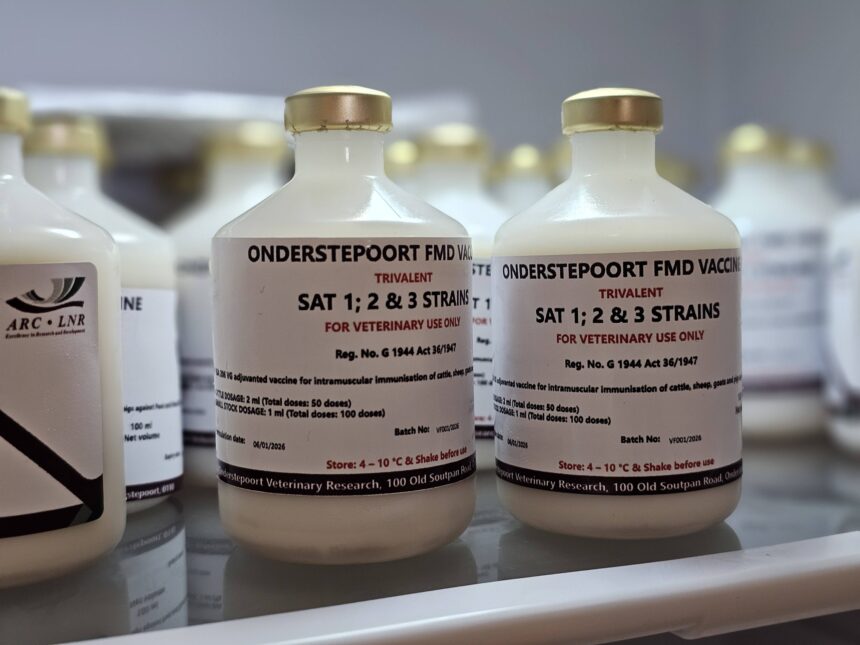
Developing an FMD vaccine is a complex process that unfolds over several years. ARC scientists began research on vaccine strains suited to South African conditions in 2010. The work involved identifying suitable strains, adapting them for cultivation and conducting long term trials to measure immune strength and duration in animals. The vaccine was officially registered in May 2022 as a stock remedy under Act No. 36 of 1947. Registration confirmed that the vaccine met quality and efficacy standards, with protection lasting up to one year per dose. However, registration did not mean immediate large scale manufacturing or full commercial availability.
After registration, a limited proof of concept batch was produced and used in Mpumalanga, where it supported outbreak control efforts. Scaling production is not a simple matter of increasing volume because biological processes change at higher production levels. FMD vaccine manufacturing involves handling live virus and requires strict biosafety and biosecurity controls. No facility outside the ARC is authorised to produce this vaccine in South Africa. Even facilities with Biosafety Level 3 infrastructure cannot automatically manufacture FMD vaccines, as production requires specialised animal health facilities, skilled personnel and years of investment in research and diagnostics.
Since 2006, South Africa has relied on imported FMD vaccines, mainly from the Botswana Vaccine Institute. This arrangement ensured supply for nearly two decades, including during the current outbreak period until late 2025. Because supply was stable and the vaccine matched circulating strains, alternative sources were not pursued while local development continued in the background. A major milestone was reached on 6 February 2026 when the first batch of ARC produced vaccine was released for operational use during the current outbreaks. This marked the first time a locally produced FMD vaccine was deployed in this context, strengthening national production capability.
Production capacity is now being expanded through defined short and medium term milestones. Over the next 12 months, the ARC aims to establish capacity of up to 10 million monovalent doses per year. From March 2026, an additional 20 000 locally produced doses per week will supplement imported supplies. Once the main factory reaches full capacity, annual output could reach 20 million doses. Given that each dose provides protection for up to one year, this volume would be sufficient to support the national mass vaccination strategy and cover herd requirements.
Beyond vaccine development, the ARC has played a central role in diagnostics and vaccine matching during the outbreak. Laboratories have processed an unprecedented number of samples to track circulating strains and guide control measures. Plans are in place to expand laboratory capacity and recruit additional skilled personnel to strengthen national response systems. The ARC also performs vaccine matching to ensure that imported vaccines remain effective against local strains. While the ARC focuses on research, validation and production, the distribution and rollout of vaccines fall under the Department of Agriculture as part of the national disease control programme. Through coordinated efforts between government, industry and research institutions, South Africa is working to restore long term resilience against Foot and Mouth Disease and protect the livestock sector from future shocks.
Join 'Farmers Mag' WhatsApp Channel
Get the latest Farming news and tips delivered straight to your WhatsApp
CLICK HERE TO JOIN