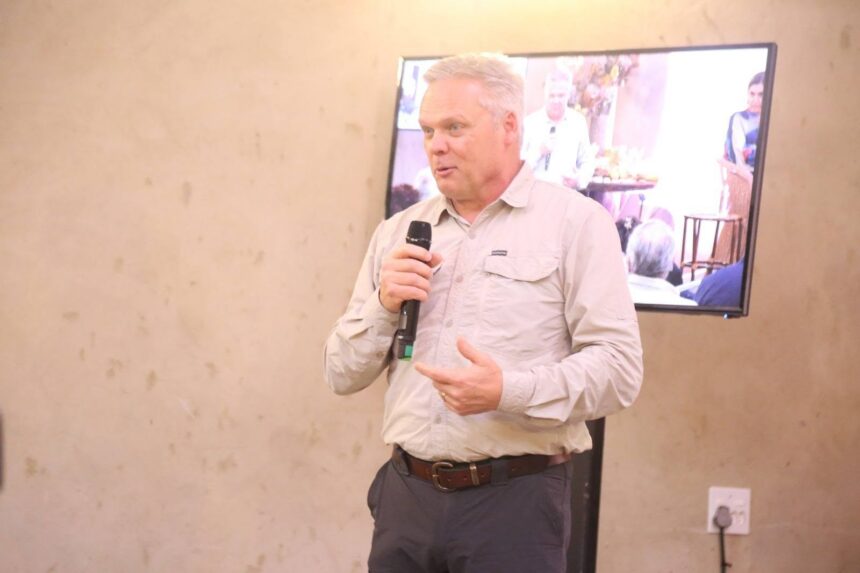
Minister Willie Aucamp has called for stronger cooperation, greater use of science and innovation, improved market access and sustainable livestock production as South Africa works to unlock more value from its beef industry. Delivering the keynote address at the 2026 Livestock Registering Federation (LRF) Stockman School at Aldam in the Free State, Aucamp engaged directly with livestock producers, industry leaders, researchers and other stakeholders. The three-day event was held under the theme “Unlocking the beef value chain” and focused on key areas including genetics, animal health, markets and climate-smart livestock production. The Minister said agriculture must be treated as more than a job, describing farming and stockmanship as a calling that requires commitment, knowledge and determination. His address placed the profitability, resilience and long-term sustainability of South African livestock farming firmly at the centre of the discussion.
Aucamp told delegates that he regarded his role as Minister of Agriculture as a calling and expressed his willingness to work alongside farmers and the broader agricultural industry. He said farmers face many challenges but argued that South African producers have shown a strong willingness to innovate and adapt. He also praised the knowledge and expertise available within the country’s agricultural sector, particularly the role of research in improving production. According to Aucamp, platforms such as the LRF Stockman School help producers stay informed about developments that can strengthen their businesses and farming operations. He encouraged producers to make full use of opportunities for continuous learning because farming requires ongoing investment in knowledge, skills and technology.
The LRF Stockman School has become an important platform for sharing research-based information with livestock producers, and Aucamp highlighted the value of bringing international experts and industry specialists together with farmers. The 2026 programme attracted strong participation and included producers operating at different levels of the beef value chain. Aucamp stressed that knowledge gained at the Stockman School can benefit both established commercial farmers and emerging producers. He said the industry needs to ensure that more small-scale and developing farmers can progress into successful commercial farming businesses. The participation of farmers from different backgrounds therefore supports a broader objective of strengthening the livestock sector across the full production chain.
The Minister said unlocking the beef value chain is not simply an academic exercise but an economic priority for the agricultural sector. He explained that the industry must consider every stage of the process, from the selection of seed stock and genetics to commercial herd management, processing, marketing and the delivery of beef to consumers. Each part of the chain affects efficiency, quality and profitability. For livestock producers operating with tight margins, decisions about genetics, animal health, nutrition, reproduction and herd management can have a significant impact on business performance. Aucamp also made it clear that there is nothing wrong with farmers making a profit, arguing that profitable farming is essential to maintaining productive and sustainable agricultural businesses.
Genetics featured strongly in the Minister’s address because improved genetic selection can contribute to more productive and efficient livestock enterprises. He encouraged farmers to work with sought-after genetics and to apply precision in their breeding decisions. Modern livestock production increasingly depends on accurate information that allows producers to select animals according to traits that support productivity, efficiency and market requirements. Genetic improvement is a long-term process, which means farmers need reliable records and sound breeding strategies to achieve meaningful results. The message from the Stockman School was that investment in genetics should form part of a broader farm business strategy rather than being viewed as an isolated production decision.
Aucamp also highlighted the importance of supporting small-scale and emerging livestock farmers as they seek to enter the commercial market. He pointed to programmes and partnerships involving public institutions, research organisations and the livestock industry that are designed to help developing producers gain access to knowledge and modern production tools. The Minister said more emerging farmers need to progress into successful commercial operations and that the expertise shared through initiatives such as the Stockman School can contribute to that transition. He emphasised that farming is a business and that producers need to understand market access, technology, investment and continuous skills development. Strengthening these areas can help farmers build enterprises that are better positioned to compete and grow.
Market access was another major issue addressed during the keynote speech, with Aucamp discussing efforts to expand opportunities for South African agricultural exports. He referred to discussions with China regarding potential exports of South African beef products and highlighted the importance of meeting animal health and disease control requirements when pursuing international markets. He also referred to market developments involving Egypt, Jordan and countries in the Middle East. Expanding export markets could create additional opportunities for South African livestock producers, but access depends on meeting strict requirements related to animal health, traceability, biosecurity and product standards. The Minister indicated that market development would remain an important part of efforts to strengthen the agricultural value chain.
Animal health and biosecurity remain central to the future of South Africa’s livestock industry, particularly in the context of foot-and-mouth disease. Aucamp described the response to the disease as an example of how government, farmers, industry organisations and suppliers need to work together. He said that farmers who require foot-and-mouth disease vaccines should be able to access them and acknowledged the contribution of international suppliers to the country’s vaccination efforts. He also said that South Africa needs to rebuild domestic capacity to protect the country against future animal health challenges. Strong biosecurity is essential not only for protecting livestock but also for maintaining market access and protecting the reputation of South African beef in domestic and international markets.
The Minister linked animal health directly to regional cooperation, stressing that livestock disease does not respect national borders. He referred to the challenges faced by neighbouring countries and argued that South Africa cannot protect its own livestock industry in isolation from developments elsewhere in the region. Cooperation between countries can support stronger disease control and reduce risks to livestock producers and agricultural markets. A coordinated regional approach can also help protect farmers whose livelihoods depend on the movement and sale of livestock and livestock products. For South African producers, stronger regional biosecurity could therefore form an important part of protecting both domestic production and future export opportunities.
Aucamp also placed land ownership and security of tenure among the issues affecting emerging farmers, particularly those who want to invest and grow their businesses. He argued that farmers are more likely to make long-term investments when they have secure rights to the land on which they operate. Secure tenure can also affect access to finance because agricultural assets and land rights can play a role in a farmer’s ability to raise capital. The Minister noted that commercial farmers regularly use financing to fund production and reinvest in their businesses, while farmers operating under insecure arrangements may face greater limitations when attempting to obtain investment capital. For emerging farmers seeking to expand production, access to land must therefore be considered alongside finance, infrastructure, technical support and market access.
The Minister stressed that obtaining land alone does not guarantee farming success. Successful livestock production requires commitment, hard work, sound management and a willingness to invest time and resources into the enterprise. Farmers must make careful decisions because the margins in agriculture can be narrow and poor production choices can have serious financial consequences. Aucamp argued that farmers need to use science and innovation to improve productivity and make their operations more efficient. This approach is particularly relevant to livestock producers who need to manage breeding, animal health, feed resources, infrastructure and environmental pressures while maintaining a viable business.
The role of government, according to Aucamp, should be to create an environment in which farmers can farm effectively rather than attempting to dictate how individual farms should be managed. He said farmers understand their own operations and that government should focus on removing unnecessary obstacles and providing an enabling environment. This includes creating conditions that support production, improving agricultural services and working with industry to address challenges that affect the farming sector. The Minister acknowledged that government has not always provided the level of enabling support that farmers require and said there is a need to correct this. His position places greater emphasis on cooperation between government and producers while recognising the expertise already present within the farming community.
Research and innovation were central to Aucamp’s discussion of the future of the livestock industry. He highlighted the collaboration between the Department of Agriculture, the Agricultural Research Council, higher education institutions and industry organisations through the Beef Genomics Programme. The programme involves the use of genetic and genomic technologies to improve livestock production and strengthen the information available to breeders and farmers. Aucamp referred to an investment of more than R182 million in the programme, with industry contributing more than 60 percent, and said the first phase delivered a reported return on investment of more than 18 percent according to an independent evaluation. He stressed that the benefits of such research should extend beyond established commercial producers and reach emerging and small-scale farmers as well.
The integration of advanced genetics into broader livestock development could have important implications for farmers operating at different levels of the value chain. Aucamp said future work is expected to place greater emphasis on climate-smart genomic measurements for both small and large livestock enterprises. The objective is to improve farm resilience and productivity while reducing the carbon footprint of livestock operations. Climate-smart livestock production is becoming increasingly important as farmers manage changing environmental conditions and pressure to improve resource efficiency. Applying genomic tools alongside sound herd management could help producers make more informed breeding decisions while supporting the long-term sustainability of livestock enterprises.
The Minister also highlighted the role of partnerships in developing new agricultural technologies and extending innovation into other livestock industries. He referred to cooperation involving the Technology Innovation Agency and the Department of Agriculture, describing the model as an example of public-private collaboration. The objective is to improve genomic solutions and adapt technologies for sectors including small stock and dairy production. Such partnerships can help connect research, funding and practical farming needs. For producers, the value of these initiatives will ultimately depend on whether the resulting technologies are accessible, practical and capable of improving productivity under real farming conditions.
Aucamp repeatedly returned to the need for collaboration, saying that no individual farmer, organisation or government department can solve the challenges facing agriculture alone. The beef value chain includes producers, breeders, researchers, animal health professionals, processors, marketers, financial institutions and government agencies, all of which influence the performance of the sector. Better coordination between these stakeholders can help identify bottlenecks and create more effective responses to challenges. Differences of opinion will remain within any large industry, but shared objectives can provide a basis for cooperation. The Minister’s message was that South African agriculture will be stronger when government and industry work towards common goals with honesty, integrity and a clear focus on production.
The 2026 LRF Stockman School therefore provided more than a platform for technical discussions about livestock production. It brought together expertise on genetics, animal health, market access, business management and climate-smart farming while creating space for producers to engage with industry leaders and researchers. Aucamp’s keynote address connected these areas to the broader economic importance of a profitable and resilient beef value chain. His message was particularly relevant to farmers who need to balance rising production demands with animal health risks, environmental pressures and market requirements. For the livestock sector, the ability to learn, adapt and work together will remain essential to maintaining competitiveness and building sustainable farming businesses.
The future of South Africa’s beef industry will depend on the ability of producers and their partners to turn knowledge and innovation into practical results on farms. Strong genetics can improve herd performance, sound animal health practices can protect production and markets, while better business management can help farmers remain profitable. Secure access to markets and productive land can provide the foundation for growth, but farmers also need the skills and determination to manage their enterprises effectively. Government has a role to play in creating an enabling environment, supporting research, improving animal health systems and working with the private sector. The 2026 LRF Stockman School reinforced the message that unlocking the beef value chain requires action across every part of the industry, from the breeding decisions made on individual farms to the markets that ultimately connect South African beef with consumers.
Join 'Farmers Mag' WhatsApp Channel
Get the latest Farming news and tips delivered straight to your WhatsApp
CLICK HERE TO JOIN