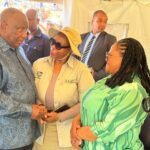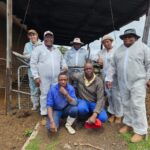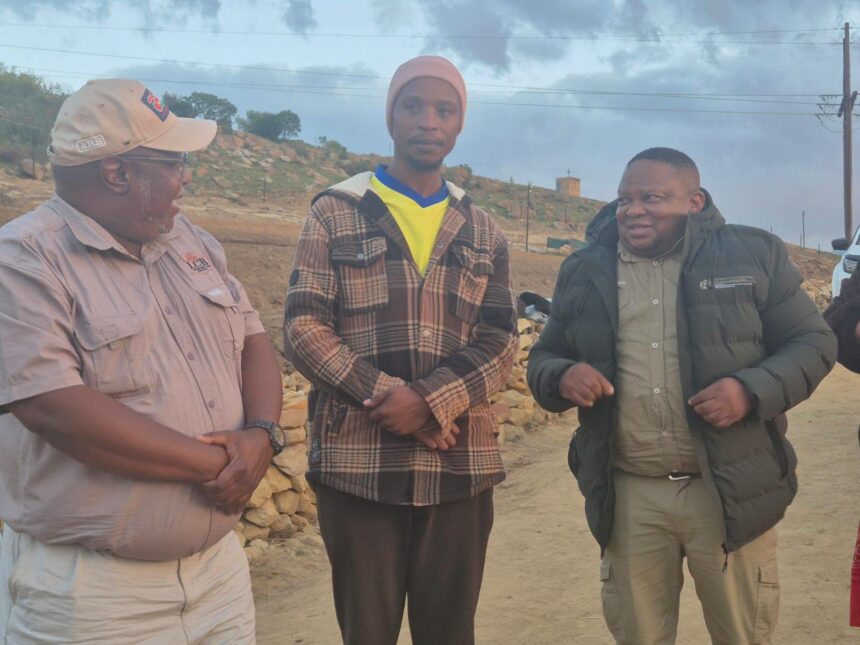
The Free State Department of Agriculture, Rural Development and Environmental Affairs is continuing to support agricultural development and community-based farming through engagement with emerging enterprises in QwaQwa. On 7 October 2026, DARDEA Head of Department Mr Tshepo Mabilo and the District Director for Thabo Mofutsanyana, Mr Mxolisi Tawana, visited MS Construction and Projects in Poelong Village, QwaQwa. The visit provided an opportunity to see the farming operation, meet workers and assess the progress being made by the young entrepreneurs leading the project. More than 200 men and women, including young people, were present at the project when the delegation arrived. The visit also highlighted how agricultural enterprises can combine food production, skills development and employment opportunities to support rural communities.
The delegation was accompanied by Morena Libenyana Mopeli and Mofumahali Masetjhaba Mopeli of Monontsha. Morena Libenyana Mopeli has allocated an additional 150 hectares to the project in Monontsha Village, creating further potential for agricultural expansion. Morena Libenyana and his wife are strong supporters of the farming activities of MS Construction and Projects and have continued to contribute to the development of the initiative. The additional land could provide the project with more space to expand its farming activities as its capacity grows. Land availability is an important factor for emerging farmers because it creates opportunities to increase production, develop new enterprises and create additional work in rural communities.
MS Construction and Projects is led by two young entrepreneurs, Miss Matsae Tsotetsi, who serves as Chief Executive Officer, and Mr Molingoane Morwa Phillimon. Their business has adopted a mixed farming model that brings several agricultural activities together rather than relying on one type of production. The project focuses on vegetables, poultry, herbal capsules, fruit and vegetable juices and other agricultural activities. This approach allows the enterprise to explore different parts of the agricultural value chain, from primary production to processing and value-added products. The company is also accredited by AgriSETA, which adds an important training and skills development component to its work.
The presence of more than 200 workers at the Poelong project demonstrates the potential of agricultural enterprises to support local employment. The project has also made a wider contribution through its work with the African Conservation Trust, helping to create more than 500 part-time fixed employment opportunities across QwaQwa. The initiative also mentors and pays stipends to 28 non-profit organisations from the Social Development database, as well as supporting emerging small businesses. These activities show that the impact of an agricultural project can extend beyond the farm itself when production is connected to community development. For rural areas where employment opportunities can be limited, projects that combine farming, enterprise development and community participation can play an important role in strengthening local economic activity.
Support from the Department of Agriculture, Rural Development and Environmental Affairs has helped the farmers develop essential infrastructure at the project. Three boreholes have been drilled to improve access to water, which is critical for vegetable production, livestock and other agricultural activities. The project has also fenced six hectares and constructed two security houses to protect the farming operation and its assets. Work is currently underway on an underground reservoir and poultry houses, which are expected to strengthen the project’s production capacity as development continues. Reliable water infrastructure, suitable fencing, secure facilities and appropriate livestock housing are all important components of a productive and sustainable farming enterprise.
Water remains one of the most important requirements for agricultural production, particularly in projects that combine vegetables and livestock. The drilling of three boreholes gives the farmers an important source of water, while the construction of an underground reservoir can help improve water storage and management. Better water infrastructure can support more consistent production and reduce some of the challenges associated with unreliable water availability. The planned poultry houses can also provide more suitable facilities for poultry production as the enterprise develops. These investments demonstrate the importance of combining financial and technical support with physical infrastructure when assisting emerging farmers.
The project has also received recognition for its contribution to community development and agriculture. MS Construction and Projects received an MEC Special Recognition Award at YAFF 2025 and achieved third place in the Free State IWISA Community Champion competition. These achievements provide recognition for the work being done by the enterprise and its contribution to its community. The project is also receiving incubation support through the Maluti TVET College Centre for Entrepreneurship and the SAB Tholoana Foundation. Business incubation can help emerging entrepreneurs strengthen their management skills, improve planning and develop the systems needed to grow an agricultural business.
The involvement of young entrepreneurs is another important feature of the project. Agriculture is increasingly creating opportunities that go beyond traditional farming, with businesses able to operate in production, processing, manufacturing, marketing and other parts of the value chain. The leadership of Tsotetsi and Phillimon shows how young people can build enterprises around agricultural resources while creating opportunities for other members of their communities. Their focus on products such as herbal capsules and fruit and vegetable juices also shows the potential for value addition within agriculture. Turning agricultural produce into processed products can create additional business activities and help enterprises participate in more stages of the value chain.
The project’s AgriSETA accreditation also points to the importance of skills development in agriculture. Successful farming requires practical knowledge, business management, production planning and an understanding of markets. Training and mentorship can help emerging farmers and young entrepreneurs improve their ability to manage these different demands. Institutions such as TVET colleges and business incubation programmes can provide additional support as agricultural enterprises develop. Combining practical farming experience with formal training and business development can strengthen the long-term prospects of emerging agricultural businesses.
The visit by DARDEA officials to MS Construction and Projects comes at a time when rural agricultural development remains closely linked to employment creation, food production and economic participation. A successful farming enterprise does not only produce food. It can also create demand for agricultural inputs, transport, processing, packaging, marketing and other services. This creates opportunities for other small businesses and community organisations to participate in the agricultural economy. The MS Construction and Projects initiative illustrates this wider role through its employment activities, mentorship programmes and support for emerging businesses.
The allocation of an additional 150 hectares in Monontsha Village could further strengthen these opportunities if the project is able to develop the land sustainably and secure the necessary resources. Expanding agricultural land requires careful planning, particularly in areas such as water availability, infrastructure, production systems, labour and access to markets. The experience gained at the Poelong project can provide a foundation for future expansion. Continued collaboration between farmers, traditional leadership, government departments, development organisations and private sector partners can help ensure that additional land is used productively. Such partnerships are particularly important for young agricultural entrepreneurs who are building their businesses while developing the infrastructure required for long-term growth.
The work at MS Construction and Projects also highlights the value of community participation in agricultural development. The presence of more than 200 workers, including youth, demonstrates that farming projects can become important community economic activities when they are properly developed. The reported creation of more than 500 part-time fixed employment opportunities across QwaQwa further shows the potential reach of initiatives that combine agriculture with community development. Supporting non-profit organisations and emerging small businesses adds another layer to this economic impact. The result is an agricultural project that is connected to a broader network of people and organisations rather than operating as an isolated farming operation.
For QwaQwa and the wider Thabo Mofutsanyana District, projects such as MS Construction and Projects can contribute to a stronger rural agricultural economy. Their focus on mixed farming, processing, skills development and employment creates several possible pathways for growth. Government support has helped address some of the infrastructure requirements while business incubation programmes are helping the entrepreneurs strengthen their enterprise capabilities. Continued development will depend on the project’s ability to manage its resources, expand production responsibly and build sustainable markets for its products. The involvement of local leadership and development partners can also help strengthen the project’s connections within the community.
The DARDEA visit to MS Construction and Projects demonstrates how agricultural development can support more than food production. The project combines farming, youth participation, job creation, value addition, skills development and community support under the leadership of young entrepreneurs. Its investment in boreholes, fencing, security facilities, water storage and poultry infrastructure provides a foundation for continued development. Recognition through agricultural and community awards, together with incubation support, further reflects the progress made by the enterprise. As the project expands its activities and prepares to utilise additional land in Monontsha, its continued development could provide further opportunities for farmers, workers, young people and small businesses across QwaQwa.
Join 'Farmers Mag' WhatsApp Channel
Get the latest Farming news and tips delivered straight to your WhatsApp
CLICK HERE TO JOIN