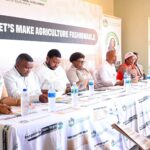


South Africa’s agricultural sector faces a critical challenge: how to expand production, create jobs and strengthen rural economies while ensuring that more people can participate in the industry. These issues took centre stage on 14 October 2026, when Agbiz Chief Economist Wandile Sihlobo joined a discussion at the AgriSA Congress led by Qaanitah Hunter and featuring Lourensa Eckard. The conversation explored the political economy of South African agriculture, with particular attention to partnerships, inclusive growth and employment creation. Sihlobo highlighted the importance of the Agriculture and Agro-processing Master Plan in supporting sector growth and creating opportunities across the agricultural value chain. He also pointed to the government’s planned release of approximately 2.5 million hectares of land as a potential avenue for advancing agricultural transformation and broadening participation in farming.
The political economy of agriculture is important because farming operates within a wider system of land ownership, investment, public policy, trade and employment. Decisions made by government, agricultural businesses and other stakeholders influence who can access productive resources, where investment flows and how economic opportunities are distributed. South Africa’s agricultural sector includes established commercial producers, emerging farmers, smallholder operations and agricultural businesses serving domestic and international markets. These groups often face different challenges, ranging from access to finance and infrastructure to market participation and production costs. Building a more inclusive sector requires policies and partnerships that recognise these differences while supporting the growth and competitiveness of agriculture as a whole.
Partnerships were a central theme of the discussion at the AgriSA Congress. Cooperation between government and the private sector can help address challenges that neither can easily resolve independently. Farmers require reliable infrastructure, effective public services, access to markets and a policy environment that supports long-term investment. Government, in turn, can benefit from private-sector expertise, capital, production capacity and established market networks when developing agricultural programmes. When these relationships are based on clear responsibilities and measurable outcomes, they can support investment, improve productivity and create opportunities for more participants in the sector.
The Agriculture and Agro-processing Master Plan featured prominently in Sihlobo’s discussion as a framework for supporting agricultural growth and development. The plan aims to strengthen collaboration across the agricultural value chain and address constraints that limit the sector’s performance. Its broad approach recognises that agriculture depends on more than production at farm level. Processing, logistics, market access, infrastructure and investment also influence whether agricultural businesses can expand and compete. Effective implementation therefore requires cooperation among farmers, agribusinesses, government institutions and other stakeholders, with attention to practical results rather than commitments alone.
For farmers, the value of the Agriculture and Agro-processing Master Plan lies in its potential to support a more productive and competitive agricultural economy. Reliable access to inputs, finance, water, energy, transport and suitable technology can influence production costs and farm profitability. Stronger links between producers and processors may also create additional opportunities to supply local and export markets. However, the benefits will depend on how effectively agreed priorities translate into investment and support on the ground. Progress must ultimately be assessed through outcomes such as improved production, expanded market access, viable farming businesses and increased employment.
The government’s planned release of approximately 2.5 million hectares of land was another important issue raised during the discussion. Land access remains a central part of agricultural transformation in South Africa, particularly where aspiring farmers need opportunities to establish or expand productive operations. Making land available can create a pathway into agriculture, but access alone does not guarantee a successful farming business. New and emerging farmers may also need secure tenure, suitable infrastructure, working capital, technical advice, equipment and access to reliable buyers. The impact of the planned land release will therefore depend on how the land is allocated, prepared for production and supported after beneficiaries gain access.
Land reform and agricultural transformation also need to consider the commercial realities of farming. Different types of agricultural production require different levels of capital, expertise, infrastructure and time before they generate returns. Livestock enterprises, field crops, horticulture and intensive farming operations each have distinct requirements and risks. Matching land to suitable agricultural activities and ensuring that farmers receive appropriate support can improve the prospects of long-term productivity. Transparent allocation processes and clear performance measures can also help strengthen confidence in transformation initiatives while ensuring that productive agricultural resources are used effectively.
Inclusive growth was another important consideration in the discussion. Economic growth in agriculture can create wider benefits when opportunities extend beyond established businesses to emerging farmers, rural entrepreneurs and workers. These benefits may arise through employment, agricultural supply contracts, processing businesses and services linked to farming. Smallholder producers can become more competitive when they have access to appropriate support and opportunities to participate in established value chains. For inclusion to be sustainable, however, new entrants must be able to build viable businesses rather than rely indefinitely on short-term assistance.
Job creation remains particularly important because agriculture supports livelihoods through both direct farming activities and related industries. Farms employ workers in planting, harvesting, livestock management, packing and other production tasks, while agro-processing businesses create additional demand for labour and services. Expanding local processing can help retain more economic activity within agricultural communities, depending on the scale and nature of the investment. However, employment growth requires businesses to remain commercially viable and respond to real market demand. Investment in skills, technology and efficient production systems can help the sector improve its competitiveness while developing a workforce equipped for changing agricultural needs.
Agro-processing offers an important link between agricultural production and broader industrial development. Turning raw commodities into processed food and other agricultural products can create additional value, support manufacturing and open opportunities for businesses further along the supply chain. For farmers, stronger agro-processing industries can provide additional markets for their produce, although the benefits depend on competitive prices, consistent demand and suitable supply arrangements. Investment in storage, cold chains, transport and processing facilities can also help address bottlenecks that limit market access. These connections reinforce the importance of treating agriculture as an integrated value chain rather than focusing on primary production alone.
South Africa’s agricultural growth also depends on creating conditions that encourage long-term investment. Farmers and agribusinesses need a reasonable level of certainty when making decisions about land, equipment, infrastructure and production expansion. Policy coordination, reliable public services and cooperation between stakeholders can help reduce uncertainty and improve confidence. At the same time, investment must respond to practical challenges such as climate risks, water availability, rising input costs and access to suitable markets. Addressing these pressures is essential if agricultural transformation is to support both wider participation and a stronger production base.
The discussion at the AgriSA Congress highlighted the relationship between agricultural policy, economic growth and social inclusion. Sihlobo’s emphasis on partnerships and the Agriculture and Agro-processing Master Plan reflects the importance of coordinated action across the sector. The government’s planned release of approximately 2.5 million hectares of land also presents a significant policy consideration, with the potential to broaden participation if accompanied by appropriate support and access to markets. These measures will require careful implementation, clear accountability and sustained cooperation among public and private stakeholders. For farmers, the priority is to ensure that transformation initiatives lead to practical improvements in productivity, commercial viability and access to economic opportunities.
South Africa’s agricultural future will depend on its ability to combine growth with meaningful transformation. The conversation involving Wandile Sihlobo, Qaanitah Hunter and Lourensa Eckard at the AgriSA Congress brought these priorities into focus, particularly the need for partnerships, job creation and broader participation in farming. The Agriculture and Agro-processing Master Plan provides a framework for cooperation, while the planned land release creates an opportunity to expand access to agricultural production. Neither initiative will deliver lasting results without effective implementation, investment and support for farmers at different stages of development. By connecting land access with productive farming, stronger markets and sustainable business opportunities, South Africa can work towards an agricultural sector that is more competitive, inclusive and capable of supporting rural economic growth.
Join 'Farmers Mag' WhatsApp Channel
Get the latest Farming news and tips delivered straight to your WhatsApp
CLICK HERE TO JOIN