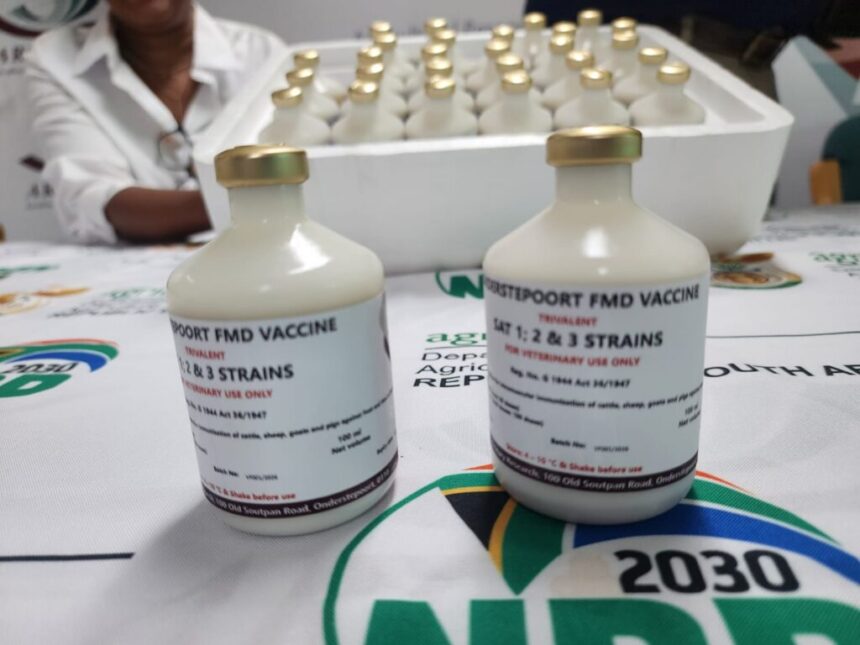
South Africa is taking a significant step to expand its capacity to produce Foot and Mouth Disease (FMD) vaccines after a proposal by Agriculture Minister Willie Aucamp to allow qualifying private companies to use the Agricultural Research Council’s (ARC) intellectual property was unanimously supported by the ARC and its Board on Monday, 21 September 2026. The proposal will allow approved local and international companies to manufacture the ARC’s FMD vaccine at a larger scale through conditional intellectual property licensing agreements. The move comes as South Africa continues to deal with FMD and works to increase the availability of vaccines for livestock farmers. The ARC has developed a vaccine designed for the domestic FMD strains and has been working to expand its own production capacity. However, manufacturing constraints have limited the organisation’s ability to produce the vaccine at the scale currently required.
The ARC vaccine provides protection against the domestic FMD strains and requires a single annual administration, according to the information provided by the department. This makes the vaccine an important part of South Africa’s broader efforts to strengthen livestock disease control. The ARC has been developing local FMD vaccine production capacity for several years, with its vaccine registered for use in South Africa in 2022 and limited batches subsequently produced. The organisation has also been working to expand its manufacturing systems and infrastructure as part of the longer-term effort to restore domestic vaccine production. The decision to bring qualifying private companies into the manufacturing process is intended to complement that work rather than replace the ARC’s own production programme.
The current manufacturing challenge is one of the key reasons behind the new approach. Producing FMD vaccines at large scale requires specialised facilities, technical expertise and strict biosecurity measures because of the nature of the disease and the production process. The ARC has the scientific and technical capability to develop and produce its FMD vaccine, but scaling production to meet national demand requires additional capacity. Conditional licensing could allow companies with the necessary capabilities and facilities to contribute to production while operating under agreements established with the ARC. This could expand the number of production channels available for the ARC vaccine and help increase supply as South Africa continues its vaccination programme.
Minister Aucamp said the partnership with the private sector represents an important development for protecting the livestock sector, strengthening national biosecurity and securing food supply chains. He also said the decision followed concerns raised by farmers and other stakeholders who have called for faster action to address the FMD outbreak. The decision to make ARC intellectual property available to qualifying manufacturers marks a change in how the country can use its domestic scientific assets to increase vaccine production. For livestock farmers, increased manufacturing capacity could help address one of the practical challenges affecting disease control, namely access to sufficient vaccine supplies. The implementation will still require regulatory, technical and contractual processes, meaning the decision does not mean that large-scale private production will begin immediately.
The licensing arrangements will also be designed to protect the ARC’s intellectual property while allowing additional manufacturers to contribute to vaccine production. Companies that participate will need to meet the conditions established under the licensing agreements and comply with the relevant requirements for producing veterinary vaccines. This is particularly important for FMD because manufacturing must take place under stringent biosecurity conditions. The ARC has emphasised that third-party production will be introduced alongside its own efforts to rebuild and expand internal manufacturing capacity. The intention is therefore to increase overall production capability while maintaining the ARC as a central part of South Africa’s long-term FMD vaccine programme.
An important part of the decision is the commitment to reinvest licensing income into the ARC’s own manufacturing capacity. The income generated from these agreements will be ringfenced and used by the ARC to increase its ability to produce FMD vaccines. This could provide an additional funding stream for infrastructure, equipment and other requirements associated with expanding production. It also means that private sector participation is being positioned as a way to support the development of longer-term public production capacity. The ARC will continue working on its own manufacturing expansion while third-party manufacturers contribute additional production capacity in the interim.
The latest decision also comes as South Africa continues to assess how well available vaccines match the FMD viruses circulating in the country. At the request of Minister Aucamp, the ARC will submit representative field-circulating FMD virus isolates from South Africa to the Pirbright Institute in the United Kingdom in October for a second round of vaccine-matching assessments. The exercise will provide an additional scientific assessment of the suitability of local and imported vaccines against viruses currently circulating in South Africa. Vaccine matching is important because FMD is caused by multiple virus serotypes and strains, and the effectiveness of a vaccine depends on how well it matches the viruses present in a particular area. The additional assessment is therefore intended to provide further scientific information to guide the country’s vaccination response.
South Africa’s broader FMD response continues to involve government departments, provincial veterinary services, commodity organisations, organised agriculture, researchers and livestock producers. Vaccination remains one part of the response, alongside animal identification, traceability, movement controls, surveillance and other biosecurity measures. The availability of sufficient vaccine is particularly important because large-scale vaccination programmes require reliable supply over sustained periods. Recent government efforts have included both locally produced ARC vaccine and imported vaccines as authorities work to strengthen protection across the national herd. Expanding domestic manufacturing capacity could reduce some of the pressure associated with relying on limited production capacity while giving South Africa greater control over an important component of its animal health response.
The decision by the ARC and its Board to support conditional licensing of its FMD vaccine intellectual property creates a new pathway for increasing vaccine production in South Africa. Private companies with the required capabilities could contribute to large-scale manufacturing while the ARC continues to develop its own production facilities and technical capacity. The additional vaccine-matching work at the Pirbright Institute will also provide further scientific information on the suitability of available vaccines against viruses circulating in the country. For farmers, the immediate priority remains effective disease control and reliable access to appropriate vaccines, while longer-term efforts focus on strengthening South Africa’s ability to produce vaccines locally. By combining ARC expertise, private manufacturing capacity and continued investment in public production infrastructure, the country is working to build a stronger and more sustainable FMD vaccine supply as it continues its efforts to protect livestock and restore disease-free status.
Join 'Farmers Mag' WhatsApp Channel
Get the latest Farming news and tips delivered straight to your WhatsApp
CLICK HERE TO JOIN