

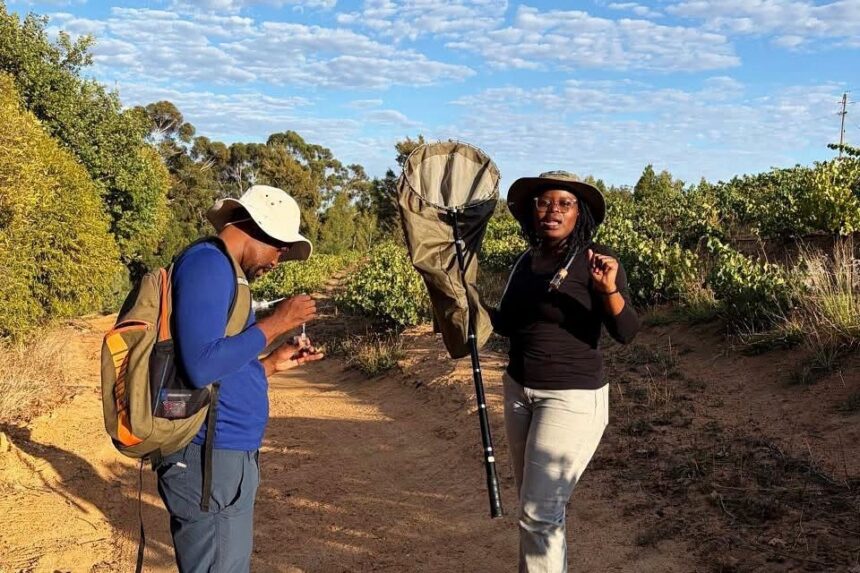
Protecting crops from emerging agricultural pests starts with understanding what is happening in fields before a potential threat becomes established. Dr Zolile Maseko and Ms Sarah Mokwena from ARC Plant Health Protection have been conducting field sampling as part of national surveys focused on psyllids, also known as jumping plant lice. The surveys are designed to detect the possible presence of invasive psyllid pests while also improving knowledge of South Africa’s native psyllid fauna. This work forms part of an important agricultural early warning system that can help identify potential threats before they spread widely. Early detection gives researchers, farmers and agricultural authorities a better opportunity to respond to emerging pests and protect crop production.
The national psyllid surveys have focused primarily on crops and wild plants belonging to the potato and tomato family. These plants are important hosts to monitor because certain psyllid species can affect agricultural production and may also be associated with serious plant health concerns. Field sampling allows researchers to collect specimens and examine the psyllid populations occurring in different environments. Including wild plants in the surveys is also important because pests can survive and reproduce outside cultivated fields, creating potential pathways for movement into agricultural areas. By examining both crops and surrounding plant communities, researchers can build a more complete picture of psyllid populations and potential risks.
Psyllids are small insects that can be difficult to identify without specialised knowledge and careful examination. They feed on plant tissues and some species can cause direct damage to their host plants through feeding activity. Certain psyllids can also act as vectors for plant pathogens, which can increase their potential impact on agriculture. This makes accurate identification and monitoring particularly important when assessing whether a species is native, established or potentially invasive. Regular surveys can help researchers detect changes in psyllid populations and identify unusual findings that may require further investigation.
The surveys are valuable because invasive pests can create significant challenges once they become established in a new environment. An invasive species may encounter suitable host plants, favourable environmental conditions and limited natural controls, allowing populations to increase rapidly. Once a pest becomes widespread, eradication can become considerably more difficult and costly. Farmers may then face additional expenses related to monitoring, pest control, crop losses and changes to production practices. Conducting surveillance before a pest becomes established provides an opportunity to identify potential threats early and strengthen the agricultural sector’s preparedness.
The absence of a new invasive psyllid threat during the surveys is encouraging news for crop protection. It means that the field sampling did not detect evidence of a new invasive psyllid threat in the areas surveyed. However, the result does not mean that monitoring can stop or that farmers should become less vigilant. Agricultural pests can move between regions through natural pathways and human activities, while new threats can emerge over time. Continued surveillance therefore remains an important part of maintaining South Africa’s plant health preparedness.
The research also contributes to understanding South Africa’s native psyllid fauna. Documenting native species provides researchers with important baseline information that can help distinguish naturally occurring insects from newly introduced species. This knowledge can become particularly valuable when unusual psyllid populations are detected during future surveys. Without a strong understanding of native insect populations, identifying changes in distribution or the arrival of unfamiliar species can be more difficult. Building comprehensive knowledge of the country’s biodiversity therefore supports both scientific research and practical agricultural pest management.
Field sampling plays an important role in turning surveillance into useful agricultural intelligence. Researchers can collect specimens from different host plants and locations before analysing them to determine their identity and significance. Repeated sampling over time can also help reveal changes in pest distribution, abundance and host associations. These observations can provide information that supports future risk assessments and agricultural decision-making. The work conducted by Dr Zolile Maseko and Ms Sarah Mokwena therefore contributes to a broader system designed to monitor plant health threats across South Africa.
Early warning systems are particularly important because pest management becomes more effective when farmers and authorities can respond before populations reach damaging levels. Detection at an early stage can allow experts to investigate a potential threat and determine its distribution and significance. Where necessary, appropriate control or containment measures can then be considered based on scientific evidence. Early detection can also help prevent unnecessary responses to harmless or native species by providing accurate information about what is actually present. This balance between vigilance and evidence-based decision-making is essential for effective crop protection.
Farmers also have an important role to play in strengthening agricultural pest surveillance. Regularly inspecting crops can help producers notice unusual insects, changes in plant health or symptoms that do not match familiar production problems. Farmers should avoid assuming that an unfamiliar pest is harmless simply because it appears in small numbers. Reporting unusual findings to relevant agricultural authorities or plant health specialists can help experts investigate potential threats. Cooperation between farmers, researchers and government authorities strengthens the overall surveillance network and improves the chances of detecting emerging problems early.
Protecting crops also requires attention to plants growing outside cultivated fields. Wild host plants can provide habitats and food sources for insects that may later move into agricultural production areas. This does not mean that every wild plant or psyllid represents a threat, but it demonstrates why surveillance needs to extend beyond commercial fields. Researchers can use information gathered from wild plants to better understand how insects are distributed and which plant species they associate with. This broader approach helps create a more accurate understanding of the agricultural environment and the potential pathways through which pests could move.
The national psyllid surveys demonstrate how research, fieldwork and early warning systems can work together to protect agricultural production. The finding that no new invasive psyllid threat was detected is positive, but continued monitoring remains essential because pest risks can change over time. The work also strengthens scientific knowledge of South Africa’s native psyllid fauna and provides valuable information for future surveillance. Farmers can support these efforts by monitoring their crops, remaining alert to unusual pests and reporting potential concerns through appropriate channels. By knowing what is happening in fields, orchards and surrounding vegetation, South Africa can improve its ability to detect emerging threats early and protect crops before new agricultural pests become established.
Join 'Farmers Mag' WhatsApp Channel
Get the latest Farming news and tips delivered straight to your WhatsApp
CLICK HERE TO JOIN




