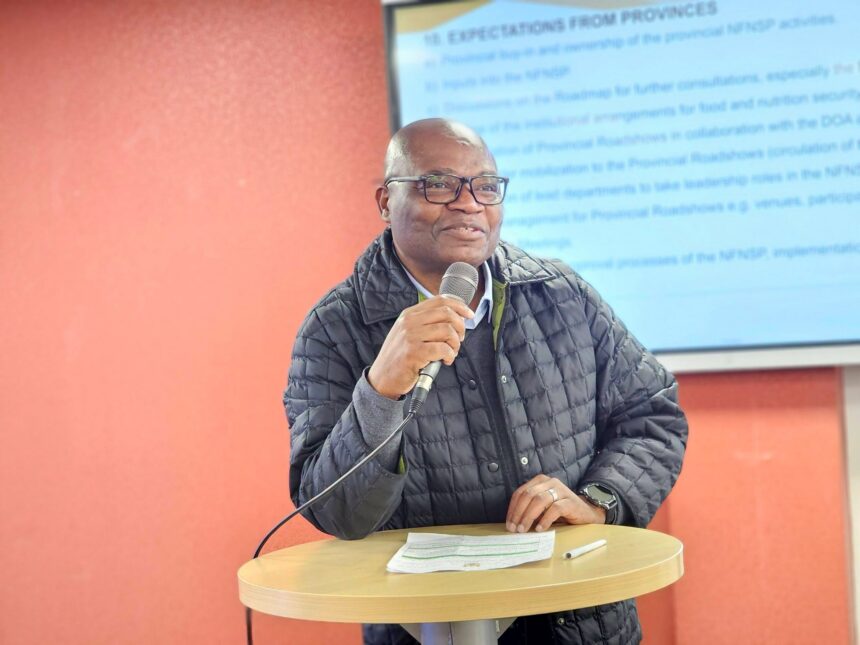
South Africa’s farmers are set to have an important voice in shaping the country’s next National Food and Nutrition Security Plan as the Department of Agriculture takes its consultation process to Johannesburg. The consultations form part of a broader national process aimed at developing a long-term framework for improving food and nutrition security between 2025 and 2033. For farmers, the process is significant because food security begins with the ability of producers to grow crops, raise livestock and supply reliable quantities of nutritious food to local markets. The discussions bring together provinces, municipalities, academia, civil society, the private sector, development partners, technical experts and communities to examine the challenges affecting the country’s food system. The goal is to develop a plan that responds to real conditions on the ground and provides practical pathways towards a stronger and more resilient agricultural sector.
The consultation process recognises that food security is not simply about having enough food available on supermarket shelves. It also depends on whether farmers have the resources and conditions needed to produce food consistently and sustainably. Issues such as access to finance, agricultural inputs, water, infrastructure, technology, extension services and markets can directly influence a farmer’s ability to remain productive. High production costs, climate variability, logistical challenges and agricultural diseases can place additional pressure on farming businesses and threaten the stability of food supplies. A national food security strategy therefore needs to consider the challenges faced by producers across the entire agricultural value chain.
The Department of Agriculture has already identified farmer support, food security and agricultural productivity as important areas of its work. Its food security and agrarian reform functions include developing strategic support for farmers and cooperatives, providing extension support, supporting development finance and promoting participation by rural women, youth and other vulnerable groups. These areas will be important to the success of the new food and nutrition security framework because farmers need more than policy commitments to increase production. They need practical support that helps them improve productivity, manage risks, access markets and build viable agricultural businesses. For emerging and smallholder farmers in particular, stronger access to finance, infrastructure, technical knowledge and reliable markets could make a significant difference to their ability to expand production.
The plan also has the potential to strengthen cooperation between different levels of government and stakeholders involved in agriculture. Farmers often deal with challenges that fall across several areas of responsibility, including roads, water infrastructure, electricity, animal health, land management, market access and local economic development. Better coordination between national government, provinces and municipalities could help reduce delays and ensure that agricultural priorities are addressed more effectively. The Department of Agriculture has previously emphasised the importance of coordination and has linked food security to programmes involving agriculture, social protection and other sectors. For farmers, effective coordination matters because delays in one part of the system can have consequences for production, profitability and the movement of agricultural products.
Climate resilience is another issue that should remain central to discussions about the country’s food future. Farmers are increasingly required to manage changing weather patterns, droughts, water shortages and other climate-related risks while maintaining production. The Department of Agriculture has identified climate resilience, water-efficient irrigation and sustainable production as important areas for the agricultural sector. The new plan provides an opportunity to strengthen support for farming methods and technologies that help producers manage climate risks while protecting natural resources. Investment in irrigation, soil health, water management, climate information and appropriate technology could help farmers become more resilient and maintain food production during difficult seasons.
Food security also depends on farmers being able to reach markets and receive a fair return for their production. Producing food is only one part of the agricultural value chain, as products must also be stored, transported, processed and sold efficiently before reaching consumers. Weak rural infrastructure, limited market access and high logistics costs can reduce the benefits of increased production and place additional pressure on farmers. The Department of Agriculture has highlighted market access and agricultural marketing as important areas for strengthening the sector, including support for smallholder farmers. A food security plan that connects production with viable markets could therefore help create stronger agricultural businesses while improving the availability and affordability of food.
The consultations are also important for farmers who want to see greater investment in agricultural technology, innovation and skills. Digital tools, precision agriculture, improved production systems and better access to information can help producers make more informed decisions and use resources more efficiently. South Africa is also pursuing broader agricultural innovation initiatives that focus on areas such as digital decision-support systems, precision agriculture, early-warning systems, agro-processing and value-chain development. These developments could create opportunities for farmers to improve productivity and adapt to changing market and environmental conditions. However, technology must be accompanied by training, affordable access and practical support so that it benefits farmers of different sizes and levels of development.
Smallholder and emerging farmers will have an especially important role in the food security conversation. Many of these producers have the potential to increase production but continue to face barriers involving finance, inputs, infrastructure, land, technical support and market access. Government has identified gaps in these areas as obstacles to the wider commercialisation of Black producers and has pointed to initiatives involving finance, extension services and digital platforms. Addressing these challenges could allow more farmers to participate meaningfully in agricultural value chains and contribute to local food supplies. It could also help create jobs, strengthen rural economies and provide greater opportunities for young people and women entering agriculture.
The involvement of the private sector, research institutions, development partners and communities is equally important because no single institution can solve the country’s food security challenges on its own. Agribusinesses can contribute through markets, investment, processing and technology, while universities and research organisations can provide evidence and innovations that improve agricultural production. Communities can provide valuable knowledge about local food systems and the challenges affecting households, while farmers can bring direct experience of what is required to produce food under changing economic and environmental conditions. Bringing these perspectives together can help ensure that the final plan is grounded in practical realities rather than developed in isolation. The Department of Agriculture has described collaboration with farmers, private-sector organisations and development agencies as essential to building a competitive, inclusive and resilient agricultural sector.
For farmers, one of the most important aspects of the consultation process will be what happens after the plan is adopted. A successful strategy will need clear goals, measurable targets, realistic implementation pathways and systems for monitoring progress. Farmers need to see how national commitments translate into functioning extension services, accessible finance, improved infrastructure, effective disease control, better market opportunities and support for climate resilience. They also need consistency so that agricultural businesses can plan investments and production decisions with greater confidence. The effectiveness of the plan will ultimately be measured not by the document itself, but by the improvements farmers and food producers experience on the ground.
The Johannesburg consultations therefore represent more than another policy discussion because they provide an opportunity to shape the future of South Africa’s food production system. Farmers are among the most important stakeholders in that conversation because they are responsible for turning land, water, skills, technology and other resources into the food that feeds the nation. Their experiences can help policymakers understand the practical obstacles that affect production and identify solutions that are realistic for different farming regions and production systems. The proposed National Food and Nutrition Security Plan is intended to be a national effort rather than a strategy developed by government alone, making meaningful participation from farmers and other agricultural stakeholders particularly important. If the consultation process results in coordinated action, stronger farmer support and measurable improvements across the food value chain, it could provide a stronger foundation for sustainable agricultural production and food security through to 2033.
Join 'Farmers Mag' WhatsApp Channel
Get the latest Farming news and tips delivered straight to your WhatsApp
CLICK HERE TO JOIN